A solo sailor uses a basketful of tricks
Issue 99 : Nov/Dec 2014
This is the second in Karen Sullivan’s series of articles about prepping a boat and sailor for singlehanding. She’ll discuss sail changes in the January 2015 issue and anchoring in the March and May 2015 issues.
Any multitasking you’ve ever done will pale in comparison with getting under way alone for the first time. But… if you act nonchalant about it, you will eventually feel nonchalant. And expertise will come with practice, so it’s a good idea to rehearse the techniques described here at every opportunity until they become second nature.
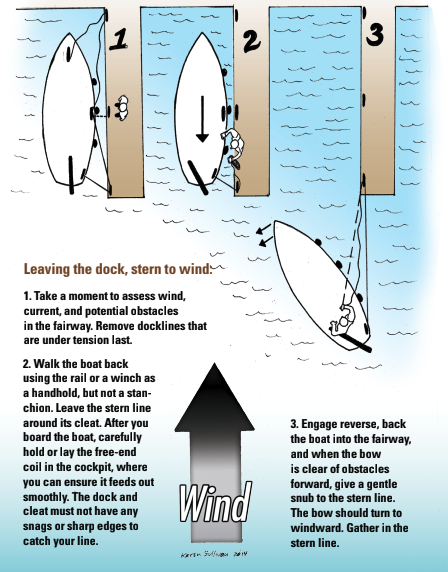
Departing a slip
Before you leave your slip, look around. Are transom-tilted outboard motors restricting maneuvering room in the fairway? Is anyone else in or approaching the area you’ll need for turning the boat? Look for current around pilings and your hull, and glance up at flags and wind indicators. Walk around the boat and notice what wind and current might do to it once you cast off the lines. Which docklines have tension on them? Those are usually the ones to release last.
Say you’re in a narrow slip and the wind is coming from astern. Set up a short breast line led from a cleat amidships to keep the boat in place while you release the loose docklines (in the diagram at right, they are the bow lines and forward-led springs). Use care when placing released docklines on deck. If you are sloppy, a loop hanging over the side could pull the whole line into the water to drag alongside and foul your prop.
(If the wind’s coming from the direction of the bow, the loose lines will be at the stern, which will make leaving the slip much easier.)
In tight quarters, put the helm amidships so the boat will back straight out. If your boat is small enough, undo the stern line, spring line, and breast line and walk the boat back, rolling the hull on the fenders. You’ll need some momentum before stepping aboard, turning the helm, and engaging reverse gear. Grab points include shrouds, winches, or the rail, but not stanchions, which aren’t meant for such loads. Just before you climb aboard, give the bow or stern a push or tug to start the boat turning in the direction you want to go.
One trick for avoiding which-way-do-I-steer confusion when going astern is to stand in front of the wheel or tiller and face aft. Then steer the boat like you would a car moving forward. If it’s a tiller, simply point the rudder in the direction you want to go. It’s a good idea to find out how well your boat backs up; some do it easily and others don’t.
Doubling a spring line
Most of the time, this is all that’s needed for undocking. On some boats, backing into the wind makes turning the bow upwind more difficult, and occasionally a strong wind astern, or close proximity to obstacles, makes a stern spring line useful. If you want the bow to swing to port, you’ll need to gently pull the stern to starboard with your stern spring. You need a stern line at least twice the length of your boat, and it should be supple, not stiff with salt, because it must slide easily.
Make this long line fast on your stern cleat and loop it around the dock cleat. Bring the end back aboard and coil it carefully. As you go astern, you can let the carefully coiled loose end pay freely out of your hand or from the cockpit. Once you’re clear of obstacles, give the line a gentle tug to turn the bow upwind. When you are ready to gather in the line, don’t throw the loose-end coil into the water as it could tangle. Instead, let it feed off the boat, and keep the engine in neutral until the line is aboard. The biggest challenge I have had in doing this stern-spring trick is stopping well-meaning bystanders on the dock from grabbing the slipping line as they try to “help.”
Slipping a dockline works best on smooth surfaces that don’t snag rope fibers, so if your dock cleats have galvanized seams with sharp edges, consider sanding them off. If a line snags on the dock, release it quickly from the boat end. Nylon line will sink and await your return. Polypropylene, never good material for docklines anyway, will float and put other boats at risk.
It’s useful to have a strong cleat placed amidships, just abaft the boat’s beamiest point. Using shrouds, stanchions, or rail fittings as mid-boat attachment points for docklines is asking for stress on the fittings that they were not designed for as well as chafe on the lines. When I’m maneuvering solo, I have found I’m at a disadvantage on a boat that doesn’t have strong midships cleats.
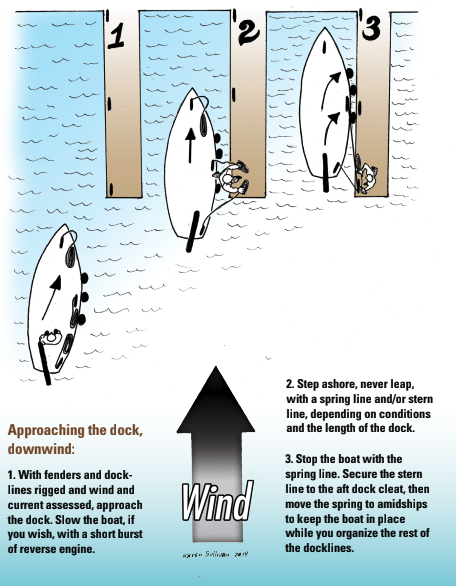
Returning to a slip
It’s a good idea to find an empty dock and practice your approaches and departures in different conditions. Docking upwind or up-current is preferred because these “brakes” can help you control the boat better.
It’s time to come back to your slip, but let’s say the wind is again going to make it more difficult by coming from astern. You’ve got your fenders down and the other docklines properly rigged and easy to reach. You’ve practiced approaches and turns and other moves that show you how your boat behaves. You’ve looked over the tops of other boats to see if anyone’s maneuvering in your fairway. You know the state of the tide and the probable current direction and velocity at your slip. Now it’s a matter of coming in with just enough speed for turning.
Tune out all distractions as you concentrate on lining up the boat with the slip. Proceed slowly, using a small burst of reverse as you close with the dock to take off most of the boat’s way.
The solo sailor’s best friend when docking is a spring line attached amidships and led back to the cockpit. Step (never leap!) ashore with your spring line in hand. Take one wrap around the dock cleat that will end up nearest your boat’s stern and let it slip, keeping enough pressure on it to slow the boat as it closes with the dock. You can do this with a stern line too, but the spring will stop you faster if the dock space is short. Snub the spring to stop the boat, then grab the stern line and tie it to that aftmost dock cleat. Move the springline to amidships, making it a temporary short breast line to keep the boat from drifting out, and walk forward to secure the bow. You’ve done it! At this point you can drop the nonchalance and allow yourself a grin.
Karen Sullivan sailed with her partner, Jim Heumann, from Port Townsend, Washington, to New Zealand in their Dana 24 from 2011 to 2013. Before that, she cruised in Alaska’s Prince William Sound and soloed down the Inside Passage in her previous Dana. A long time ago she sailed between Maine and the Caribbean in various boats. She is at work on a book about their Pacific crossing. Read more at: http://karenandjimsexcellentadventure.blogspot.com.
Thank you to Sailrite Enterprises, Inc., for providing free access to back issues of Good Old Boat through intellectual property rights. Sailrite.com