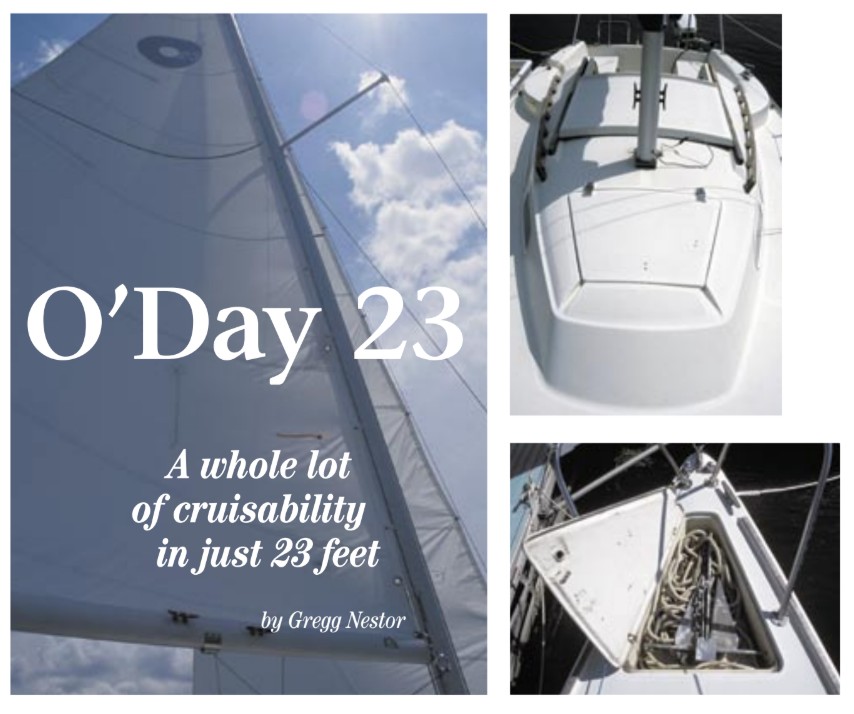
A whole lot of cruisability in just 23 feet
Issue 34: Jan/Feb 2004
GEORGE O’DAY, 1960 OLYMPIC sailing gold medalist and 1967 America’s Cup winner, was one of America’s leading production sailboat builders. Over his lifetime, George designed, created, or implemented no fewer than 32 boats. The company he founded spanned more than 30 years and had a reputation for building boats that were easy to handle and performed well under sail.
At one time, the company’s offering included sprightly daysailers, comfortable weekenders, and luxurious bluewater cruisers, from 12 to 40 feet in length. Many sailors are aware of the O’Day Widgeon, Javelin, Daysailer, and the 19-foot classic Mariner daysailers. It was in the 1970s and early 1980s in particular — when trailerable cruisers represented a significant portion of the sailboat market — that O’Day became the undisputed leader in building trailersailers.
Early in the life of his company, George utilized the talents of many noted marine architects, such as Uffa Fox and Phillip Rhodes. In the later years, C. Raymond Hunt Associates provided the mainstay designs. In 1971, the O’Day 23 left the Hunt drawing board.
The production run of the O’Day 23 began in 1972 and lasted approximately 13 years, with the last boat leaving the assembly line at the Falls River, Massachusetts, plant in 1985. The exact figures are not known, as most of the O’Day records unfortunately are lost, but it’s estimated that nearly 1,700 O’Day 23s were built. During its life span, the company was assimilated by a series of conglomerates and unfortunately folded in 1989.
For its time, the O’Day 23 was a very different small cruising boat. It was one of the first pocket cruisers to have full 5-foot headroom below, an optional pop-top that could increase headroom to 6 feet 4 inches, berthing for four, a private head, and even a hanging locker.
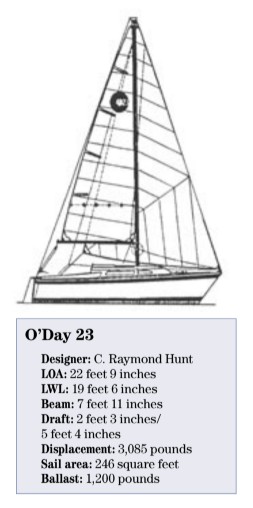
The boat has a long waterline of 19 feet 6 inches for swiftness, a wide beam of 7 feet 11 inches for added stability, 1,200 pounds of encapsulated lead for stiffness, a 27-inch shoal-draft keel for gunkholing as well as easy launching and retrieval, and a manageable weight of 3,085 pounds for trailerability. The boat looks and feels larger than its size because of a clever utilization of available space and the attention to detail that both pleases the eye and eliminates the discomforts often found on boats of this size.
Design and construction
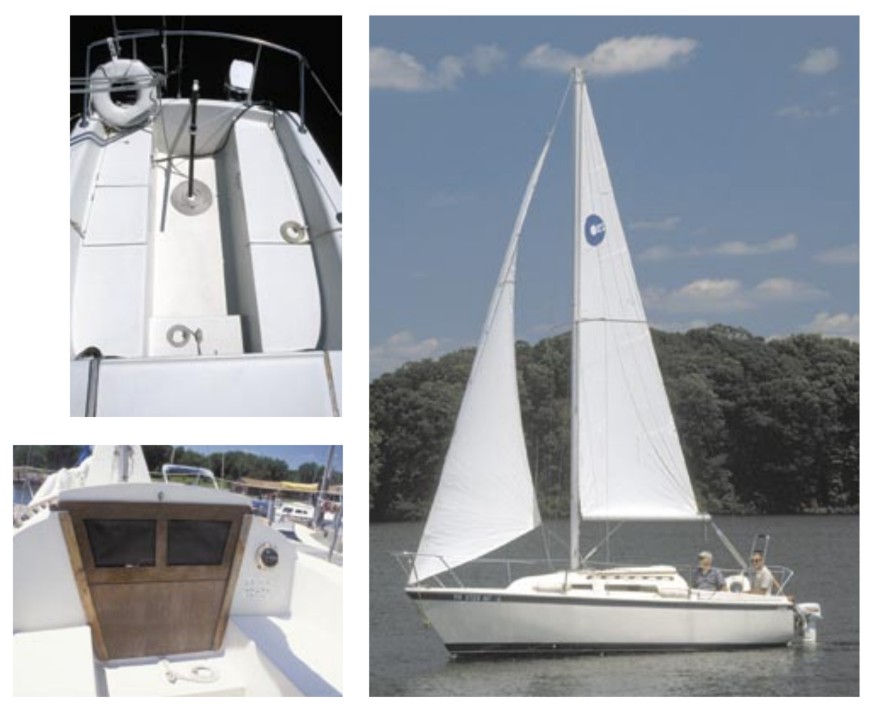
The profile of the O’Day 23 shows little sheer, moderate freeboard that is responsible for the generous sitting headroom, a pronounced bow overhang, and a flat stern. The height of the coachroof blends well into the overall lines of the boat, and its turtle-shell forward end is classic. Both the hull and deck are fiberglass. The hull is solid hand laminated; the decks are a sandwich of two layers of fiberglass with a core of end-grain balsa. End-grain balsa is extremely light, resists crushing, and provides good insulation against heat, cold, and sound. All deck hardware is backed with either stainless-steel backing plates or marine plywood.
The O’Day 23 sports a shoal-draft keel comprised of 1,200 pounds of lead bonded in place. It also incorporates a lightly weighted fiberglass centerboard that, when down, increases windward ability and adds lift. The centerboard is easy to raise or lower by hand without the aid of a winch. With the centerboard up, it draws only 27 inches, compared to 5 feet 4 inches with it down. The transom-mounted spade rudder is a fiberglass-and-foam core sandwich. The rudder does not extend below the depth of the shoal-draft keel. It is unnecessary, therefore, that it be a kick-up type, and it does not kick up. This shoal-keel/rudder combination facilitates backwater cruising. The tiller is varnished ash. Also located on the transom are a stainless-steel swim ladder and an adjustable outboard motor bracket.
On deck
The 6-foot foredeck is clutter-free and features a flush anchor locker with overboard drain. Fourteen-inch-wide sidedecks, inboard shrouds, a moldedin fiberglass toerail, non-skid decking, and 5 feet of teak handrail make for reasonably comfortable maneuverability on deck. Stainless-steel bow and stern pulpits, stanchions, and single lifelines complete the package. Brightwork is at a minimum. It is limited to the hand- rails, hatch boards, and companionway slides.
The 6-foot 3-inch cockpit is roomy and can be used to expand the living/sleeping area with the addition of a canopy or boom tent. It is self-draining and has a bona fide bridge deck to prevent water from cascading below should a wave fill the cockpit.
To starboard is a molded-in icebox with drain, ideal for easy drink access. Just aft of the icebox is a fuel-tank locker, which easily accommodates the standard 6-gallon fuel tank. The port seat locker houses the battery and accesses a cavernous storage area. The cockpit coamings flow nicely back from the cabin and are of reasonable height. They offer back support and a feeling of being “down in the cockpit.” The hull-to-deck joint is lapped, sealed, mechanically fastened, and covered with a two-piece vinyl rubrail.
Belowdecks
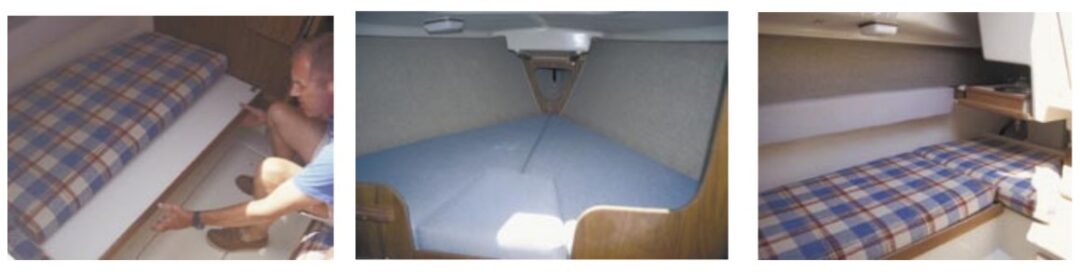
Below, the O’Day 23 utilizes a molded fiberglass pan that incorporates the cabin sole and a similarly constructed overhead liner to supply most of the structural support. Access to hardware is gained by removing flexible plastic plugs in the headliner to expose the fasteners. A foam-backed fabric hull liner gives the boat interior a finished look and adds insulation and sound absorption. Teak bulkheads, cabinets, and solid trim complete the interior. A large fiberglass sole panel provides access to an almost nonexistent bilge. Without a well-developed bilge to collect water, any significant amount of water that finds its way below will quickly rise above the cabin sole and slosh about the interior, soaking anything not protected by watertight containers.
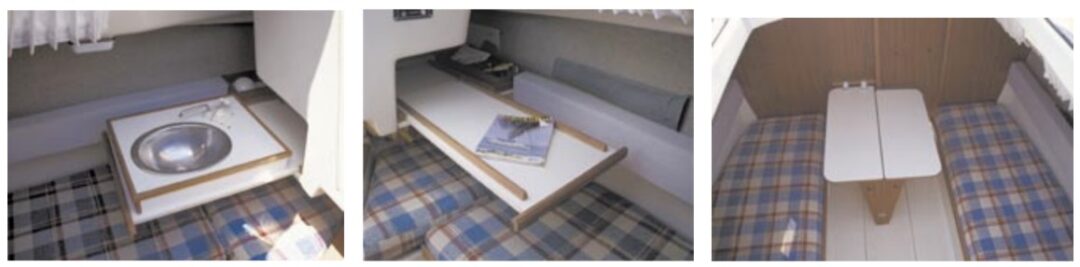
Forward is a comfortable V-berth, measuring 6 feet long by 5 feet 5 inches wide. This includes a removable insert. Just aft of the V-berth on the port side is a Porta Potti with a sliding molded fiberglass sink with manual pump and storage vanity above. Across from the head on the starboard side is a hanging locker. Overhead is the flush-mounted forward hatch, offering light and ventilation. This area is separated from the V-berth by a partial teak bulkhead and from the main cabin by a full teak bulkhead with a folding door. The layout of the main cabin is traditional, with settee berths to port and starboard. The starboard berth measures 5 feet 11 inches, while the port is 6 feet 6 inches and incorporates a slide-out extension converting it to a double. The four fixed portlights provide good daytime illumination but do not open for cross-ventilation. At night, four 12-volt cabin lights adequately illuminate the boat’s interior.
The galley is divided into two units, one to port and the other to starboard. The starboard section is an ingenious one-piece unit comprising a stainless-steel freshwater sink with manual pump (which drains overboard via a bronze through-hull gate valve), cutting surface, and utensil storage bins. The entire unit is on tracks and slides aft to store under the cockpit when not in use. The port galley section is also on tracks and is a simple laminated counter for food preparation, which also accommodates a tabletop stove. Completing the main cabin/galley is a bulkhead mounted drop-leaf table and a molded, insulated, self-draining icebox that doubles as one of the companionway steps. Underneath the starboard cockpit seat and galley unit is the deck-filled 15-gallon freshwater tank. Including the forepeak, the hanging locker, under all berths, and behind the settee backs, there are more than a dozen bins and places to stow gear.
The rig
The O’Day 23 sports a 27-foot mast, stepped on deck with a hinged tabernacle. The mast and boom are anodized aluminum. The boat has a single-spreader rig with upper and single lower shrouds and a single backstay. The sloop is masthead rigged with 246 square feet of sail consisting of a Bermuda mainsail and genoa. The original mainsails came with one reefing point, jiffy reefing, and a cringle for a cunningham downhaul. All halyards are external and cleated at the mast base. The genoa tracks are located on the sidedecks adjacent to the cockpit coamings. Located on each of the coamings is a Barlow #16 winch and jam cleat. There is a 4:1 boom vang and end-boom sheeting. The mainsheet tackle attaches to a small triangular plate located on the lower section of the backstay. This clears the cockpit of any running rigging.
Underway
The O’Day 23 is a very satisfactory first cruiser. It was designed and built to be sailed in relatively protected waters. Like most trailerable boats, it is a bit tender. When the wind picks up, it develops weather helm. To eliminate this and reduce the angle of heel, reef the mainsail at about 12 to 15 knots of wind. At greater than 15 knots, reduce the headsail area. This will flatten out the boat nicely and allow it to cruise at hull speed. Since the sheeting angles are quite wide, it’s not very close-winded. Remember to keep the centerboard down when going to windward to help it point better. On a run, lift up the board to reduce drag and pick up speed.
Things to check out
Remember that an O’Day 23 can be anywhere from 19 to 32 years old. Some will be in great shape, while others may require extensive work. Check the deck for delamination caused by a balsa core saturated with water. Pay keen attention to all fittings. Delaminated areas sound dull and hollow when you tap them with a plastic hammer or the handle of a screwdriver. Mast compression is another potential problem. Look for signs of cracking, bending, or movement of the mast-support beam. The forward hull sections have been known to flex or oil-can, so check for cracks. Caulk spread lavishly around fittings and ports is a good indication of leaks. Also look for and question any holes that were cut in the overhead liner. The gudgeons and pintles are a bit undersized and might need to be replaced with a more substantial set.
Unfortunately, the O’Day Corporation of yesteryear is no longer in business; however, there are several active websites for O’Day owners, including http://www.odayowners.com and http://home.att.net/~oday. D&R Marine, which owns the rights to O’Day, can provide parts and technical support. The company is also beginning to offer a few new O’Day boats, “Rebuilding a Legend One Boat at a Time,” in the words of the advertisements. Contact D&R at http://www.odaysailboats.com or its new site http://www.drmarine.com.
In summary
The O’Day 23 is an inexpensive, nicely equipped and appointed pocket cruiser. It’s designed for cruising in relatively protected waters. It’s a cruiser, not a performance boat. As a weekender, the O’Day 23 is near perfect. Due to its outstanding use of cabin space, it’ll be comfortable for a week’s vacation. Prices, which usually include boat, outboard motor, and trailer, range from $3,000 to $6,000, depending upon condition and equipment.
Thank you to Sailrite Enterprises, Inc., for providing free access to back issues of Good Old Boat through intellectual property rights. Sailrite.com