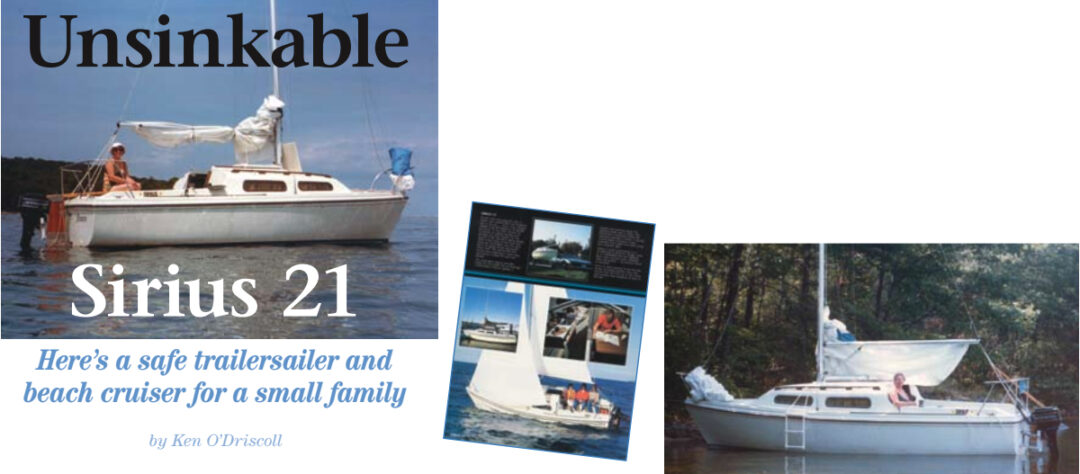
Here’s a safe trailersailer and beach cruiser for a small family
Issue 35 : Mar/Apr 2004
“Why don’t we go to the boat show tomorrow and look at small sailboats?” These innocent words were uttered by my wife, Pat, in September 1977. Little did we know their impact on our future. We had been sailing a Sunfish for the past five years and, as she told me much later, she thought I might enjoy a larger boat. The good thing is that I can always blame her for starting us down the path to where sailing became such a big thing in our lives.
I’ve noticed in recent advertising that 27-foot boats are called “entry-level.” But in the 1970s, the term referred to boats in the 20- to 24-foot range. At the show, we were naturally drawn to such boats, and the Sirius 21 quickly caught our fancy. The fact that it was locally made and obviously well designed and engineered figured large in our decision. Given the promise of the salesman that he would come with us on our first sail and literally show us the ropes, we ended up taking delivery of a new one the following spring. Although we didn’t know it at the time, it was to be the first of a series of sailboats named Fineen (see Good Old Boat, November 1998, for a description of Fineen III, a Niagara 35). We never trailered it and owned it for only two years, but it provided an excellent platform for learning how to sail, and fond memories of it linger 25 years later.
The Sirius 21 was built by Van de Stadt and McGruer which, for 25 years, was a successful boatbuilding firm in Owen Sound, Ontario. Hubert Van de Stadt is a nephew of the famed Dutch designer E. G. Van de Stadt, and Fraser McGruer comes from a Scottish boatbuilding family. Together they designed and built a series of small boats, beginning with 9-foot dinghies and daysailers and ranging through the Siren (a 17-footer with a jib and a cuddy cabin), the Sirius 21, and finally the Sirius 28. This progression led to careful and successful designs of both the 21- and 28-foot Sirius boats.
Went bankrupt
As was the case with so many fine Canadian and U.S. boatbuilders, the firm closed in bankruptcy in 1988, a victim of soaring material costs and high interest rates. But in the winter when our boat was being made, the Sirius plant employed about two dozen people and was turning out boats at a rapid clip. Since the plant was less than a two-hour drive from our home, we made a visit there in late winter and observed the building process. The hull was laid up in the mold by first using unidirectional mat of fiberglass roving that was hand-rolled with the application of the liquid resin before curing. A chopping gun was then used to distribute the fiberglass strands and resin. This process allowed a high glass-to-resin ratio, giving the hull extra strength. To my (limited) knowledge, no problems with osmosis have been encountered by Sirius owners.
The first Sirius 21 was launched in 1977 and quickly became popular — more than 100 of them were sold that first year. Eventually, more than 600 were sold. Although the boat is eminently trailerable, most of the owners we have known and met bought the boat because of its small size and good design, rather than because it fits easily on a trailer. Trailersailors I’ve talked with tell me that the Sirius is quite easy to set up and launch.
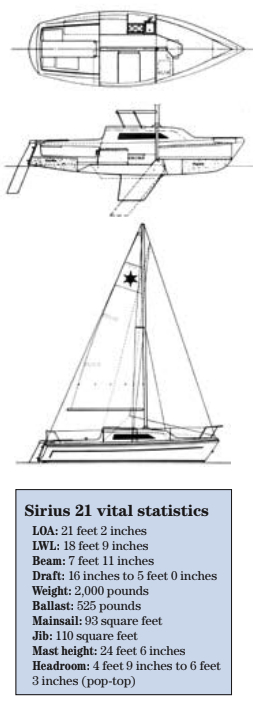
On the outside, the Sirius is nicely put together with simple, single-spreader rigging; some boats have a jackstay to support the mast better. There is an anchor locker forward. A bracket on the port transom mounts an outboard. The boat was originally designed with a 4.5- or 7.5-hp long-shaft motor in mind, but many have used a 9.9-hp with no problem. The rudder is outboard and rigged so it can easily be kicked up in shallow water. The centerboard or swing keel is of cast iron, goes down 5 feet and represents just over 25 percent of the 2,000-pound displacement. It can be cranked up to allow sailing in as little as 16 inches and can be locked with a pin when fully up or down. When up, the cast-iron swing keel extends a few inches beyond the fiberglass bottom so grounding causes no problem. This makes the Sirius a delight for gunkholing, since it is possible to go into the shallowest of waters.
Mast tabernacle
The mast is deck-stepped and can be raised easily by two people. The mast rests in a tabernacle that has a J-shaped slot on either side; a stout steel pin runs through the mast and rests securely in the crook of the J — or it should. In a severe wind and high waves that we once endured for four hours, something caused the pin to come adrift; the mast twisted about 30 degrees in the tabernacle and was only saved from falling by the pin jamming against the side of the tabernacle. I replaced the pin with one an inch longer and never had the problem again. The boat’s sailing is quite sprightly, easily achieving 5 knots in a small breeze. But in a stronger breeze it develops weather helm that can put a noticeable curve in the tiller unless the main is trimmed carefully.
It should also be noted that some find the boat’s motion uncomfortable in waves of 3 feet or so. This isn’t surprising, for one can calculate Ted Brewer’s motion comfort index to be a rather low value of 10.0 from the Sirius specifications. It was this physical fact (not the theoretical ratio) that persuaded my wife and me to buy a larger boat after only two years in the Sirius.
The cockpit easily holds four adults, is self-draining, and has two sail lockers and a portable gas supply for the outboard. There are two small winches that are hardly needed to control the 110-square-foot jib but might be needed for the genoa of 156 square feet. The mainsheet comes off the end of the boom as a block and tackle arrangement that ends in a jam cleat on the stern quarter. It easily controls the 93-square-foot mainsail.
Pop-top roof
It is down below that the boat shows the excellence of its design. Begin with the hatch, or rather the pop-top roof that covers it. When raised, a notch on it is supported by a pin on the mast, and so provides plenty of headroom for a six-footer. A small optional tent, fitted around the pop-top, keeps out the rain or bugs at night. With the pop-top up, the entire port-side galley and most of the starboard dinette have 6-foot 3-inch headroom. The dinette can be converted to a double bunk.
Among the design features that impressed us when we bought ours as novices was the foam flotation in the Sirius 21 that made it unsinkable. In fact, with the keel locked in the down position, the boat is self-righting. The foam also results in a stiffer hull and gives a measure of insulation for both sound and heat.
Of course, this also puts a limit on storage space, but the boat still has ample room for weekending or even short cruises. (We knew, but did not envy, a family of two adults and three small children who went coastal cruising aboard a Sirius 21 for two weeks at a time in Georgian Bay.)
The forward V-berth also accommodates six footers, as well as a Porta Potti underneath it. The trim below is teak, and the hull and deck liners give a finished appearance to the interior. With the forward hatch open and the pop-top raised, it is quite airy down below, and two non-opening windows (later replaced by one long window) on each side make it bright inside. Another neat touch is the carefully designed space between the aft quarterberth and the centerboard well, which is the perfect size for a Coleman cooler.
Major fire
In 1984, the Van de Stadt and McGruer plant where the Sirius was made suffered a major fire. The following year, having re-established production, the company introduced the Sirius 22, featuring a redesign of the aft portion of the hull and an optional fixed keel. The hull was lengthened by putting a reverse transom on it. The thought was that it could better bear the weight of the popular 9.9-hp outboard that most buyers chose. The fixed fin keel was a lead casting with a National Advisory Committee for Aeronautics (NACA) profile and had a draft of 3 feet 6 inches. Otherwise, the Sirius 22 was identical to the 21. Unfortunately, the demise of the company a short time later meant that few of the 22-foot versions were made.
When the boat was first on the market in 1977, it could be bought for roughly $5,300 U.S. However, the list of options for the boat was quite long, which is a charitable way of saying that the original owner could greatly reduce the cost by buying a stripped-down version. Among the more obvious items that were options, and might therefore be missing from a resale today, are lifelines, bow and stern pulpits, a galley sink, a 5-gallon water tank, a compass, navigation and interior lights, and electronics such as a distance log and VHF radio.
These days, at any given time, a small number of Sirius 21s can be found listed on the Internet, most of them in Canada but some in the United States. Prices seem to range from $4,500 to $8,300 depending on age and condition. Note that the Internet ads do not always specify whether or not a trailer is included in the price.
(I would like to acknowledge Ted Youngs for his help in researching some of the information in this article. Ted and his wife, Fern, are “very Sirius sailors,” and he kept much of the original literature from their Sirius 21 when they bought their present Sirius 28.)
Thank you to Sailrite Enterprises, Inc., for providing free access to back issues of Good Old Boat through intellectual property rights. Sailrite.com