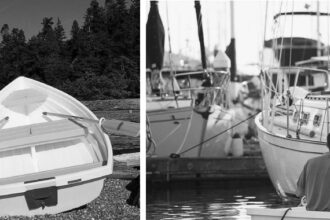
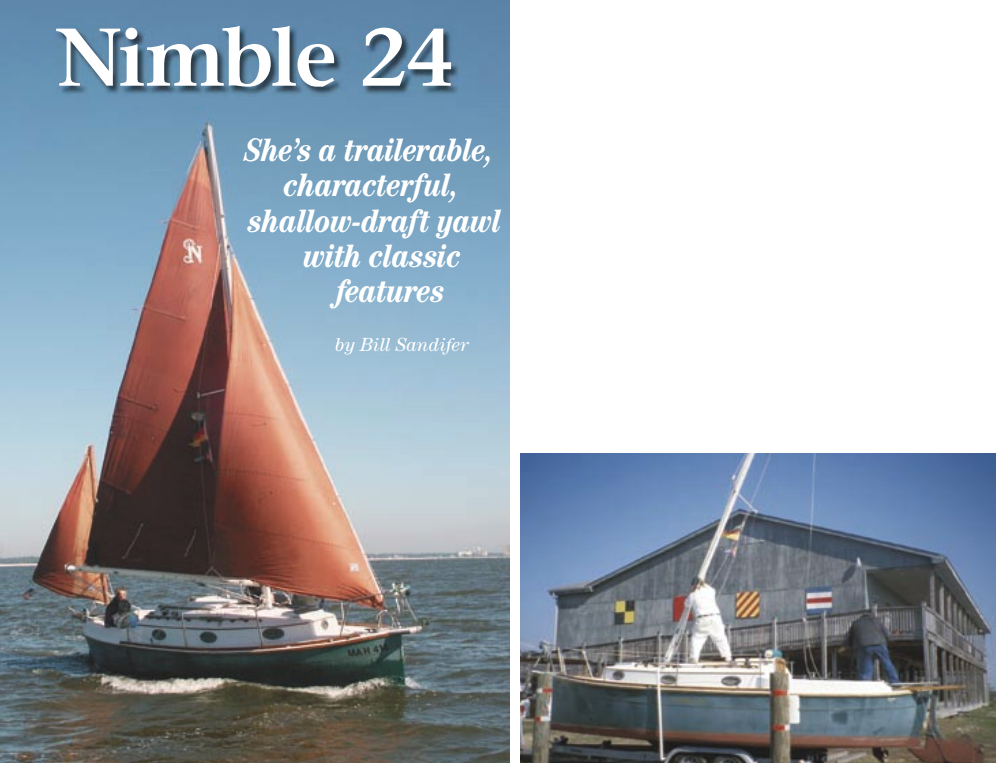
She’s a trailerable, characterful, shallow-draft yawl with classic features
Issue 37 : Jul/Aug 2004
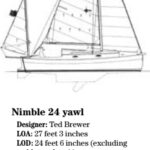
The old saying that “if it looks right, it probably is right” applies to the Nimble 24. This is a canoe yawl in the English Rob Roy tradition started in the late 18th century. Today’s 24-foot version of this boat is a good-looking, capable coastal daysailer and overnighter. This is not to say that longer cruises or wider waters are not within her capabilities, but she is more suited to cruises of limited duration in near-shore waters. The main reason for this is her lack of internal volume and headroom.
In the Nimble 24, designer Ted Brewer has created a sweet-looking, sweet-sailing boat with low freeboard, a handsome sheerline, and double ends. To have increased the headroom belowdecks would have severely detracted from the beauty of this classic design.
The first thing you notice when stepping aboard is her stability. She is not overly tippy or sensitive to a person of my size stepping directly on the gunwale. The next thing you see is all the beautiful bronze hardware — cleats, portlights, and chocks — that is standard on this boat. It is obvious that the builder, Jerry Koch, took great pride in his product and did not skimp on the hardware. This high quality in materials and workmanship is repeated in the glasswork, the teak joiner work, the hardware installation, and the overall fit and finish of the boat.
Sailers and trawlers
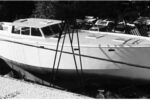
Ted Brewer and Jerry Koch were the designer and builder, respectively, of the Nimble and Nomad series of boats. These hulls doubled as sailboats and trawlers, depending on their deckhouse configuration. They range from the Nimble 20 and 24 through the Nomad series of trawlers, which run 20, 24, and 26 feet. The size difference was gained by simply cutting the Nimble 20 in half and adding the appropriate midship section.
The queen of the line, the Nimble 30, is a true round-bottomed hull that is not readily trailerable. The builder is quoted as having said that the rest of the line can be towed behind an average sedan. When we pulled the Nimble 24 test boat from the water, we used a 1-ton van. I would not like to do it with anything less.
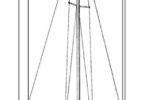
Tesseract, our test boat, is the centerboard model with a stub keel and centerboard trunk. She has a draft of l foot 1 inch, board up, to 4 feet 2 inches, board down. An offshore version with a fixed-keel configuration was also built. That model has a draft of 2 feet 6 inches. Sail area is 275 square feet, divided into main, jib, and mizzen. The quality of the standard hardware is excellent, and more was available as an option, all of equally good quality. If I were selecting a Nimble 24, I’d go for the centerboard model for its ability to anchor in shallow water.
Other than a GPS, fathometer, and safety equipment, there is little extra that one might want aboard. There is adequate stowage for a crew of two, but a crew of four would be pushing the envelope for more than perhaps an overnight, and that is a real “perhaps.” I can see where they would all sleep, but how they would get out of the bunks is another matter. A singlehander would have no problem and could easily cruise the Bahamas in this seaworthy small craft. Because it’s trailerable, this boat opens up most cruising areas: you could tow her to Maine, the Chesapeake, the North Channel, or Puget Sound. She could even go to Alaska via the Inside Passage as long as a capable crew is carefully watching the weather, of course.
In spite of the quality of the boat overall, Bob Dumaine, the owner of our test yawl, is baffled by broken hinges for the cockpit seat cover over the area molded in for the outboard fuel tank. Apparently these hinges were through-bolted to the deck before the deck was installed on the hull. This makes it faster to assemble the boat, but the owner suffers from this shortcut in the end. The Nimble has quality bronze hinges, but those on Bob’s boat broke just inboard of the hinge pin, and there is now no way to unbolt the outboard section to replace them. This may be quibbling a bit, but it would be nice if you could get at the fasteners for all deck hardware when replacement is required. Bob is considering cutting a 4-inch diameter hole in the vertical outboard face of the gas-tank locker in order to reach the bolts and then closing the hole with one of the screw-in access hatches available on the market. This may be a future project.
Getting under way
Under way the Nimble 24 is easily singlehanded, but with two of us aboard, I handled the lines while Bob backed out of the slip and turned toward the open Gulf. The boat has a 9.9-hp, 4-stroke Yamaha outboard, but the Nimble 24 was also built with a small diesel inboard. The price difference between these options was $6,300.
Once clear of the jetties, I removed the sail ties and Bob easily raised sail from the cockpit. The sails are a 100 percent jib, full main, and full mizzen. Bob plans to add roller furling and a 135-percent genoa for a little more sail area and ease in singlehanding. We settled down in the comfortable cockpit for a daysail in light air.
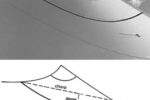
Because this is a trailerable keel/centerboard boat with a fin-type centerboard in a low trunk, she really does not point well until the board is fully down. The bottom of the hull is interesting in that it is nearly flat athwartship, with a stub keel and fore-and-aft rocker similar to a sharpie’s. Without the board, there is just the stub keel to keep her from sliding sideways through the water when the sails are up. The original Rob Roy yawls were built of wood and were round-bottomed. They would have had even less internal room, but they may have had a better grip on the water.
Ted Brewer says the round-bottomed yawls were a little tippier than the Nimble. He felt that such a small, light yacht needed more form stability than was available with the round bottom so he designed the hard-chine sharpie shape. The fore-and-aft rocker was added for hull strength, not aesthetics. Earlier, Ted had designed the Rob Roy 23 yawl with a round bottom similar to the original English yawls, so he has had experience with both types of bottoms.
With this flat-bottom configuration, going to windward in a steep chop produces a slapping noise when the boat encounters a wave, but this does not translate into physical motion and it is not really objectionable. To compensate for the pounding, the boat performs well off the wind and would probably surf in appropriate-sized seas. Bob and I had several hours of enjoyable off-wind sailing followed by a short motorsail to windward to gain harbor.
Belowdecks
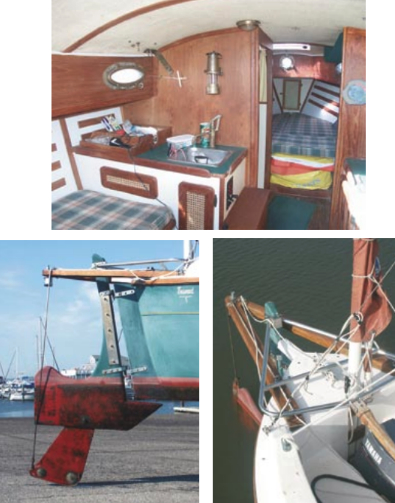
The bunks are 6 feet 8 inches long. The Porta Potti is adequate, although the head area is cramped. The boat has a water tank of about 20 gallons, a sink, and a pump. There is room for a stove, though with the limited headroom I think I’d cook in the cockpit with a propane grill suspended overboard.
I would think that a person of my size — 6 feet and 200 pounds — would get very tired of crouching belowdecks. In the cockpit or in the companionway it is, of course, possible to stand upright. In foul weather, however, it becomes a sitting-on-the-bunk exercise to get one’s pants on. This in no way detracts from the appropriateness of the boat for its intended use but is simply a statement of fact.
Trailerability
By definition, this is a trailerable sailboat, but it is quite big and heavy. With a beam of 8 feet 3 inches and a length overall of 27 feet 3 inches, this is a good-sized vessel. Its weight is advertised at about 3,000 pounds. Add assorted personal gear, such as an ice chest, water, fuel tanks, sails, and other options, and the actual weight may come close to 4,000 pounds. It requires at least a four-wheeled trailer with surge or electric brakes. To tow it, you need a V6 or V8 engine in a full-sized truck or SUV. A vehicle rated by the manufacturer to tow 5,000 pounds with a towing package — transmission oil cooler, frame hitch, and oversized brakes — is the best bet for towing the Nimble 24.
After our sail, it was time to put her on the trailer and take her home to Bob’s house. This exercise took two experienced people a couple of hours to accomplish as Bob needed to wash the bottom, remove the sails, drop the masts, and get her ready for the trip home. With a little less of an agenda and more help, the time from trailer to water or water to trailer could be cut to less than an hour, but this is still no “instant boat” to launch. The boat floated onto the trailer nicely with no need to winch it aboard. Winching it onto a trailer would be a lot of work.
Conclusion
I like this boat. She is an excellent daysailer or overnight cruiser for a party of two. Ted Brewer has done an excellent job by creating a capable, beautiful small boat that would be a joy to own and sail.
Unfortunately, the Nimble company recently ceased operations with the death of Jerry Koch. The Nimble 24 sells used for around $15,000 and is good value for the money. I think it will hold its value in today’s economy.
Thank you to Sailrite Enterprises, Inc., for providing free access to back issues of Good Old Boat through intellectual property rights. Sailrite.com