Designer Ted Brewer remembers builder Jerry Koch with fondness
Issue 37 : Jul/Aug 2004
In early 1982 I was approached by Jerry Koch, who asked me to come up with a unique small boat design unlike anything then in production. My mind immediately went to the small and charming English Humber yawls of the late 19th century, and I suggested that this type of yacht would find a niche in the market. Jerry was not familiar with the type. I drew up a rough sketch of a trailerable version, mailed it off to him, and awaited his comments.
It was an instant hit with Jerry. I was immediately commissioned to design the boat that became the Rob Roy 23. That name was based on the yacht featured in the 1867 John MacGregor book, The Voyage Alone in the Yawl Rob Roy. Jerry Koch was actually more entrepreneur than boatbuilder at that time and arranged for the little yawls to be built by Marine Concepts in Florida. Eventually he tired of this arrangement, sold the rights to the design to the builder, and started his own production shop, Nimble Boats.
In 1984, Jerry came to me for a new design. This time he had much bigger ideas. He wanted another Humber canoe yawl, but this time he wanted a 30-footer, the Nimble 30. He also wanted a much smaller boat to start the line and, in 1985, commissioned the Nimble 20 design before the ink on the 30’s drawings had dried. The plug and molds were still in the works.
In the meantime, I’d been sailing my own Rob Roy 23 in the San Juan Islands, and my first thought was that a 20-foot version was too small and would be on the tender side. I’d taken my little yacht through some rather heavy weather and, while quite able, she was not an ideal craft for a beginning family. The Rob Roy had a fairly narrow, round-bilged canoe hull. One way to increase stability is to widen the beam, another is to use a more powerful hull form. The narrow beam was easily answered by adding 10 inches to the 6-foot 11-inch beam of the Rob Roy, and the hull form was modified to that of a more powerful, hard-chine, arc-bottom sharpie. That solved the form stability part of the problem, and the tiny Nimble 20 proved to be a rugged little cruiser for a couple or a small (very small) family.
Quick and easy answer
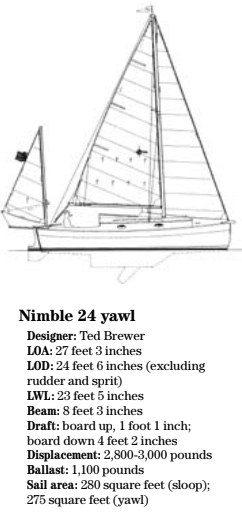
Eventually, Jerry wanted a new boat somewhere between the Nimble 30 and 20 in size. The problem was that Nimble Boats was always one step short of Chapter 11 and could not afford completely new tooling. So, in 1987, the quick and easy answer was to stretch the Nimble 20. That boat was actually 20 feet 10 inches; by cutting one of the hulls in two amidship and pulling it apart about 3 1⁄2 feet, we arrived at a 24-foot 3-inch LOA for the new boat. At the same time, we let the deckline follow its natural curve to the new midships, and that increased the beam to about 8 feet 3 inches. Notice that I said “about,” as I don’t think that anyone ever measured the final result. I certainly didn’t!
Nimble Boats then proceeded to fair up the new “24” and ready it for use as a plug for a new mold. I returned to the drawing board to work up a new deck plan (based on the 20’s deck mold of course), a new layout, and a larger sail plan.
Jerry was always a man with ideas, so we also did a deep-keel version and, later that year, I was drawing up the pilothouse version of the 24 that became the Nimble Arctic. The Nimble 20 also spawned the Vagabond “trawler,” and her 24-foot sister was later developed into the Nomad trawler. Finally the Arctic was enlarged with a longer pilothouse to become the Kodiak. So that little Nimble 20 had a great many descendants over the years.
My last design for Jerry was the 29-foot Wanderer trawler/motorsailer in the early 1990s. Jerry Koch passed away last fall, far too young. He was, undoubtedly, the most maddening, annoying, obstinate, inventive client ever . . . always coming up with some new and wild idea for me to translate into a working design. But we had a lot of laughs and a lot of great times together for more than 20 years. I loved him, and I miss the crazy devil.
Thank you to Sailrite Enterprises, Inc., for providing free access to back issues of Good Old Boat through intellectual property rights. Sailrite.com