An elegant and convenient way to store galley knives
Issue 43 : Jul/Aug 2005
Close behind the two loves of my life (my partner, Judy, and my 1979 Newport 41, Forty Two) is my love of cooking. Sharp knives of the proper design and weight are important to any cook. However, these can be a hazard on a rolling yacht, if loose, and a danger, if left uncovered in galley drawers when you reach inside for something.
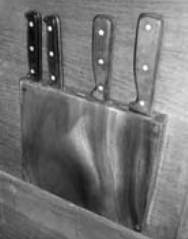
At home, my knives are kept in a wood block. I needed something similar aboard. While searching through kitchen stores and on the Internet, the only blocks I could find ready-made were large square blocks designed to stand on a kitchen counter. There are drawer inserts available, but why take up valuable drawer space in a small galley?
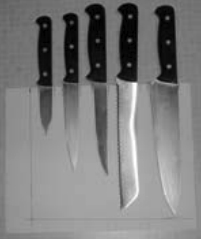
What was needed was a block to hold the five knives that I use most often: an 8-inch chef’s knife, a bread knife, a fillet knife, and 5- and 3-inch utility knives. The ideal would be to store the knives beside each other in a slim block that could be attached to a vertical surface in the galley. Adopting the usual cruiser’s do-it-yourself approach, I set about designing my own knife block.
I laid the knives across a sheet of paper to create a template for the dimensions of the block and the width of the slots. Having arrived at these basic dimensions, the next stop was a specialty lumber shop that I knew had a great selection of hardwoods. Luck must have been with me; I found a piece of 1⁄2-inch mahogany that was exactly the right width. Any straight-grained hardwood would have worked, however. A wider piece would have meant ripping the wood to the correct width on a table saw.
Cut the slots out
Once home, I cut the board to twice the finished length of the block. Then I transferred the slot dimensions to the wood and, using a straightedge cutter in a router, cut the slots 1⁄8-inch deep. Once the slots were made, I cut the board in half and clamped the two pieces together for a test fit. After checking that the knives fit in the block, I glued the two pieces together with epoxy. This produced a finished block 1-inch thick with 1⁄4-inch slots for the knives. I drilled mounting holes in each corner and countersunk them for plugs.
After hand sanding, the final finishing was several coats of varnish. Since I use stainless-steel knives, I left the slots untreated, but the bottom could have been sealed with tape and the slots filled with cooking oil. Finally, I mounted the block in the galley below the counter using bolts through the panel and covered the bolt heads with plugs. A final coat of varnish covered the plugs.
So far this season the knives have stayed in place in some heavy seas and more than 2,000 miles.
Thank you to Sailrite Enterprises, Inc., for providing free access to back issues of Good Old Boat through intellectual property rights. Sailrite.com