Learn how best to combat marine fouling
Issue 59 : Mar/Apr 2008
The year was 1625 when William Beale registered the first patent for a toxic underwater paint. It was a mixture of iron powder, cement, and copper. How effective it was is anyone’s guess. But one thing’s for sure: Bill’s paint was the opening shot in the war against marine fouling, which still rages today.
Antifouling paints have come a long way since then. Not only are they more advanced, they are also becoming more ecologically friendly. They come in a variety of formulations, types, and even colors, thus making the selection process a bit involved. Before you head off to the chandlery with checkbook in hand, there are a few preliminaries to consider.
Selection guidelines
There are many variables that directly influence the selection of an antifouling paint. These include freshwater or saltwater use, water temperature, nutrient content, how the boat is used, the length of the sailing season, the material the hull is made of, and if the bottom is currently painted.
Salinity is an issue. Boats that sail in fresh water generally experience different kinds of biological growth from that experienced by their saltwater cousins. Freshwater sailors, for example, don’t worry about barnacles or toredo worms. They are, however, extremely aware of slime formation, and Great Lakes sailors are concerned about zebra mussels.
Water temperature also has a direct bearing on fouling. A boat kept in the cold water off the coast of Maine or in Lake Superior will not foul as quickly or extensively as one kept in the warm and sunny waters of Florida and the Gulf Coast.
Waters with a high nutrient content, such as the coastal waters in proximity to highly urbanized/industrialized areas and the lower Great Lakes (which experience significant agricultural run-off), provide an almost unlimited food source for marine organisms. While a variety of bottom paints with a high biocide content will generally perform well in most of these cases, strength isn’t always the answer.
Usage matters too. Boats that are regularly used can benefit from a polishing or “soft” antifouling paint. This is a type of antifouling paint that continuously exposes fresh biocide as the boat moves through the water. Boats that spend considerable time at their moorings may possibly be better protected by a “hard” antifouling paint that slowly releases biocide at a controlled rate. Trailersailors, who routinely launch and retrieve their boats, should consider a paint that doesn’t lose its effectiveness when exposed to air and can also withstand the routine abrasion of sliding off and on a trailer. A single-season paint may work well for boats with short sailing seasons, while multiseason paints are more economical for boats that sail year-round.
Construction material also plays a role. If your boat is fiberglass or even wood, most types of antifouling paints will work equally well. The final choice is often due to economics in this case.
However, if the hull is made of metal, especially aluminum, the field of choice is narrowed considerably. Since copper is the active biocide in most antifouling paints, think: galvanic corrosion. Metal boats require barrier coatings and/or special antifouling paints. The best way to achieve good results with metal boats is to properly prepare the hull prior to applying the antifouling paint. This usually involves degreasing, sanding, fairing, and coating the surface with a suitable primer. Two or more coats of the proper primer will promote good adhesion of the antifouling paint. The application of three to four coats of a copper-free antifoulant, such as Interlux Trilux 33, completes the process.
The last consideration when selecting an antifouling paint has to do with compatibility. On a bare hull, your palette of paints is endless. However, if your boat’s bottom is currently painted, your selection is automatically narrowed. This is especially true if you either don’t know what the current paint is or don’t want to remove it.
Basic ingredients
While formulas may differ between companies and products, modern antifouling paints consist primarily of four basic ingredients: resin, solvent, pigment, and biocide.
It is the resin that gives the product its mechanical properties. It holds the product together, forms the coating film, and controls the release of the biocide. Many resins are used, including tree rosins, alkyds, one-part epoxyesters, vinyl, and Teflon.
The solvent impacts the product’s application characteristics, especially its flow and drying speed. It keeps all the product’s solids in suspension until it evaporates as the paint dries. Some of the more common solvents include petroleum distillates, alcohol, and water.
Pigments not only add color to antifouling paint, but also affect the product’s thickness. In some instances, depending upon what they are, pigments can act as a passive biocide by inhibiting normal metabolic growth. Zinc oxide and, to a greater extent, zinc pyrithione (the active ingredient in many anti-dandruff shampoos) act as “sunscreens,” inhibiting algal growth.
Biocides make up the active ingredient that repels, is toxic to, or inhibits marine biological growth. The most common biocide in use today is copper and its oxides, which are not very toxic to marine life. They function more as repellants than as biocidal agents. Less-used materials include zinc compounds and hydrogen peroxide. In one of their formulations, ePaint utilizes an isothiazalone (trademarked by Rohm and Haas as Sea-Nine 211) to combine zinc omadine (pyrithione) and hydrogen peroxide.
Recent technology based on cybutryne (a triazine compound) inhibits photosynthesis. When blended with conventional copper-based antifouling paints, this material increases slime protection. Cybutryne is marketed by Interlux as Biolux and by Pettit and West Marine as Irgarol.
The right paint
Antifouling paint takes two different forms: polishing (soft) or hard. For the most part, their selection can be dovetailed with the type of water and sailboat use.
Polishing types of antifouling paints are of a soft composition and include the traditional sloughing paints, ablatives, and copolymers. Except for the multi-season copolymers, the soft-rosin sloughing paints and the more durable ablatives are single-season products. All are formulated to gently wear away like a bar of soap as the boat moves through the water. This erosion exposes fresh biocide, reduces the thickness of the paint, and sloughs off any biological growth. Through normal action, the paint will eventually disappear altogether, exposing the bare hull. During the paint’s active life, the paint should not be scrubbed. Scrubbing will remove not only the paint but also the biocide, reducing the product’s lifespan. Polishing paints are depleted by mileage, not by time in the water. They are generally regarded as being maintenance-free. With minor surface preparation, polishing paints will overcoat most existing antifouling paints.
Hard paints include epoxy esters, dry lubricants (Teflon), and vinyl paints. Antifouling paints in this group function by what is termed “contact leaching.” Upon contact with water, the binder in the paint begins releasing its biocide at a steady controlled rate. Unlike polishing paints, the active biocides in hard antifouling paints will be depleted with time, not mileage. Once the biocide has been exhausted, the hard paint binder still remains. The typical lifespan of a hard antifouling paint is approximately 12 months when in contact with water. All of the hard antifouling paints produce a very thin film and can be overcoated several times before stripping is required.
Unlike polishing antifouling paints, which are all quite similar, the three types of hard antifouling paints possess distinct differences. Epoxy ester-based hard antifouling paints include some of the best-selling products on the market. They are suitable for fresh and saltwater applications, are reasonably priced, and can overcoat most other products. Dry lubricant (Teflon) paints produce a coating with the lowest drag coefficient available. It’s no surprise that this class of hard antifouling paint is favored by racing sailors. Its ultra-thin film is tough and unaffected by air, making it a good choice for trailerable boats. Its antifouling properties aren’t the best in saltwater and it can’t be overcoated with other paints. Lastly, vinyl-based antifouling paints produce an extremely durable film. It, too, is liked by racing sailors, especially since it can be wet sanded and burnished to a slick racing finish. Unlike Teflon-based paints, vinyl-based products can be overcoated by most anything else; however, they will not overcoat anything but themselves.
Compatibility
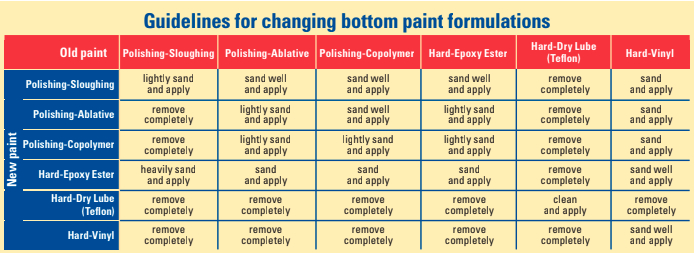
While selecting the right paint for the right job is important, knowing if the new paint is compatible with old paint is critical. Carefully review the compatibility chart in the sidebar on Page 42.
Gregg Nestor , a contributing editor with Good Old Boat, has had a lifelong interest in all things aquatic. Gregg and his wife, Joyce, cruise Lake Erie aboard their Pearson 28-2 and also trailersail an O’Day 222.
Thank you to Sailrite Enterprises, Inc., for providing free access to back issues of Good Old Boat through intellectual property rights. Sailrite.com