Issue 26 : Sept/Oct 2002
Every sailor is instructed, encouraged, and eventually submits to reading Adlard Coles’s Heavy Weather Sailing. Sometimes we find extreme circumstances at sea. Besides, it’s a bit exciting to read about being in extreme weather conditions. But what about docking? Reading about being in extreme docking conditions may not be as exciting, but steaming your pride and joy toward an irregular concrete, steel, or wooden structure with nails, rebars, and bolts protruding into your berth is reason for excitement!
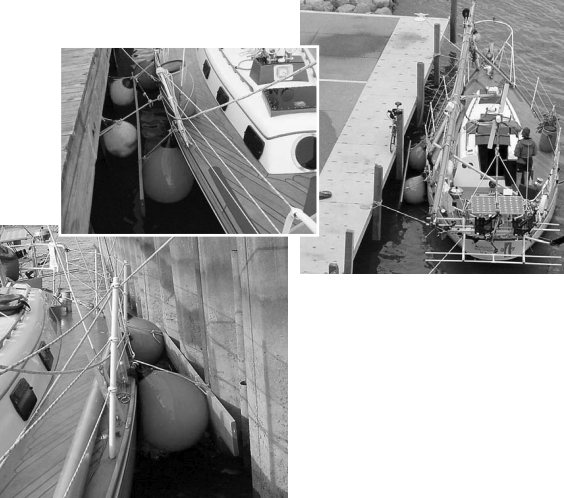
Some of these docking situations are easily handled with a fenderboard. The board spans fender-swallowing gaps, creases, and holes in an otherwise unapproachable wall or dock, providing a regular continuous surface for the fenders. Using a fenderboard may allow you to tie up where you want to; it has allowed us to park for free, avoiding crowded, expensive marinas. I would point out that docking for free in unusual places is fine and good, but seek out the property owners to get permission once you’ve tied up. And leave the site as you found it.
To start, place two fenders over the side, spaced adequately to support your boat. Then span the distance with a board, overlapping each fender a bit. Ordinary fenders. Typical wooden board.
The size of the fenderboard used is proportional to the size of your vessel, the amount of protection you desire, and the number of hours (or
dollars) you spent sanding, repairing, filling, fairing, priming, and painting your vessel.
On Windigo III, our Islander 37, we use 27-inch round fenders and a 12-foot, pressure-treated 2 x 12. Smaller boats (20 to 30 feet) can use standard white fenders and a 6-foot 2 x 4. Because you can use any old board, it is possible to practice with different sizes to arrive at a usable combination for your vessel.
A longer and wider board will accommodate more varied docking situations, but the ultimate size will be limited by your storage options and your physical ability to maneuver the board into place. Our 12-foot board lies nicely on our side deck, tied off to the shroud chainplates.
I have found that using the very large 27-inch round fenders without a board accommodates many of the less extreme circumstances. (Interestingly, we have never needed to use the board in any of the locks we’ve transited while heading south through the nation’s heartland on the Tennessee-Tombigbee and other waterways.)
The fenders are hung as usual from the rail. The board is simply hung outside of the fenders by lines tied through holes drilled near each end. The lines supporting the board should be tied well ahead of and behind the fenders on the rail so the board will rest on both fenders. Some skippers attach the fenders to the board, making a unit that is placed over the side, but it’s easier to store two fenders and a board separately, making the fenders available for use by themselves.
What would be an impossible fending surface becomes inviting using the fenderboard. A corrugated-steel seawall. A high dock with pilings or vertical members 8 to 15 feet apart. An old lock wall or concrete seawall. Piers, pilings, and mooring cells designed for much larger vessels. In fact, if the fenderboard is not long enough to rest on two members, just use one. If your boat is properly tied with breast and spring lines, a fenderboard centered on one supporting member will provide a very secure berth.
Thank you to Sailrite Enterprises, Inc., for providing free access to back issues of Good Old Boat through intellectual property rights. Sailrite.com