Issue 26 : Sept/Oct 2002
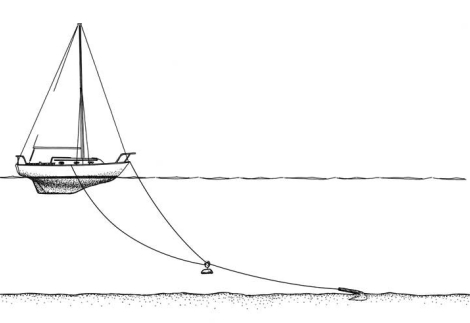
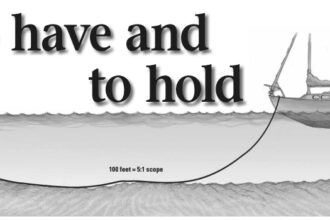
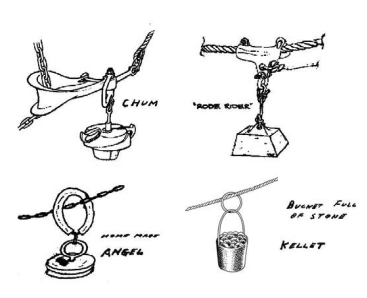
When the weather worsens while we’re at anchors, we all like to think we have a “guardian angel” looking after us. Well, a few experienced cruising skippers do. Why not join their ranks and carry your own angel — otherwise known as a chum, rode rider, or kellet?
In the past, most small boats carried these devices to beef up their ground tackle because the traditional fisherman’s anchor was not particularly effective in small sizes. The earliest reference I have found dates back to 1875 when a version of this device called a chum was made in Scotland for a well known chandler, so they are not new, just forgotten (see sketch on opposite page).
The advantages of angels are:
- The holding power of the anchor can be increased by up to 100 percent. This is achieved by reducing the angle of pull and keeping the chain closer to the bottom.
- Snatch is also reduced by decreasing the ability of the chain to lift off the bottom when set back by wind and wave.
- The angel and anchor are lifted separately, so they are more easily deployed, recovered, and stowed than a larger anchor with equivalent holding power used without an angel. This lessens the risk of back injury and requires less strength from the person handling the anchor gear.
- An angel can be made for a few dollars. The design I have used on my 26-foot cat also acts as an anchor-recovery device.
Making an angel
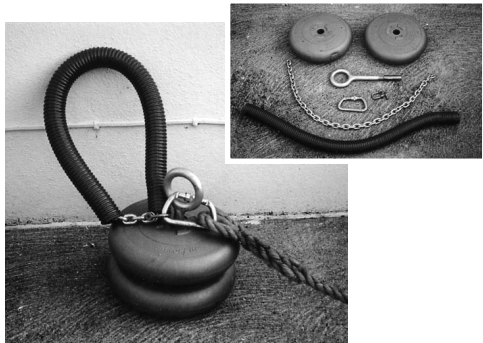
Take two surplus 14-pound lifting weights, which many of us have lying around from attempts at fitness training, which, in my case, did not last long or work. (I had hopes of having a body like Arnie . . . we are all entitled to our dreams.)
Visit your local hardware store for a three-foot length of stout chain, a length of 1 1⁄2-inch flexible hose, one large eyebolt, one screw carabiner, and a D-shackle. You now have all it takes to make you own “guardian angel.”
Using an angel
An angel is an excellent way to keep most of your chain on the bottom if you are using a chain-and-rope rode. It is set one-half to two-thirds of the way down the length of the anchor rode, just off the seabed. You will find the motion of the boat is greatly reduced, and the anchor will be less likely to drag.
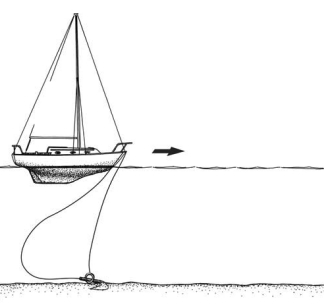
There is also a bonus: if you remove the chain and hose from the weights you can use this as a recovery device, should your anchor foul the bottom (see sketch on opposite page). Take up the slack on the anchor rode, lower the chain/hose ring down to the anchor, slacken off on the anchor rode and the line attached to the ring. Motor forward about twice the depth to the anchor, and make the ring line fast. With a little luck, the ring line will slide down the anchor shank, and when you heave in, it will pull the anchor out backward. Take care not to catch the anchor or ring lines in the prop.
Thank you to Sailrite Enterprises, Inc., for providing free access to back issues of Good Old Boat through intellectual property rights. Sailrite.com