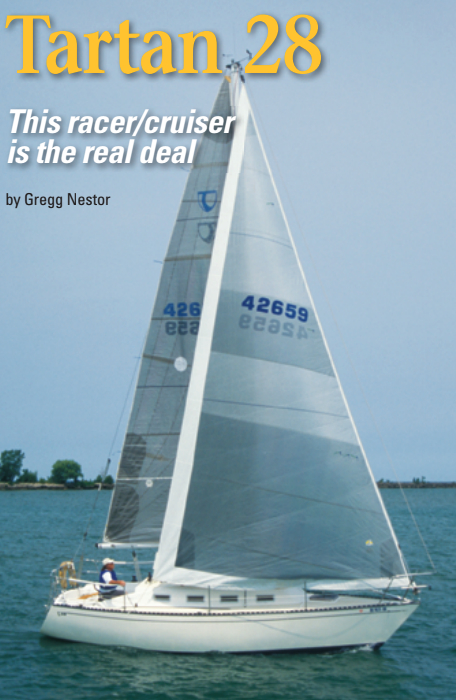
This racer/cruiser is the real deal
Issue 70 : Jan/Feb 2010
In 1971, the Grand River, Ohio, premises of the Douglas & McLeod Plastic Corporation, builder of the legendary Tartan 27, burned to the ground. The following year, Ray McLeod, Sr., died of cancer. It was at this juncture that Ray’s partner, Charlie Britton, purchased the assets or, should I say, ashes of the former Douglas & McLeod Plastic Corporation. He changed the company’s name to Tartan Marine and concentrated on producing a line of auxiliary sailboats.
While Charlie continued to build the highly successful Tartan 27 and Tartan 34C, he also expanded the line to include boats ranging from 26 to 48 feet. During the decade of the 1970s, the company built 10 different models, all exhibiting the classic good looks typical of Sparkman & Stephens designs. After a decade at the helm, Charlie sold Tartan Marine to the partnership of James Briggs and John Richards. It was after this change in ownership that the Tartan 28 was introduced.
In the years that followed, the company changed hands several more times. In 1996, its production facility was relocated across the river to Fairport Harbor, Ohio, and in 1997, Tartan acquired the assets of C&C Yachts. Today, Tartan Yachts builds about 100 boats per year, all of which are designed by Tim Jackett, president and chief designer.
Design
The popularity of the International Offshore Rule (IOR) was waning when the Sparkman & Stephens-designed Tartan 28 was introduced in 1984. This is of some interest, since the famed naval architect Olin Stephens was instrumental in developing the IOR, which had a dramatic influence on yacht design from about 1968 to the late 1980s.
The influence of the IOR, which designers exploited by giving hulls pinched ends and tumblehome in the topsides, is clearly evident in the Tartan 28’s sharp entry and full midsections. However, the boat’s after sections are wider and flatter than the earlier IOR archetype that would normally have a very narrow stern.
The Tartan 28 is a racer/cruiser and was the direct replacement for the aging Tartan 27. It was in production for six years, and 136 were built. In 1990, the boat was redesigned and designated the Tartan Piper 28. The major difference between the two is that the Piper version is lighter by about 1,000 pounds. Most of the weight reduction came from switching from a fin keel to a beavertail design (a fin with a large ballast bulb that gave it a shape similar to a beaver’s tail). This decreased the boat’s draft to 3 feet 11 inches. The rig also was shortened, reducing the sail area to about 385 square feet, and the boat’s rudder was slightly enlarged. The “Piperized” version of the Tartan 28 continued in production until 1994.
Construction
According to Art Averell, Tartan’s after-market sales manager, the Tartan 28 was built “like a tank.” The majority of the hull above and below the waterline is solid fiberglass and is hand laid-up with mat and unidirectional rovings. Those areas of the hull above the waterline from the forward bulkhead to the stem are cored with a combination of end-grain balsa and Coremat. Coremat is the trade name for a microsphere-filled, random-laid, chopped-fiber polyester fabric that, because of its good conformability, is used as a bulking and print-control mat and is ideal for adding stiffness to laminates. The boat’s gelcoat is NPG/ISO polyester resin. It’s backed by vinylester resin for blister and chemical resistance.
The deck is a hand-laid, balsa-cored laminate with a non-skid pattern molded into all horizontal surfaces. In high-stress areas, such as beneath mooring cleats and winches, the balsa core is replaced with reinforcements of solid fiberglass.
The Tartan 28’s deck lands on an inward-facing flange on the hull. This lap joint is bedded with butyl rubber. Beneath it is a 1⁄4-inch aluminum backing plate through which the joint, along with the slotted aluminum toerail, is bolted every 4 inches with 1⁄4-inch stainless-steel bolts.
In the hull, a molded liner or pan forms an integrated floor-timber structure that provides strength and rigidity. There’s also an overhead liner. In the saloon, this liner has removable panels with teak battens hiding the seams.
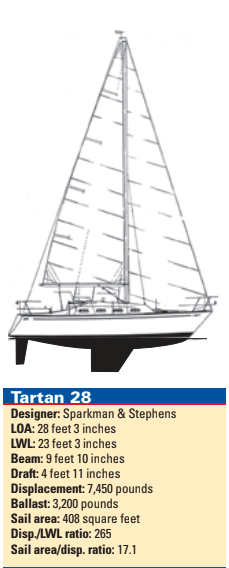
The standard keel for the Tartan 28 is a fin that gives the boat a draft of 4-foot-11-inches. This external ballast, comprised of 3,200 pounds of cast lead alloyed with antimony, is fastened to the hull with stainless-steel keel bolts, faired with epoxy and microballoons, and finished with an epoxy coating. Other keels include an optional Scheel keel and the Piper’s beavertail, both drawing 3 feet 11 inches. Completing the underwater picture is a balanced spade rudder. The Tartan 28’s standard underwater configuration gives the boat a displacement/LWL ratio of 265 and a ballast/displacement ratio of 43 percent.
All deck hardware is of good quality and is through-bolted with appropriate backing plates. All through-hulls below the waterline are fitted with stainless-steel-and-bronze ball valves.
Deck features
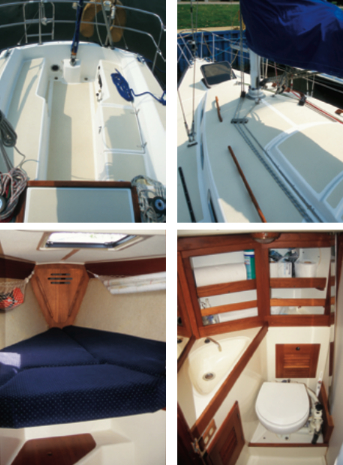
Slotted aluminum toerails run the full length of the boat and terminate at hefty mooring cleats forward and aft (midships cleats were an option). The boat’s perimeter is secured by double-rail bow and stern pulpits and through-bolted stanchions supporting 3⁄8-inch vinyl-coated lifelines.
Wide sidedecks, shrouds attached to inboard chainplates, and the absence of a foredeck anchor locker allow reasonably unobstructed movement on deck. The coachroof features eight 5 x 15-inch opening portlights with screens, a molded-in sea hood, and two pairs of teak grabrails. Just forward of it is a 19-inch-square aluminum-framed hatch.
The Tartan 28’s modified T-shaped cockpit is 7 feet long. Standard steering gear is a varnished ash and mahogany laminated tiller. A pedestal with a 28-inch wheel was optional. The cockpit coamings are reasonably high and, along with the seat bottoms, are properly sloped and comfortable. Beneath the port seat is a cavernous sail locker and farther aft is the panel and controls for the engine. Water drains through a pair of 2-inch cockpit scuppers. A manual bilge pump is fitted within easy reach of the helm.
Belowdecks
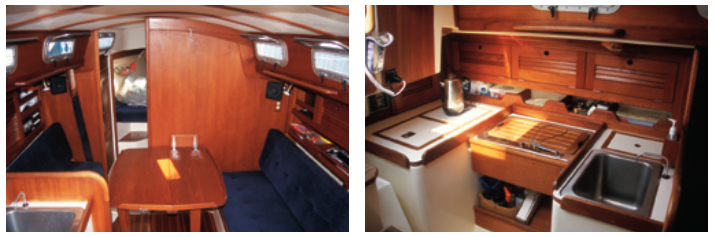
Even though the cabin layout of the Tartan 28 is predictable, its all-teak interior and cabinet joinery is impressive and exudes a salty charm.
With its insert in place, the V-berth forms a reasonably comfortable double. Beneath it is stowage and a 14-gallon holding tank. Following aft is a hanging locker with a bureau to port and the head compartment to starboard. A louvered door encloses the locker; a solid wooden door creates privacy in the head. The head is fitted with a marine toilet, a counter-molded sink with a freshwater foot pump, and a fair amount of stowage. Hot and cold pressurized water and a shower were options.
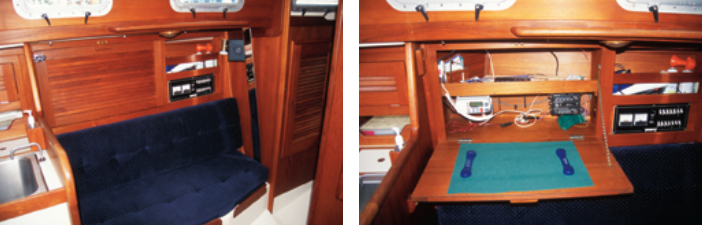
In the saloon, opposing settees face a bulkhead-mounted drop-leaf table. The short port settee, while designed mainly for seating, can be employed as a child’s single berth. Sliding out the lower portion of the starboard settee converts it to a double. Its padded seatback can be repositioned to function as a padded leeboard. Over the starboard settee there’s a bookshelf, and a fold-down navigation station with additional storage is fitted above the port one. The 17-gallon aluminum fuel tank is housed beneath the port settee and the 30-gallon polyethylene water tank beneath the starboard settee.
The U-shaped galley is aft and to port. It includes a 4-cubic-foot icebox, a two-burner gimbaled alcohol stovetop, and a single deep stainless-steel sink with a foot pump for fresh water. When the cooktop’s cutting board is in place, counter space improves from adequate to good. Stowage for provisions and galley utensils is convenient and plentiful. Mechanical refrigeration, hot and cold pressurized water, and a CNG stove with oven were optional.
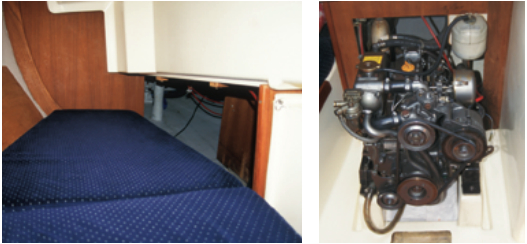
Aft on the starboard side is a large quarter berth with stowage below. Removing the quarter berth’s inboard panel gives access to the propeller shaft and packing gland.
The sole is teak and holly, and all the cabin woodwork is finished in hand-rubbed oil. This includes the two pairs of teak handrails that are mounted at shoulder/deck height. Headroom is a comfortable 6 feet 1 inch.
The rig
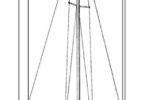
The Tartan 28 is a masthead sloop; the keel-stepped mast has a bridge clearance of 42 feet. All standing rigging is 1 x 19 stainless-steel wire and consists of a headstay, a split backstay with four-part tackle, a pair of cap shrouds, and a single pair of lowers. There’s also a baby stay, which is an effective aid in bending the double-airfoil-spreader mast for racing or for getting the best performance while cruising. Sail area of 408 square feet gives a sporty 17.1 sail area/displacement ratio.
All halyards (main, genoa, and spinnaker) are internal, meaning they run through sheaves inside the mast. Sail controls are led aft through line stoppers positioned forward of two Barient #18 winches mounted aft on the cabintop. This convenient arrangement allows the crew to stay in the cockpit most of the time.
Headsail sheets can be led aft through tracks with cars mounted on the sidedecks or through toerail-mounted snatch blocks. Once the sheets have been properly directed aft, Barient #22 self-tailing winches are used to trim them. These winches are positioned outboard of the coamings within easy reach of the helm. The ratcheting 5:1 mainsheet terminates at a Lewmar traveler situated on a narrow ledge just aft of the companionway.
All running rigging is double-braided polyester, stainless-steel, or pre-stretched polyester where appropriate. Hardware is brand-name and adequately sized.
Under way
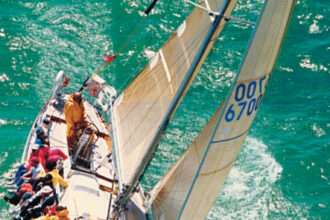
The Tartan 28 is a well-behaved racer/cruiser. It performs well to weather and its upwind ability increases as the wind picks up. Its refined underwater shape makes the boat easy to steer and very maneuverable. The hull’s wide and flat aft sections add to the boat’s already formidable stability.
At 174 seconds per mile, the Tartan 28’s PHRF rating is the same as several fleets of J/27s and the largest fleet of C&C 27s in the country.
Auxiliary propulsion is a freshwater-cooled 18-hp Yanmar 2GM diesel. It’s coupled to a 3⁄4 -inch stainless-steel shaft via a 2:1 reduction gear and turns a 12-inch, 2-bladed propeller. This package easily powers the boat. Access to the engine for routine maintenance and inspection is very good.
Things to check out
Since the deck and the forward portions of the Tartan 28’s hull are cored with balsa, it’s important to have a professional surveyor determine if water has soaked the core or if the fiberglass skins have delaminated from the core. Potential areas of concern are around deck fittings, such as stanchions and cleats.
Examine the base of the mast below the cabin sole where it is supported by the keel and look for signs of corrosion.
Many Tartan 28s have been raced pretty hard. Look over both the standing and running rigging carefully. Pay particular attention to the turn-buckles and chainplates.
Because the engine control panel is mounted low in the cockpit, it’s subject to physical and water damage. Check it out.
Conclusion
The Sparkman & Stephens pedigree is first-class, combining a fast and agile underbody with classic Tartan interior and exterior. The deck plan is efficient and amenities rival those of much larger yachts. The boat is a racer/cruiser, with the emphasis on “racer.” Be prepared to pay $30,000 to $38,000 for a reasonably well equipped and maintained Tartan 28.
Gregg Nestor, a contributing editor with Good Old Boat, has had a lifelong interest in all things aquatic. Having recently sold both their Pearson 28-2 and O’Day 222, Gregg and his wife, Joyce, find themselves boatless. They are currently searching for that perfect good old boat. Gregg’s third book, The Trailer Sailer Owner’s Manual: Buy-Outfit-trail-Maintain, was released in 2009.
Thank you to Sailrite Enterprises, Inc., for providing free access to back issues of Good Old Boat through intellectual property rights. Sailrite.com