A boat’s back end speaks volumes about its character
Issue 70 : Jan/Feb 2010
In the previous issue (November 2009), I discussed how the shape of a sailboat’s bow affects performance and handling. Now we’ll turn our attention to the stern with a focus on the typical shapes found on the sterns of boats built in the last 30 years.
Stern overhang is very different from bow overhang. While we do our best to reduce the resistance at the bow by making it fine, at the stern we have the freedom to make the boat narrow or broad. We can put a point on it but, by filling it out, we can get it to “push” down on the stern wave, which brings some benefits. Hopefully, you will not have to push the stern through the water in any kind of weather.
As the stern gets wider, the sectional shape can be configured so the hull volume is pushed outboard where it will quickly immerse once the boat heels over. This can significantly increase the prismatic coefficient (Cp) of the boat. As the Cp goes up, the potential hull speed goes up but, at the same time, the amount of energy required to push the boat to hull speed also goes up.
Generally speaking, it’s not good to have a stern shape that drags the corner of the transom around at any heel angle. However, the huge rigs we see on today’s high-performance boats clearly have the horsepower to overcome that small amount of drag.
If you have a stern shape that does not immerse the transom when heeled, you have a nice clean shape for good light-to-medium-air performance where you will be operating at less than hull speed. But now you face the same problem we looked at in the last issue’s article on the bow. In order for stern overhang to add to your sailing length, you have to immerse it so it can do some “work” by altering the longitudinal distribution of the boat’s volume.
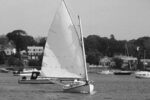
Look at the typical double-ender, a shape that is near and dear to my heart. When the stern ends in a point, you cannot drag the transom — there is no “transom.” The stern always leaves a relatively clean wake, but because there is no volume aft to immerse, your typical double-ender, say a Westsail 32, will forever sail with its sailing length essentially being its static waterline length.
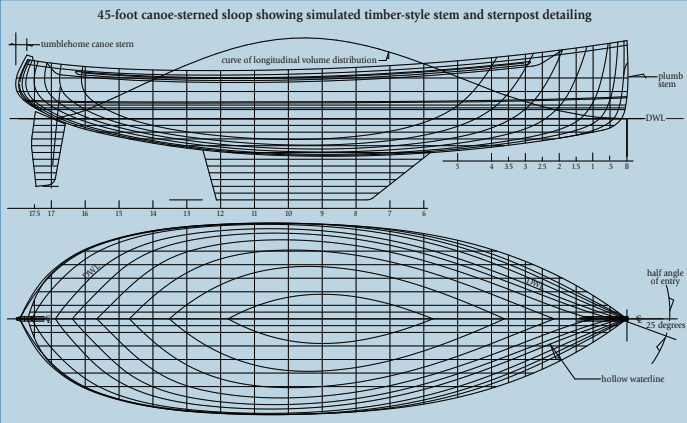
I addressed this when I designed the Valiant 40. I tried to pull volume aft and outboard so the buttocks were flattened and there was significant volume to immerse as the boat heeled. You can see another designer’s efforts to do something similar in Bill Crealock’s Pacific Seacraft series. This is the essential difference between the canoe stern and the double-ender of the Westsail type. All canoe-stern boats are double-enders, but not all double-enders have canoe sterns. I’m not going to get into the seakeeping characteristics of double-enders. I’ve never figured it out other than what I have read and what the old salts told me.
The case for volume aft
Volume aft is volume aft. If you want volume aft, the best way to get it is with a transom. If you bring your boat to a point on deck at the stern, you are going to give up volume aft. Today’s designs, in which designers try to squeeze more and more accommodations into a given length overall (LOA), are all about volume aft. I think those broad sterns are more about accommodation volume than performance.
Volume aft also adds stability to the boat. When you heel and immerse volume aft, you add to the boat’s “righting arm.” The farther outboard you push that volume, the greater the additional righting arm. Sometimes we refer to this as “power” in the stern. For some boats with modest draft and low ballast-to-displacement ratios, this additional righting arm can be an important addition to the boat’s “form stability,” or stability derived from the hull shape.
If you have a carbon 40-footer that draws 9 feet with a big T-fin-and-bulb combination, you probably don’t need any help with form stability. In those cases, the wide and flat sterns we see on today’s high-performance boats are intended to add sailing length. In fact the chines (corners) you see aft on these sterns appear to be an effort to get maximum volume aft and outboard where it will do work. Then the hull is cut off abruptly with a sharp chine. This type of shape adds wetted surface aft, but these modern racers have big enough rigs to get to hull speed very quickly and, once you get above about half your hull speed, wetted surface is not so important.
If you want to see great examples of designers making stern overhang work, take a look at film footage of the last few years of America’s Cup designs sailing. It almost looks as if the boats were launched with extended sterns and sailed heeled over while someone hung over the stern to leeward with a piece of chalk and drew a line exactly where the water left the hull. There is not an inch of unused additional overhang and the water leaves the hull cleanly. We don’t want a bone in the tail any more than we want a bone in the teeth. Those old boats from the 1920s that sailed along with 8 feet of stern overhang hanging in the air were beautiful, but that stern overhang didn’t help boat speed.
In my cruising designs, I like to keep some deadrise aft at the stern. A flat stern section can be fast when the boat is heeled, but at the dock or on the hook in some chops or wakes, a flat stern can provide a surface that waves will slap against. This can happen with alarming force and is not pleasant. Both Bill Lee and Carl Schumacher used some deadrise aft and their designs were famous for fast off-the-wind speeds. Bill Lapworth’s Cal 40, famous for its ability to surf, has 16 degrees of deadrise at the buttwater.
The effects of heel
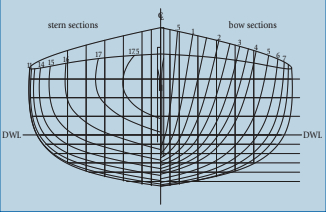
The challenge in designing sailing yachts is to combine shapes that will work well when the boat is upright, that is, running downwind or sailing in very light air, and when the boat is heeled over. As some boats heel, the water will see a wide change in hull shape and distribution of volume. The wider the stern, the more the heeled hull shape changes from the upright shape. Combined with broad beam, say length-to-beam ratios (L/Bs) less than 3.5, this can result in a boat that shows a change in helm balance as the heel angle changes.
Wide sterns also tend to lift a centerline-hung rudder out of the water so that in extreme or near-extreme conditions the rudder can suck air down its low-pressure side and stall. Sometimes we call this “ventilating.” When it occurs, the rudder loses its grip on the water and the boat usually will round up quickly. Modern wide-stern racers combat this by having two rudders. With a rudder well outboard on each side of the boat, even at heel angles of 25 degrees or more, one rudder will be well immersed and still taking advantage of the “end plate” effect of the hull to help keep the flow attached to the rudder blade. Today we are seeing more and more high-performance boats with twin rudders.
Some double-enders will retain an almost static longitudinal distribution of volume through a wide range of heel angles. I refer to these boats as having “balanced” waterlines. The helm pressure at 5 degrees heel will be almost the same as at 25 degrees.
A trade-off of traits
For cruisers, a broad stern can mean the advantage of having a nice big swim platform that makes getting in and out of the dinghy much easier than climbing over the rail. It can also mean a lot more room in the cockpit and more volume in the lazarette. Look at how many of today’s mass-produced boats have double quarter berths port and starboard. You cannot do this without a very broad stern.
Of course, there is a subjective element at both ends of the boat. While a near-plumb stem may be the best way to exploit a restricted LOA, and while production builders generally organize their models around specific market-target LOAs, the client may aesthetically prefer some overhang forward. The nice old spoon-bow profile of the Carl Alberg and Phil Rhodes designs may not be fast but it can be very attractive.
While bow profiles must reflect the sectional shapes forward and a logical termination of those shapes, stern profiles are pretty much a function of transom treatment and rake and, in most cases, that’s driven by aesthetics or pragmatism.
The angle you use to cut the transom off may be strictly aesthetic or it may be a way of maximizing sailing length while minimizing weight. Maybe it’s pragmatic, as the designer tries to squeeze in a swim platform aft or get more length to the cockpit. The client may insist on a double-ender. I happen to think a nice canoe stern is the prettiest way to end the hull. While the canoe stern may not be the epitome of the shape of speed, it certainly looks right to my eye and, over the years, for whatever reason you choose to believe, double-enders have earned a reputation as excellent sea boats.
The long stern overhangs of the designs from the years prior to the 1960s will always look great to my eye. The Phil Rhodes 1955 design, Carina, remains for me one of the most beautiful boats ever designed. With an overall length of 53 feet 6 inches, Carina has 36 feet 3 inches on the waterline, for a total of 17 feet 3 inches of overhang. At the time, this DWL was considered “generous.”
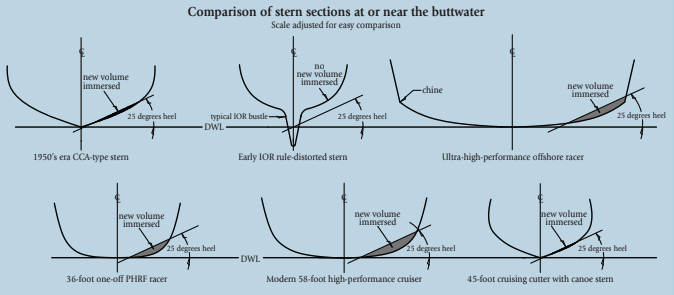
Sterns and design goals
Different design targets can drive different designs and determine their proportions. Rating or handicapping rules can have a big influence on a cruising fleet that wants to give the “impression” of high performance. It’s a bit like putting a spoiler on the trunk lid of your Toyota. The designer needs to know what the design is intended for and how it will likely be sailed. Some people scream when they heel more than 15 degrees, so what good is stern overhang going to do them? Some sailors will never or seldom push their boat beyond hull speed, so why have a big, powerful stern? Maybe a double-ender with its more predictable helm balance would better serve that sailor. The family that sails on San Francisco Bay should want a boat with a high Cp for the heavy air and improved hull speed. The sailor on Puget Sound, with its light and fluky air, would be better off with a low-Cp boat and enjoy the gains in light air. All these factors should be taken into consideration.
It’s not as if there is a “right” or a “wrong” in any of the various treatments of bows or sterns. I love the diversity of shapes I see when I look through old magazines. One of my all-time favorite boats has a totally bizarre hull shape but I still think the boat is beautiful. I even miss the early IOR days when, as designers worked out how to best take advantage of the demanding new rule, some of the boats were outright pigs. I believe what’s important is to appreciate the boat you have and understand how its hull shape works. This way you will sail more effectively in all conditions and learn how to make your boat go in sympathy with its genetic proclivities.
Robert Perry is the principal of Robert H. Perry Yach Designers in Seattle, Washington. His best-known production designs include the Valiant 40, Tayana 37, and Passport 40. He has written numerous articles for various sailing magazines.
Thank you to Sailrite Enterprises, Inc., for providing free access to back issues of Good Old Boat through intellectual property rights. Sailrite.com