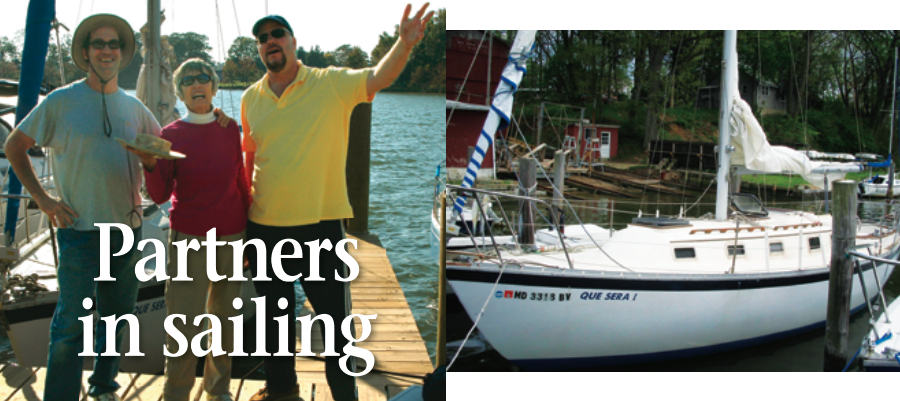
Joint ownership provided a path to the water
Issue 76 : Jan/Feb 2011
Picnicking one day in a park in Oxford, Maryland, on Chesapeake Bay, we watched sailboats glide into a wooded anchorage. That did it.
I had moved to the Washington, D.C., area to be closer to my then girlfriend, but the possibility of our joining the world of big sailboats seemed remote, especially on the joint salaries of a journalist and public health worker. And although I had sailed and raced small boats in my native Michigan, I was intimidated by the responsibility of handling and caring for a large boat. We were surprised, too, at how many sailboats we saw that seemed to have fallen into disuse and wondered how their owners could pass up the ability, that we so envied, to be on the water.
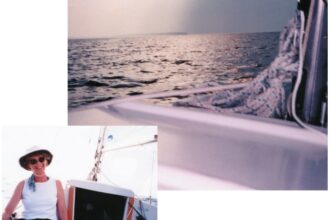
Years later, a journalist colleague took me out sailing on a 1976 Hunter 25, Rhode Keel, that he and three others owned in partnership. Terry, another co-owner of the boat, was also on board. We left their slip on the Rhode River on a beam reach and it wasn’t long before the sunlight scalloping the waves was making me think about finding a way to have a boat of my own. When they gave me the tiller, I fixed on a landmark and, sheltered in the shadow of the mainsail, we sailed home from Thomas Point Lighthouse under cobalt skies.
Seeing the quality of the light that afternoon and feeling the movement of the boat convinced me that if ever an opening in the partnership arose, I would be interested in filling it. I knew enough to sense they were solid sailors but, more important, they were excellent company and relaxed about teaching me things. I hoped I had made a good first impression by docking well, pulling into the last slip to starboard and stopping on cue. This is particularly tricky in that marina as maneuvering room is limited by a shallow marine railway nearby.
An opening
Then my reporter colleague accepted an offer in Geneva and asked if I would be interested in taking over his share of the boat. I leapt at the chance to join the partnership that shared Rhode Keel. Not only was this an economical way to access sailing on the bay, I also liked the idea of learning from and sharing the experience with others while keeping a sailboat in active use. Having sailing partners meant not having to play “host” every time we sailed with non-sailing guests and provided me with a new circle of developing friendships.
Within our partnership, Terry had the most big-boat sailing and racing experience and was generous with his knowledge, time, and sense of adventure. An old family friend and a business colleague of his rounded out the foursome, which had originally been formed in 1993. Over the years, this group has involved eight different configurations of owners. The marina managers, who also work as watermen on the bay, say it is the longest running sailing partnership they’ve ever seen.
The group has a few basic rules. If someone fell behind on his monthly payments of $130 — which are paid into a kitty to cover all maintenance, slip fees, insurance, and upgrades — he had to take over organizing the fi nancial management of the boat, such as year-end settle-up, which was normally Terry’s arena. Everyone lends a hand in maintaining the boat as well as commissioning and decommissioning her in spring and fall. Haulouts are supervised by whomever is available. In any given month, we each had a week, starting on a Friday, for our own use, and we often allowed other partners to share our sailing times when our schedules permitted. Over time, we fell into the rhythm of sailing together on weekends.
The Chesapeake is a forgiving teacher, with muddy bottoms that prevent damage during groundings, waves that hardly ever grow more than a foot or two (unless a southeaster is blowing), and multiple safe harbors if thunderstorms kick up. With the help of my sailing mentors and the practice that comes of sailing often, I quickly got the hang of winches and anchors and handling the outboard.
A bigger, newer boat
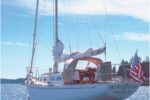
A year after I joined the partnership, it became increasingly clear to us that, despite her dry bilge and handy roller furler, Rhode Keel was growing old. Just down the road from our marina we found a boat brokerage with a 1983 Endeavour 32 for sale.
Buying a boat as a group is a bit like buying a house together: everyone has one thing he can’t live without and other things he may have to accept as compromises. Our joint list included a Bimini, roller furling, and an autopilot. My requirement was a long berth, as I stand 6-feet 4-inches in my socks. Que Sera met all our requirements and was in excellent shape. The 24-hp Universal diesel needed routine maintenance but it ran, and the sails were pretty much blown out but serviceable. We could postpone costly upgrades. We read up on her sailing qualities and learned she’d be steady in heavy winds. Deciding to go ahead, we sold Rhode Keel to a friend. The transfer coincided with a partnership transition, so the former set of partners split the proceeds from the sale of Rhode Keel. We then made a “capital call” so the new partners could buy into our new boat.
That was when my education began in earnest: varnishing trim and coamings, handling water pumps and depth sounders, managing communications with our marine mechanic — a retired anthropology professor — and taking care of our gorgeous wood-paneled interior. These were all new tasks we never had to contend with on the Hunter.
I’ve taken on much of the maintenance out of a desire to learn and to be useful. I’ve picked up valuable tips from our mechanic and through trial and error. Because Que Sera is sailed by several skippers, I made start-up and shut-down checklists and plasticized them. These reminders help us safeguard the engine and electrics, ensure that springlines are set to cope with tides, and ensure that we knot the jibsheets so the jib won’t unfurl in a storm when she’s untended in her berth.
My real sailing lessons have come from Terry, who taught me to sit to leeward when I have the helm so I’ll be able to see the jib telltales as well as the crab pots that can foul propellers (as I discovered one howlingly chilly day on Rhode Keel). Terry also urges me to avoid pinching, or sailing too close to the wind. I’ve gotten the hang of falling off a few degrees, noting the corresponding surge in boat speed.
He’s detailed the finer points of how to use the traveler to flatten the main and improve her progress to windward. I can assist Terry with setting the spinnaker — he’s really the first among equals under sail — but I have yet to try it when he’s not aboard. Early on, I came up with the idea of maneuvering Que Sera manually out of the slip with the help of boathooks until we’re clear of the finger piers because of her excessive prop walk. I also learned to maintain just enough speed for steerageway as we approach the dock.
Our partnership was reduced to just three members when one member’s family moved to California. Despite some early efforts to locate a replacement, we’ve put recruitment on hold as we’re enjoying our greater access to the boat.
My then-girlfriend had become my wife, and our kids, now 10 and 6, are building a bank of positive experiences on gentle-wind days when we swim off the boat. And, for years now, I’ve taken my father and a friend on three-day weekends in the fall to Maryland’s Eastern Shore.
When the partners and friends sail her together, we always learn something. We enjoy holding long electronics-free conversations and playing hand drums and flutes on cool autumn evenings huddled next to the warm engine compartment. We also hold an occasional informal “book group,” with everyone agreeing to read the same book before we embark.
As partners, we share costs and maintenance for Que Sera but, more important, we sail together a lot, which strengthens our bonds. What’s sad to us is seeing the number of boats at our marina and elsewhere that have fallen into disuse. Que Sera is sailed all spring, summer, and fall by a partnership based on the bonds of friendship. What else are good old boats for?
Steve Gibb lives with his wife, Carolyn, and two children in Silver Spring, Maryland, where he works in environmental communications. He has been a member of the sailing partnership for three years. The consortium sails Que Sera out of Edgewater, Maryland, on the Chesapeake Bay.
Thank you to Sailrite Enterprises, Inc., for providing free access to back issues of Good Old Boat through intellectual property rights. Sailrite.com