A drop-in alcohol stove is an easy, functional fit
Issue 79: July/Aug 2011
Like most older boats, ours came with a worn-out and obsolete stove. Sarmiento, our Bristol 35.5, had a pressurized-alcohol fixed-mounted stovetop that had seen better days. It wouldn’t fi t our needs for several reasons. We wanted a gimbaled stove so we could cook while under way. In fact, many of the anchorages that we expected to visit are very rolly. There would be times, we knew, when the anchorages would present more of a challenge to cooking — with pots flying — than when we were under way. We also thought a pressurized-alcohol stove was inefficient, cranky, and somewhat dangerous because of fl are-ups.
For all these reasons, I set off on “the great stove search.” It was easy to eliminate the pressurized-alcohol stove. I also quickly discarded kerosene stoves, which cook reasonably efficiently but have other drawbacks. They may be even crankier than pressurized-alcohol stoves and, in addition, produce some black soot, have a distinct odor, and require regular maintenance.
High-end propane stoves and compressed-natural-gas (CNG) stoves are very similar to the natural-gas stoves in many homes, and cooking on one would not be very different from cooking on the natural-gas stove in our house. However, I soon realized I couldn’t afford a high-end propane stove.
I then began to look at installing a less expensive propane or CNG stove with oven, but soon discarded the CNG option because it is difficult to obtain CNG outside the U.S. Thus, my original search pointed to a propane stove and oven. By the time I was done, however, I would go in a different direction.
Problematic propane
After I started to design a propane system for my boat, I was taken aback by the additional costs and complexity of the installation.
Since Sarmiento didn’t come with a propane stove as original equipment, I needed to find a place to build a propane locker or lockers. I say “lockers” because I would want at least two tanks on board. With one tank it is possible to run out of propane in the middle of nowhere. That can cause severe coffee withdrawal, something I really wanted to avoid.
Finding a place to build two lockers with overboard drains to keep propane leaks out of the boat was not easy. Nor would the installation be cheap, as I would have to buy two propane tanks with regulators and, for safety, a gas detector and control system. I probably would hire someone to install the necessary plumbing and safety systems, because the last thing I would want is to blame myself if my boat blew up due to a faulty installation. The cost of the additional equipment and installation would more than double the original cost of the stove. And, in the end, I would always be a little nervous.
Neat alcohol solution
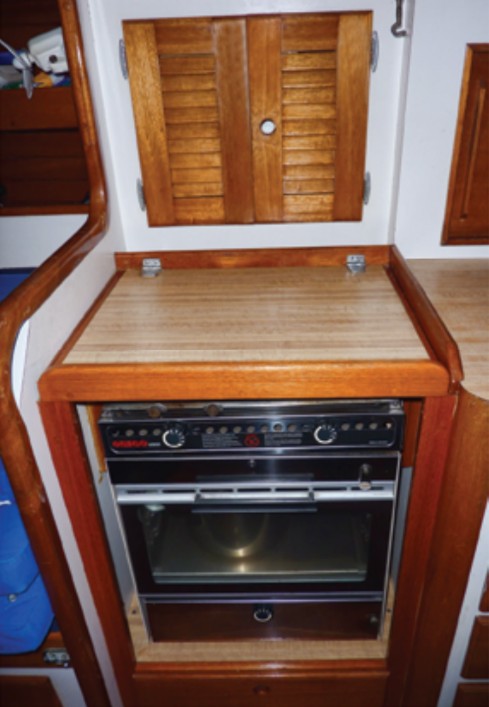
As this debate raged within me, I discovered the Origo non-pressurized alcohol stove. To install the Origo stove, all I needed to do was remove the old stovetop and the air conditioner below it and fi t the stove into the opening. It would be quick and easy and it would save many hundreds of dollars.
I was a little skeptical about the heat potential of an alcohol stove. However, various sources indicated that the stovetop would produce somewhere between 5,000 and 7,000 Btu per hour at the burner. Although propane potentially can supply greater heat, as a practical matter, lower-end propane stoves tend to produce 6,000 to 7,000 Btu per hour at the burner. My experience has been that the Origo stove takes a little longer than propane to boil water — six to eight minutes for coffee and a little longer for pasta water (there’s more of it). But what’s time to a sailor?
Now that it is installed, I can say that the Origo stovetop is easy to use. The alcohol is contained in a canister packed with a nonflammable filler. A flue is used to adjust the flame. All you need to do is open the flue and use a barbecue lighter to ignite the burner.
Each canister holds about a quart of alcohol and will burn four to six hours, depending on the flue setting. We tend to use about a quart and a half a week. Most recently, we have been using industrial alcohol. It costs us $3 to $4 a liter and seems to work as well as the more expensive Origo stove alcohol, which isn’t available in Mexico where we cruise.
On small pocket cruisers in particular, the single-burner non-pressurized alcohol stove might prove desirable since it doesn’t take up much room. This Origo unit is a little less than 6 inches tall with a 10-inch-square top. All you need to do to add a galley where you didn’t have one before is modify an existing cabinet or create a small cabinet in which to fi t it. It can be installed in a small space as a fixed unit or with an optional gimbal.
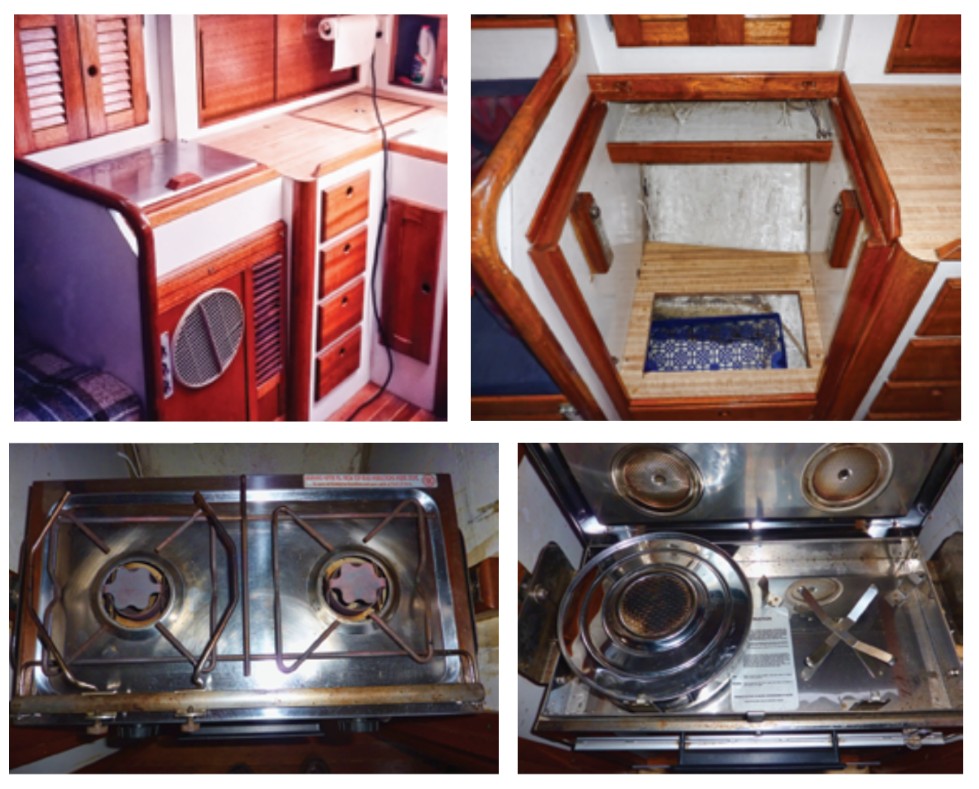
Adequate performance
The Origo stove performs most cooking chores reasonably well, including simmering. We tend to cook simply on the boat — no intricate sauces — but we have cooked many a good meal on our stove.
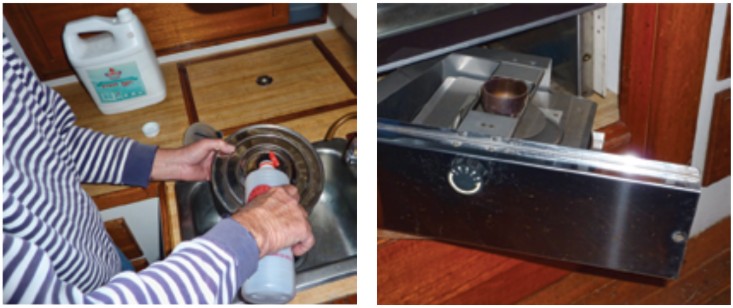
It isn’t without its faults. Filling the fuel canisters without making a mess takes some practice. We store our stove fuel in a gallon jug and use a quart bottle to fill the canister. To contain spills, I fill canisters in the sink. Once you get the hang of it, it’s possible to fill a canister quickly without making a mess. In terms of cooking, the biggest disadvantage of the Origo is the rather small oven. It will hold a chicken but not a turkey. Because it has little insulation, the oven has cold spots and doesn’t cook evenly. To make sure that all the chicken is properly cooked, some parts of the chicken may be overcooked. Cooking brownies or bread can be an experience because some parts may be a little doughy. They’re still good — you won’t have any problem eating them in a secluded cove.
In my experience, low-end propane ovens, although larger, have the same problems as the Origo oven. They may not hold a turkey but they might hold two chickens. Lacking good insulation, they also have cold spots. Baking in them seems to take about the same length of time as in the Origo.
Operator errors
We’ve used our Origo stove for almost 15 years. The only problems we have encountered have been user-induced.
I once bought alcohol in a hardware store in a small town in Mexico. When I returned to the boat and filled the canisters, I was very surprised to discover that the alcohol was nonflammable. Unless you put small covers over the canisters, flammable alcohol will evaporate over time. Of course, nonflammable alcohol won’t evaporate, at least not within a cruising season. As a result, I was forced to buy two new canisters to correct this operator error.
The other event was less costly. Soon after we installed the Origo stove, we took off on a short cruise. After about a week, we stopped at a small village on an island to replenish some supplies and spotted a freezer with two individual-sized pizzas. We thought it would be a great idea to try out our new oven by cooking frozen pizza.
After pre-heating the oven, my wife said she didn’t think the oven was getting hot enough. “No problem.” I said. “We’ll just keep the pizzas in there a little longer than recommended.”
A little later, she said, “This oven isn’t even getting up to 250 degrees.” My first disappointing thought was that alcohol might not be a very hot fuel. That thought was followed by, “Oh no! The thermometer is in Celsius!” We quickly pulled the slightly carbonized pizzas from the oven. Our one consolation was that the pizzas wouldn’t have been very good anyway, even if cooked properly.
One potential maintenance issue with Origo stoves is that rust can form on the chimney/diffuser. This hasn’t happened to us yet, but if it does, Origo will replace it at no charge.
A full-time cruiser or liveaboard might want to stick to a high-end propane stove and oven because of its similarities to a household stove and oven. However, for most of us who would buy a low-end propane stove, the Origo works about as well. What really recommends it as a replacement stove is that you simply drop it in place. You don’t have to plumb propane and create overboard-vented storage boxes for the tanks or worry about leaks or complicated system maintenance.
Non-pressurized alcohol stoves: a second opinion — Karen Larson
When we bought her nearly 20 years ago, Mystic, our C&C 30, came with an Origo two-burner stovetop and oven. Jerry and I have had no other cooking systems with which to compare our Origo, but for our cooking needs we’ve been happy with this arrangement.
It’s true that we don’t worry about fuel safety and explosions when cooking with non-pressurized alcohol. But, like Carl, we probably wouldn’t recommend non-pressurized alcohol for full-time cruisers for three reasons: the fuel is a bit more expensive to buy, is said to be harder to find in some parts of the world, and can have an unpleasant odor if you have to do a lot of cooking in a confined cabin (cooking a large pot of water to boil pasta or a couple of pots for showers can make our eyes water).
Like Carl, we also use a smaller container — a dishwashing-liquid bottle with a squirt top — for filling our canisters. Spills are not a problem.
We have learned that these canisters should be kept topped up with fuel. If they get too empty, it can be difficult to extinguish the flame that can get started in the material down inside the canister. The flame is contained, but the canister becomes very hot and the normal shutoff flap is not enough to suffocate it. This has led to a couple of unexpected and exciting moments aboard until we misted the super-heated canister with water from a hand-pumped spray container we keep nearby for rinsing dishes. Friends who have had a similar experience with their stove believe a draft coming in through the companionway opening near their stovetop can also contribute to this sort of failure.
As for the oven, I never minded the size since I have never had any desire to cook a turkey aboard. The oven is large enough for 12 muffins and one large or two small loaves of bread. Since there are only two of us aboard (and never at Thanksgiving time) that’s big enough for me. I was a bit confounded by the uneven cooking in the oven until I learned to rotate a muffin tin front to back halfway through the baking cycle. I still do that even though it is probably unnecessary since Jerry added a large diffuser to the bottom of the oven. This is a thick sheet of metal that prevents the central flame from the fuel canister in the bottom from making a hot spot in the middle of whatever is baking there.
On our project boat, Jerry has decided to install a propane cooktop, so he has taken on the complications of installing the plumbing for a gimbaled stovetop. Now that Carl points out the simplicity of a drop-in Origo cooktop, I’m not sure why we made that choice, but at least we’ll soon be able to resolve the ongoing debate about which fuel can cook a pot of water faster. Since all fuels have advantages and disadvantages, we’ll soon be learning to adjust to yet another cooking system. The important thing is to have warm food at mealtime and hot tea whenever we wish.
Carl Hunt is a semi-retired economist. He lives in Colorado and has sailed for 30 years and cruised his boats from British Columbia to Mexico. He has chartered and cruised other people’s boats throughout the eastern United States and the Gulf of Mexico, the Caribbean, the Mediterranean, and elsewhere.
Thank you to Sailrite Enterprises, Inc., for providing free access to back issues of Good Old Boat through intellectual property rights. Sailrite.com