Reviving a derelict dory sparked a young boy’s passion
Issue 79: July/Aug 2011
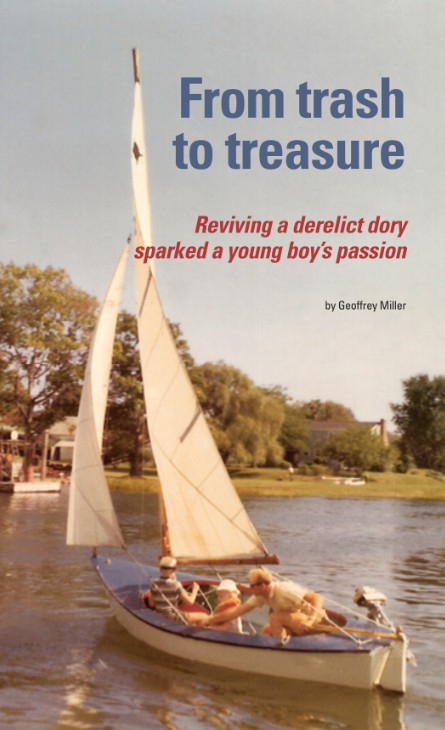
We rescued Hee Haw from death at the hands of a boatyard employee armed with a can of gasoline and a match. She was a 16-foot open sailing dory, but to a 7-year-old boy, she was the sovereign of the seas.
It was the spring of 1968, and my father was looking for a small family daysailer for the Connecticut shore of Long Island Sound. At a local marine store, he was offered several fiberglass boats, but in those days, hard as it is to believe now, there was still considerable prejudice against fiberglass sailboats. They were heavy, ugly, and people wondered if, on a hot afternoon, the fiberglass would return to the state of goo from whence it had come.
Then, in a back corner of the boatyard, an old deteriorating Grand Banks dory caught Dad’s eye. I watched curiously as he probed her with his pocketknife. He explained that there was some rot in the centerboard trunk, but the keel and frames were sound and the plywood planking was OK. She was a sad mess to look at. The paint was peeling and her mast, rudder, tiller, and rusty metal centerboard lay on the ground beside her. The salesman said this boat was beyond repair and they were going to burn it to salvage the bronze fastenings. However, she had a beautiful suit of cotton sails: a mainsail and two jibs. No one knew her history or why a derelict would have a suit of almost-new sails. Dad bought the sails for $100 and the salesman, thinking Dad was nuts, threw in the dory.
The next morning, we went to get her with a rented boat trailer and the help of a neighbor who, when he saw the boat, also looked at my father as if he were nuts. But I never doubted my father’s sanity. We had our very own boat.
As they loaded her onto the trailer, Dad told me to go find the sail battens. I had no idea what sail battens were. He explained and off I went, picking up every stick of wood in the yard that fi t his hasty description. Unaware that we only needed three, I returned with an armful of wooden slats and tossed them into the trunk of the car. We now had a set of sail battens and enough paint stirrers to last us 10 years. Then we took our new yacht home.
The apprentice boatbuilder
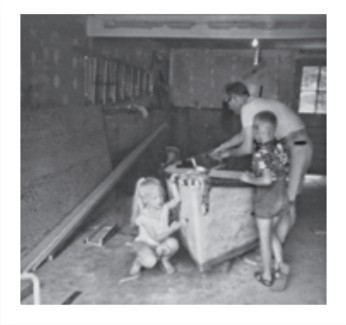
Throughout the following months, we spent our weekends working on Hee Haw. I was learning about boat carpentry and having a great time. When we went to a local lumberyard that sold marine-grade lumber, I couldn’t understand why Dad would sort through an entire stack of boards, pick out one or two, and then restack what he didn’t want. The wood on the top of the pile looked OK to me. But he taught me how to properly select lumber, especially for structural marine carpentry. The skills I learned while working on that boat, even little things like rubbing wood screws on a bar of bath soap to make them easier to drive, still serve me well today.
We replaced the centerboard trunk and everything else that was even slightly doubtful. I learned that “the best part of perfect is that sometimes it’s ‘good enough.’” I lived by this philosophy as an aircraft mechanic and a flight engineer throughout my 24-year Air Force career.
The dory’s hull was open, without decks, so we added decks that surrounded an elliptical cockpit. We sanded the entire boat nearly to bare wood and repainted it. We fastened an oak motor mount to the starboard quarter because a dory’s tombstone transom is too narrow for both an engine and the rudder. The steel centerboard was slightly bent and wouldn’t pivot without jamming in the trunk, so we hastily set it up as a daggerboard. We refinished the mast and fitted it with a tabernacle to make it easier to raise and lower.
I enjoyed shopping for equipment for the “new” boat. I thought all that shiny new marine hardware was fascinating. Now, at nearly 50, I still find shiny new marine hardware fascinating. We bought most of our equipment at a nearby surplus store that had all kinds of neat stuff. Standing in the middle of the store was an old throttle stanchion that must have come off a battleship. It had the lever marked with “full ahead,” “full astern,” and so on. I wondered why we couldn’t use this in our boat.
Launching day
Sometime in mid-August, Hee Haw was ready to go. We rented the trailer again and loaded her the evening before the launching. The only thing she needed was floorboards. Dad quickly made some out of scrap wood and slapped some paint on them. They were just slats nailed together to lie on the floor timbers, but they would do for what little remained of the New England sailing season.
It was a beautiful day in August 1968 when we brought Hee Haw to the launching ramp on the Housatonic River. Although it was more than 40 years ago, I remember that day as if it were last week.
Dad and I towed the boat behind the Chevelle while Mom and my 6-year-old sister, Robin, followed in the Corvair. Dad set up the mast and rigging once Mom returned from a nearby chandlery with some crucial parts — possibly replacements for clevis pins that had jumped overboard.
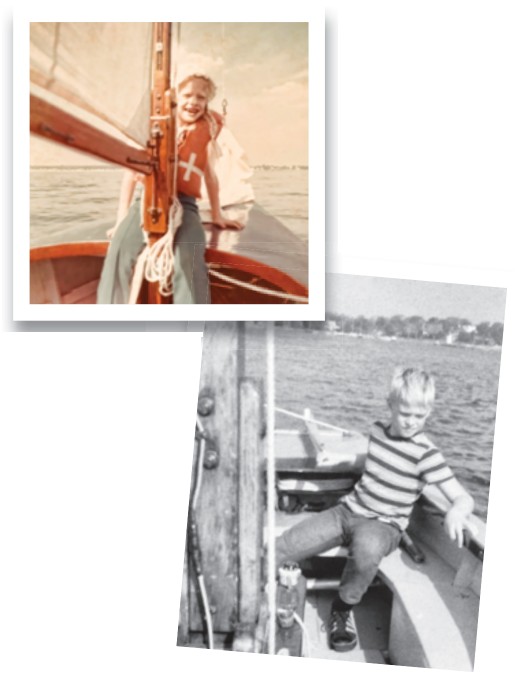
When the rig was ready, Hee Haw was launched at long last and anchored a few yards from shore. Dad scooped me up in his arms and, wading out to the boat, put me aboard. As he was climbing aboard himself, he remembered something he needed to get from the car. Wading back to the launching ramp, he saw a look of horror cross my mother’s face. He had left the boat, thinking I was safely stowed for the moment, but I had jumped into the 4-foot water to follow him back to shore. The fact that I could neither swim nor keep my head above water hadn’t occurred to me. He turned around, put me back into the boat, put a life jacket on me, and told me in no uncertain terms to “stay put.”
The maiden sail
Mom left with Robin to return the trailer while Dad and I departed on our maiden voyage. We only had to start the outboard and haul up the anchor. The outboard was a brand-new Sears Roebuck 3-hp motor. Dad had run it that morning to make sure it was ready. It started right up on the barrel, but now it was on the boat. He pulled the starter rope maybe a dozen times but it wouldn’t start. Although I didn’t know it at the time, there was ironic humor in this because the name Hee Haw was taken from a boat my great-grandfather had in the early 1900s. It had a very stubborn one-lung engine that would start with great difficulty, sputter for a few seconds, and then quit, making an “eee-aaw” sound as it stopped.
Anyway, in my memory it seems as if my father pulled on that starter rope for hours. Eventually it started and away we went down the Housatonic River toward Long Island Sound. And so began my very first boat ride on what was truly the quintessential good old boat.
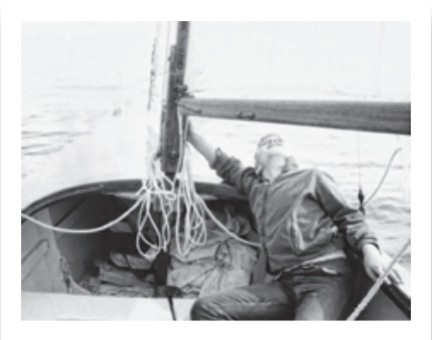
As we headed down the river, Dad let me steer as he got the sails ready. I remember him telling me to just move the tiller the opposite way I wanted to go. Now that I was a fully qualified helmsman, I was ready to sail. A little farther down the river we hoisted the sails, shut down the motor, and approached Long Island Sound under sail. As we entered the Sound, I could see land far away on the horizon.
My mother had often spoken of her childhood home in Germany, and had explained that Germany was a country far away on the other side of the ocean. When I saw what appeared to be a faraway land on the horizon, I was sure it was Germany. I asked Dad if someday we could sail to Germany and see where Mommy came from. He laughed and explained that the faraway land I was seeing was Long Island, about 12 miles away. I was disappointed.
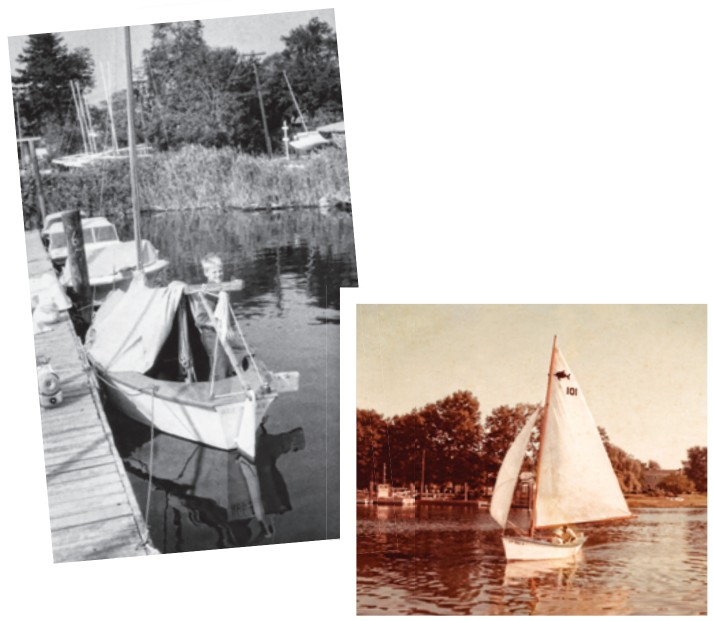
We turned east toward Milford and sailed around Charles Island to the beach where Mom and Robin were waiting for us after they returned the trailer. Then the four of us set sail back toward the river.
It was early evening as we sailed into the mouth of the Housatonic River, which was very congested with boat traffic heading in the same direction. Dad dropped the sails and started the outboard as the wind went down with the sun. We made our way up the river, fighting the outgoing tide, until we finally reached the launching ramp. Mom and Robin jumped off so they could pick up the Corvair and drive to my aunt and uncle’s house farther up the river where we were going to dock the boat. After Dad lowered the mast into the boom crutch so we could pass under a railroad trestle, we got under way again.
By now, it was dark. Very dark. To get to my uncle’s dock, we had to leave the main channel and navigate through narrow creeks that wound through the marshes. In daylight, this wasn’t difficult; their house was easy to spot from the main channel. But finding our way in darkness with only a battery lantern wasn’t so easy. We followed what we thought was the right creek, but it brought us to a restaurant a mile or so farther up the river than we wanted to be. Once Dad knew where we were, we turned back and soon found Uncle Jack’s dock. The boat was put away and we went back to Milford to retrieve our other car and then went home. And so concluded one of the most memorable days of my entire childhood.
A confirmed sailor
For the next two months we sailed nearly every weekend. By summer’s end, I was hooked. My sister became an avid sailor as well. My mother appeared to have a good time, but I found out years later she hated every minute of it. I think it might have had something to do with the time we were late getting back to Uncle Jack’s dock with a rapidly falling tide. I’m reminded of that day whenever I watch Katharine Hepburn drag the African Queen through the swamp. Fortunately, there are no leeches in the Housatonic River. If there were, I think Hee Haw would have met the fate that she narrowly escaped at the boatyard. It wasn’t until 17 years later, when they bought a very comfortable Hallberg-Rassy 29, that Mom finally realized that the phrase “g**d***boat” was actually three separate words.
Although I was quite prone to seasickness as a child and spent many afternoons leaning over the leeward rail, I never tired of sailing. Robin would curl up on the sailbags and spare life jackets under the foredeck and read. No matter how badly the boat got tossed around, she never got seasick.
When that first season ended, we hauled Hee Haw home and put her away for the winter. The following spring, we made new seats with storage lockers beneath them and properly fitting floorboards. The sheets kept snagging the slats; one day when we jibed, half the floorboards flew up out of the bilge and went overboard. My grandfather had a friend in the steel business who gave us a piece of stainless steel for a proper centerboard that could be raised and lowered with a lanyard.
The following year, we kept the boat in Milford Harbor because motoring down the Housatonic River to the Sound and back took most of the day by itself. The Sears outboard, which we needed to push us up the river against a 4-knot tide, was replaced with a quieter and lighter Evinrude Mate “horse-and-a-half,” which I still have. A year or two later, we finally got our own trailer.
Lessons for life
I learned a lot while working on and sailing Hee Haw. I learned about carpentry, sailing, small-boat handling, and basic seamanship. As we sailed, Dad taught me to splice rope and tie bowlines, square knots, and clove hitches. These lessons were great because I wanted to learn everything I could about sailing, and they also kept my mind occupied, which minimized the seasickness. For some reason I was never able to master the sheet bend. I can still eye-splice, back-splice, and long-splice, but I cannot tie a sheet bend to save my life.
The most important lesson I learned was that if something worked well once, it can usually be made to work again. Even though someone said Hee Haw was beyond repair, we repaired her and enjoyed her immensely for seven years. Since then, I have fixed many things, some of which I probably should have thrown away, only because someone told me, “That can’t be fixed.”
My own career was quite different from my parents’ careers, so I wasn’t able to share the good-old-boat lifestyle with my kids in the same way that my parents shared it with me. But last year, my daughter, who was 18 years old, spoke of one of her fondest childhood memories. When she was 5 years old, she and I would motor up and down the Suisun Slough in northern California in the 7-foot-11 Dyer Dhow that’s been in the family since I was 11, powered by the Evinrude horse-and-a-half. That was the only boat I had at the time and I never realized how much those trips meant to her until last year.
We enjoyed Hee Haw until 1975, when we sold her because we had completed our next garage project. Her successor, Robbery, was a 21-foot Ted Brewer-designed cruising/racing sloop that Dad, Robin, and I had built from scratch. I had a difficult time dealing with the prospect of parting with Hee Haw at first, but we were beginning a new era of sailing for our family. And that is another story for another time.
Geoffrey Miller was born and raised in southern Connecticut. He sailed on Long Island Sound from age 7 until he enlisted in the U.S. Air Force in 1983. In 2007 he retired from active duty and settled in upstate New York, where he works as a manufacturing engineer for a major corporation. Geoff and his son sail their Laser on Saratoga Lake.
Thank you to Sailrite Enterprises, Inc., for providing free access to back issues of Good Old Boat through intellectual property rights. Sailrite.com