A Latin beauty for bluewater cruising
Issue 84 : May/Jun 2012
I first saw a Cabo Rico at a sailboat show in the early 1980s and was smitten. However, as I was retired from the Marine Corps on half-pay, she was far beyond my means. It wasn’t until last fall, some 25 or so years later, that I was again able to get up close and personal with a Cabo Rico.
I was holed up in Barber Marina, just across the ICW from Orange Beach, Alabama, waiting for strong northerlies to abate. As has often happened when cruising alone, I was seen as an orphan and invited to a potluck on the dock. There I met Linda and Mike Nixon, owners of Voyager, a Cabo Rico 38, who invited me aboard for a look. She was gorgeous and, in spite of being 15 years old, looked like new.
Design
When I checked the Internet for information, I found a muddied history regarding the design heritage of the Cabo Rico 38. Generally, W. I. B. “Bill” Crealock is credited with the design, and company literature lists him as the designer. However, other sources say the builder, Fibro Technica, created the 38 by having general manager Dennis Garrett stretch and modify its unpopular Tiburon, a 36-foot ketch that did come from Crealock’s board. Adding to this mystery is an early Cabo Rico 38 spec sheet (ca 1981) that lists Garrett as the designer with no mention of Crealock. This conflicts with a reported quote by Bill Crealock: “The Cabo Rico 38 hull shape is the one in which everything came together best. Designed with a low profile to eliminate excessive freeboard, the 38 can make excellent headway in high wind conditions where reduced leeway is so critical.”
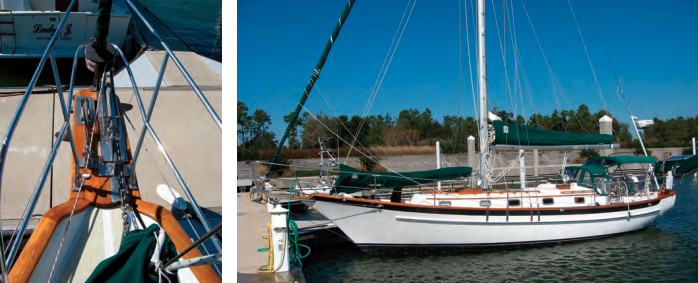
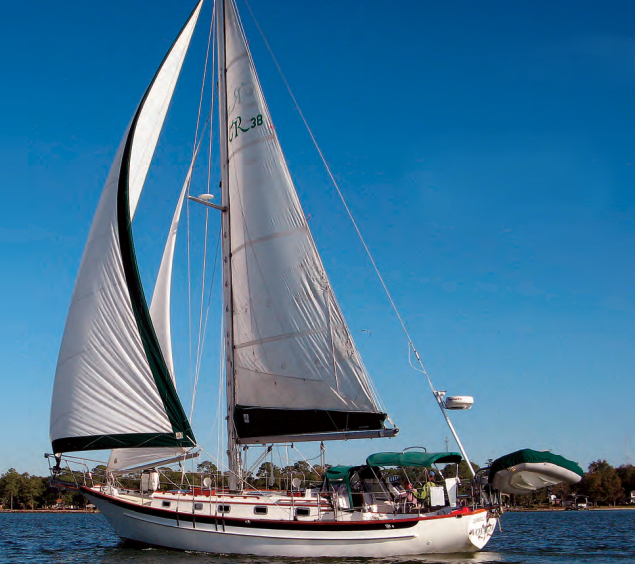
Regardless of this cloudy heritage, the profile of the Cabo Rico 38, from the clipper bow to the moderately full stern, does indeed reveal her purpose: safe, comfortable passagemaking, whether island-hopping the Caribbean or sailing around the world. The long full keel eases the steering burden on both the helmsman or wind vane/autopilot, and the low freeboard and cabin trunk minimize windage and ease the going when a slog to windward is necessary.
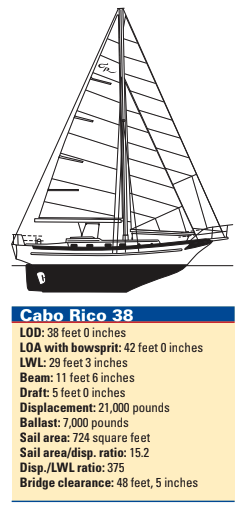
The cutter rig and bowsprit distribute the sail area fore and aft, keeping the center of effort of the sailplan low, which has the beneficial effect of reducing heeling. The side benefit of lower mast height will be especially important to Gulf Coast sailors who are cursed with several 50-foot bridges along the Intracoastal Waterway. Nevertheless, looking up from the helm while your 48-foot 5-inch mast approaches a 50-foot bridge can be heartstopping. The bowsprit also provides an excellent place to stow anchors and an ample platform from which to deploy and retrieve them. The relatively high bow on the Cabo Rico 38 may, however, give the boat a tendency to sail at anchor.
Construction
Built in Costa Rica, these Latin beauties are much more than pretty faces. Hull construction is unconventional. As with most fiberglass boats, there is a core, in this case 1/2-inch balsa. Fraser Smith, who with his wife, Edi, bought the company in 1987, says that the core is for insulation, not structural strength. A solid fiberglass hull is laid up, then the balsa insulation is added and covered by layers of mat and roving.
Cabo Rico publishes its laminate schedule, a rare practice in the boat-building business. Over the years, the company has used improved fiberglass fabric products in the laminate as they became available. Where older boats had hulls of alternating layers of mat and woven roving, more recent models incorporate a skin coat of proprietary mat that has no starch binder — starch is hygroscopic and promotes blistering. Next is the laminate, a mix of unidirectional and biaxial S-glass or E-glass roving stitched to mat. Vinylester resin is used in the first three layers next to the isophthalic gelcoat to reduce the likelihood of osmotic blistering.
The keel is molded with the hull. Seven separate castings are placed in the keel cavity and surrounded with resin. The ballast is then glassed over to encapsulate it. Cast iron was used in the earlier boats; in later models it was lead, to lower the center of gravity and increase the righting moment (and because lead won’t rust should water find its way into the cavity).
The decks and cabintop are cored with end-grain balsa. Where hardware is to be installed, the core is removed. More recently, stainless-steel plates were glassed in and drilled and tapped to accept hardware fasteners.
The hull-to-deck joint flanges are bedded in 3M 5200 and through-bolted on 6-inch centers, creating the U-shaped bulwark that adds strength and rigidity to the sheer. A beautifully fashioned teak cap tops the bulwark and covers the joint.
Fiberglass moldings are used for the engine beds, shower, and icebox. Otherwise, the interior is built, piece by piece, entirely of wood (teak, mahogany, ash, cherry, maple, and other hardwoods to suit the buyer). Plywood is used as appropriate and solid lumber is used lavishly for doors and frames, ceilings, fiddles, and drawer faces. Bulkheads and furniture are tabbed to the hull.
Throughout, the high quality of the construction is obvious. Fraser Smith credits his Costa Rican work force for this. He is quoted in The World’s Best Sailboats, Volume II, as saying, “I have one of the best construction crews in the world. The beauty of building in Costa Rica is that we can afford to put in more time. And we can afford such luxuries as three engineers on staff.”
The deck
Many of the early Cabo Rico 38s had teak decks laid over fiberglass. Teak decks are beautiful and have excellent non-skid properties but they also add weight and raise interior temperatures. Worse, as the teak ages and becomes worn, plugs covering the fasteners are likely to pop out. This allows moisture to migrate down the fastener into the core, resulting in rot and delamination. Repairs are enormously expensive. A prospective buyer should approach the purchase of a teak-decked boat with great care and have it thoroughly inspected by a knowledgeable surveyor.
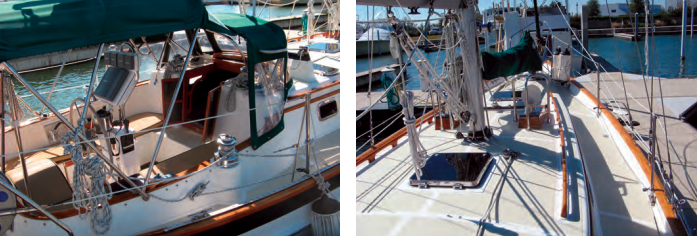
The sidedecks on the Cabo Rico 38 are wide and uncluttered and benefit from having well-placed teak handrails nearby. Ample bulwarks help crew to move forward and aft in safety. A moderate crown to the cabintop allows easier movement to the mast. The staysail boom, however, makes the journey from one side of the boat to the other a little long. Interior ventilation is provided by three overhead hatches, three Dorade vents, 10 opening ports, and the companionway hatch.
The cockpit is smallish, which is appropriate for an offshore boat, yet still comfortable. A bridge deck keeps water from the interior should a boarding sea enter the cockpit. The seats are long enough to recline on and the coamings are high enough to provide adequate back support. I especially liked the raised and crowned helm seat; however, on Voyager the oversized chart plotter mounted on the binnacle pedestal raises the instrument pod so that it interferes with forward visibility. Stowage space is provided in a large locker under the port seat and another beneath the aft deck. A hand- held shower recessed in the coaming is handy for rinsing off after a swim.
Interior
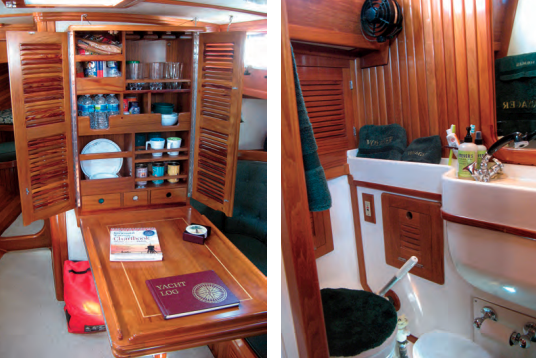
Voyager’s interior is stunning. Honey-colored teak harvested from plantations in Costa Rica is all around and, when the doors to the head and shower are closed, no fiberglass at all is visible.
The interior layout is traditional. Immediately to port as you enter is the U-shaped galley. This is well-equipped with a double sink (supplied with hot and cold pressure water), a two-burner propane stove with oven, an 8-cubic-foot refrigerator, and a microwave oven. A rail is fitted to protect the cook from the hot stove and fittings are provided for attaching a safety belt. The many lockers and bins provide good storage.
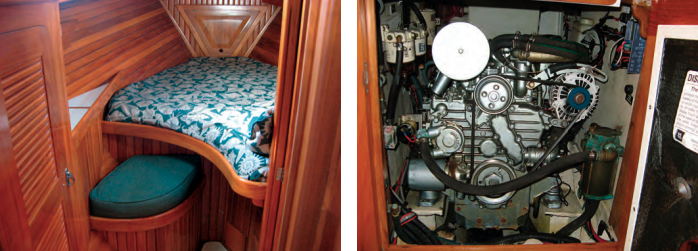
Opposite the galley is the navigation station. It can be closed off with a sliding louvered panel and a bi-fold door to provide a private dressing space adjacent to the quarter berth immediately aft. This berth is 88 by 39 inches, which is a little snug for two but adequate. Outboard of the fold-down navigation table is a hanging locker.
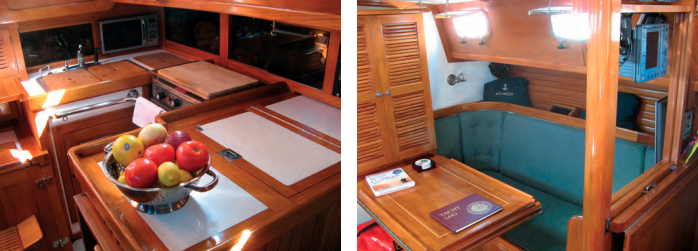
Farther forward on the starboard side is an L-shaped settee that converts to a double berth. Only 71 inches long by 42 inches wide, it would be best used for children. However, since it’s in the middle of the main cabin, it would most likely be used for sleeping only when more than four are aboard.
On the main bulkhead is a clever cabinet to which the fold-down dining table is attached. Lowering the table reveals double louvered doors and, behind them, compartmented shelving for dinnerware. The dining table is
hinged down the middle. When opened, it extends to the settee on the port side to accommodate up to six diners, although it restricts access to the head.
Next on the starboard side is the head with adjoining shower. Both are a little cramped. The passageway to the forward cabin is offset to port to gain as much space as possible.
Opposite the shower is a generous hanging locker and just forward of the shower is the head of the offset double berth in the forward cabin. In addition to the hanging locker, a smaller locker, a couple of drawers, and shelving are arranged on both sides of the cabin.
Shelves, cabinets, or drawers in every conceivable space provide a place for everything. When everything is in its place, living is pleasant and gear stays put when the going gets rough.
Fiberglass tanks for water, fuel, and holding are located in the keel, just above the glassed-in ballast where the weight will do the most good. On Voyager, water and fuel capacity are 100 and 110 gallons respectively.
Over the years, Cabo Rico offered several interiors, including a pilothouse version. Because Cabo Rico offered the buyer much control over the arrangement, few 38 interiors are exactly alike.
The rig
The sail plan is a conventional cutter rig with a single-spreader keel-stepped mast supported by a forestay, staysail stay, backstay, single uppers, double lowers, and a pair of shrouds led aft to take up the loads from the inner forestay. The chainplates are attached to the outside of the hull, which makes the sheeting angle for the jib a little wide. The jib is set on a roller furler and the club-footed staysail is hanked on.
On Voyager, the mainsail is full-battened and, when dropped, is captured by a Doyle StackPack. Sheeting is mid-boom and led to a traveler mounted on a molded-in base that spans almost the width of the cabintop just forward of the companionway. Jibsheets are controlled by two Barient #27-48 two-speed self-tailing winches. Two Barient #34 self-tailing winches control the main halyard and sheet. At the mast are two Lewmar #16 self-tailing winches, one for the jib halyard and one for the staysail halyard. A three-part vang limits boom lift.
Performance
The engine in Voyager is a four-cylinder 44-hp Universal diesel that Mike says he has found more than adequate. Various engines were installed over the long production run; the most recent ones are Yanmars. As we backed out of the slip, the fresh breeze against the high bow kept us from turning into the wind. Undaunted, Mike used the wind on the bow, together with finesse, to help him back between the rows of slips to the marina exit.
Once out of the marina, we raised sail. Getting the main up proved difficult. Mike and Linda’s previous sail had been in a fresh breeze and they had put a reef in the main. Shaking it out was encumbered by the friction inherent in the single-line reefing system. Mike tugged and fussed with the reefing line while I hauled on the halyard and we eventually got it hoisted.
We got under way flying the 120 percent genoa, staysail, and main. Conditions were not ideal for a test sail: the breeze ranged from 4 to 6 knots. Numbers don’t lie: with a displacement/length ratio of 375 and a sail area/displacement ratio of 15.2, the Cabo Rico 38 is not a sprinter.
Tacking was a stately maneuver, as one would expect from a full-keel, heavy-displacement boat, but there was never a doubt about her coming across the wind, even in the light air. One inconvenience of sailing a cutter rig, as this test sail reminded me, and more so with a genoa rather than a Yankee on the forestay, is the frequent need for someone to go forward to help the sail pass between the forestay and the inner forestay. Of course, when cruising offshore, tacking is infrequent.
While the Cabo Rico 38 was designed and built for safe, comfortable passagemaking offshore, apparently enough owners race their boats between passages to Bora Bora that a few boats have been issued Performance Handicap Racing Fleet (PHRF) ratings, the average being 186 seconds per mile. For comparison, the Cape Dory 36 rates 171 and the Island Packet 35 rates 186.
Conclusions
All sailboats are purpose-built, although some try to broaden their appeal by being racer/cruisers or cruiser/racers. The purpose of the Cabo Rico 38 is specific: cruising under sail, whether coastwise, through the islands, or crossing oceans. And it will do these things as well as or better than other sailboats of similar size and design while being the prettiest in its fleet.
Construction quality is top-notch in materials and fit and finish. My close-up acquaintance with high-end sailboats is mostly with Hinckleys, specifically the Bermuda 40 and Southwester 42, which are widely regarded in the U.S. as setting the high-water mark for quality. I won’t say the Cabo Ricos surpass the Hinckleys in this regard, but if the people in the front offices of the Hinckley company glance aft, they might see a Cabo Rico close behind.
Quality, of course, doesn’t come cheaply. My Internet survey of used Cabo Rico 38s for sale reveals asking prices of $69,900 for a 1979 and a high of $279,900 for a 2005. The fairly wide difference in price between the older boats and the newer reflects not just aging but also Cabo Rico’s policy of incorporating technical advances in materials, such as vinylester resins to combat osmotic blistering and the latest in fiberglass fabrics.
The major caution for prospective buyers is to have a competent surveyor examine the decks of any boat with teak overlays. Repairs can be dauntingly expensive. This would mostly be an issue with older boats, as the builder says that it has been several years since a buyer has ordered teak decks. As with all pre-vinylester resin fiberglass boats, check for osmotic blisters, another expensive repair item.
Paul Ring is a contributing editor with Good Old Boat. He has sailed, repaired, modified, restored, and built boats for the past 44 years and currently sails his Nonsuch 260 with first mate, Barbara Brown, out of Fairhope Yacht Club on the Eastern Shore of Mobile Bay. Paul also enjoys carving wood and sculpting clay.
Thank you to Sailrite Enterprises, Inc., for providing free access to back issues of Good Old Boat through intellectual property rights. Sailrite.com