. . . with a contemporary and a successor
Issue 84 : May/Jun 2012
Note: Ted Brewer selected the boats and tabulated the data but, due to unforeseen circumstances, was unable to write for this issue his three-boat comparison that follows each feature-boat article. We turned to Dan Spurr to fill in. –Eds.
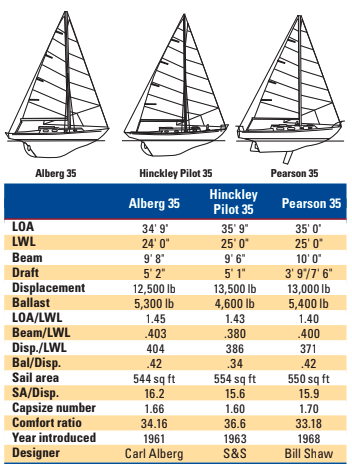
Comparing two boats of the same length from the same builder but from different eras is useful and informative. Throw in an early Hinckley and the mix gets really intriguing. In automotive terms, it may seem we’re comparing two Chevys to a Rolls-Royce. Let’s look deeper.
The Alberg 35, the second auxiliary sailboat built by Clint and Everett Pearson, appeared in 1961, two years after the Triton. Along with the 32-foot 6-inch Vanguard and 43-foot Countess, the entire model line of early Pearsons had full keels with attached rudders, short waterlines, low freeboard, and other features that typified boats designed to the CCA (Cruising Club of America) racing rule. Their uncored fiberglass hulls were thought to be an inch thick, even more in the turn of the bilge. The myth was that Pearson didn’t know how strong fiberglass was so they laid up a laminate to the same thickness of a wooden boat of that length.
Years ago, Everett told me that was baloney. “Of course we knew how strong the laminate had to be,” he said, offended that anyone would think him that dumb. Lab tests were performed. As a previous owner of a Triton and a Vanguard, I can tell you that neither of these hulls was an inch thick even at the turn of the bilge, and certainly not in the topsides. But they are strong enough to take offshore. And that’s where the Alberg differs from the later Pearson 35.
Designer Bill Shaw came to Pearson Yachts in 1964 and four years later designed a new 35 to replace the Alberg 35. The new 35 was conceived as a fun, family coastal cruiser, albeit with a decent turn of speed. The cockpit is more than 9 feet long — hardly suited to bluewater sailing but great for a sunset sail with a lot of friends. Unlike the Alberg designs, the Pearson 35 is a keel/centerboarder, offering shoal draft for gunkholing. Again, this is not a feature that appeals to many offshore skippers, but it’s necessary for sailing in places like Florida Bay and the rivers that feed Chesapeake Bay.
Under Bill Shaw, construction methods began to change too. Whereas the Alberg 35 had no fiberglass interior parts, and the bulkheads were tabbed to the hull and deck, the Pearson 35 has an overhead liner, which precludes tabbing to the deck — a nicer finish, perhaps, but with a tradeoff. And the Pearson 35 has a fiberglass rudder, unlike the Alberg’s, which is wooden.
The Hinckley Company made the switch from wood to fiberglass with the Bermuda 40, introduced in 1959. Glass was obviously the future of recreational boatbuilding, so the company’s next project was to convert the 32-foot 11-inch Pilot to the new material. Sparkman & Stephens, the designer of the original wooden Pilot, was commissioned to update it for composite construction; the result was a longer hull with more freeboard. It was very well built — probably no stronger than the Alberg but better finished. Much of the higher cost of a boat from a company like Hinckley is in the man-hours spent on the interior, not in the hull and deck layups. The company liked to say it built a wooden boat inside a fiberglass shell. That’s what you pay the Rolls-Royce dollars for — the chassis is essentially Chevy.
Dan Spurr is Good Old Boat’s research editor. He is also editor-at-large with Professional Boatbuilder, former senior editor at Cruising World, former editor at Practical Sailor, and the author of seven books.
Thank you to Sailrite Enterprises, Inc., for providing free access to back issues of Good Old Boat through intellectual property rights. Sailrite.com