Marine adhesive caulks are put to the test
Issue 84 : May/Jun 2012
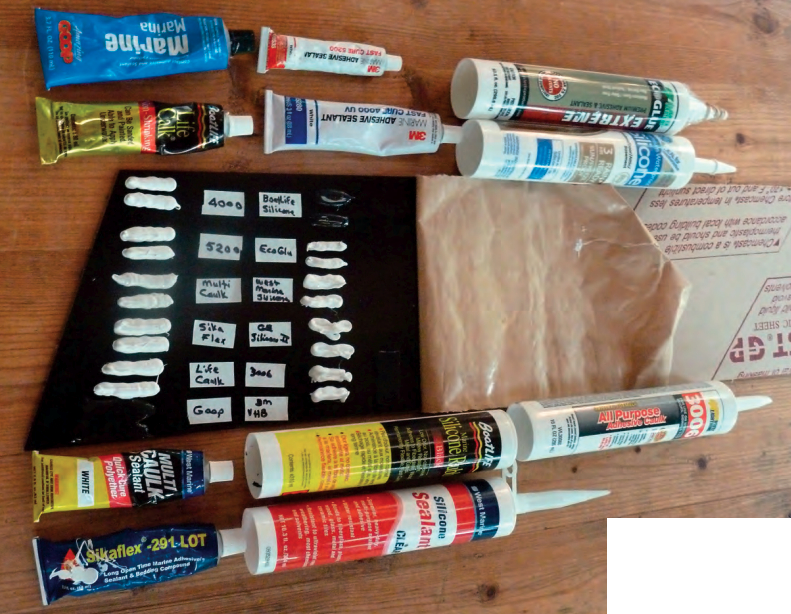
After experiencing poor adhesion results when replacing an acrylic port on my 1985 Hunter 28.5 sailboat, I decided to test a number of available marine adhesive caulks on this plastic. The plastic is Chemcast GP Cell-Cast Acrylic Sheet. The original caulk was BoatLIFE Black Marine Silicone Sealant (retested here with the others). The caulk adhered nicely to the fiberglass but not to the acrylic.
I had read about 3M VHB (very high bond) adhesive foam tape in Good Old Boat and included it in the test. It was 45-mil-thick, 0.75-inch-wide black VHB double-stick tape. I cut a 1-inch piece, applied it to the acrylic, and let it set for three days. The manufacturer says the bond gets stronger with time.
I removed the protective paper from the new acrylic plastic sheet and cleaned the plastic with both Windex and isopropyl alcohol. In a preliminary test, I found that cleaning was absolutely necessary for a decent bond. I applied a 2-inch, double-width bead of each caulk to the plastic at a temperature of about 70 F inside my air-conditioned home with relatively low humidity. I let the caulks cure for 10 days, exceeding the longest manufacturer-specified cure time. Then, with the expert assistance of my 11-year-old grandson and 7-year-old granddaughter, I attempted to remove each caulk bead. I applied both shear (parallel to the surface) and tension (perpendicular to the surface) forces by hand. The combined shear/tension results are presented in the table.
The clear winners were 3M 4000 and GOOP. Both were extremely tenacious. The 3M VHB tape also had a very good showing. My plan is to run the tape around the perimeter of the window about 0.5 inch in from the edge and push it onto the boat’s fiberglass port cutout. I will then inject the white 3M 4000 into the 0.5-inch gap all the way around as well as run a beveled sealing bead around the window’s edge. With this approach I’ll have the holding power of the tape and caulk plus the sealing of the caulk.
Ferman Wardell began sailing an 11-foot Styrofoam Snark on a 30-acre lake in North Carolina. He later owned a 12-foot Scorpion, a San Juan 21, and now Wind-Borne, a 1985 Hunter 28.5, which he cruises and races on Lake Norman near Charlotte, N.C. He has sailed extensively in the Caribbean. Ferman enjoys doing boat maintenance, repairs, and “improvements.”
Thank you to Sailrite Enterprises, Inc., for providing free access to back issues of Good Old Boat through intellectual property rights. Sailrite.com