Having circled the Americas, he’s now focused on the oceans
Issue 91 : Jul/Aug 2013
By the time you read this, with luck, Matt Rutherford will be back at sea. Aboard his newly refitted Colvin Gazelle, the R/V Ault, Matt will be heading into the empty swath of ocean between Bermuda and the Azores, collecting data on the Atlantic garbage patch and filming for a documentary. It will be the first of a series of expeditions that will reach all corners of the globe, from the Northwest Passage to Micronesia and the Antarctic. After his many years sailing, and the thousands of miles he sailed solo on his voyage around the Americas (see “A Sailor, a Boat, and a Quest,” September 2012), Matt wants to give back.
“I caught the bug a little bit with the Around the Americas trip with CRAB,” he says. After successfully negotiating the Northwest Passage, Matt and his 27-foot Albin Vega, St. Brendan, started attracting real attention from the sailing public and, by the time he returned to Annapolis, Maryland, in April 2012, they had managed to raise over $100,000 for CRAB (Chesapeake Region Accessible Boating).
Once home again, Matt launched the Ocean Research Project that fall with the aim of exploring the world’s oceans, collecting scientific data, educating and entertaining the public about the oceans, and inspiring action to change them for the better. It is easily his most ambitious project to date, but the success of the CRAB partnership has bolstered Matt’s confidence. The Ocean Research Project received its official 501(c)(3) nonprofit designation in December with the help of Iowa Senator Tom Harkin, author of the Americans With Disabilities Act and one of Matt’s most public supporters during the Americas trip.
A vessel and a crew
The new project’s first order of business was finding a boat, a crew, and the money necessary to make it all work. Despite the fact that he owns two boats — the Vega and his Pearson 323 — Matt was once again searching the listings.
“Finding a metal expedition vessel here in the States is difficult,” Matt says. Most of the metal boats he located were either home-built designs only partly finished or fancy aluminum or steel yachts far too expensive for the Ocean Research Project’s budget.
A 42-foot steel Colvin Gazelle schooner finally turned up. Matt bought her and named her Ault, after the U.S. Navy ship his grandfather served on during WWII. He sailed her north from Florida in December and immediately started disassembling her, despite his comment that she was “ready to roll . . . more or less.” Matt took out a personal loan to buy the boat. It is the age-old “chicken and egg” conundrum: theOcean Research Project needed to raise money to get the boat, but it needed the boat in order to raise the money.
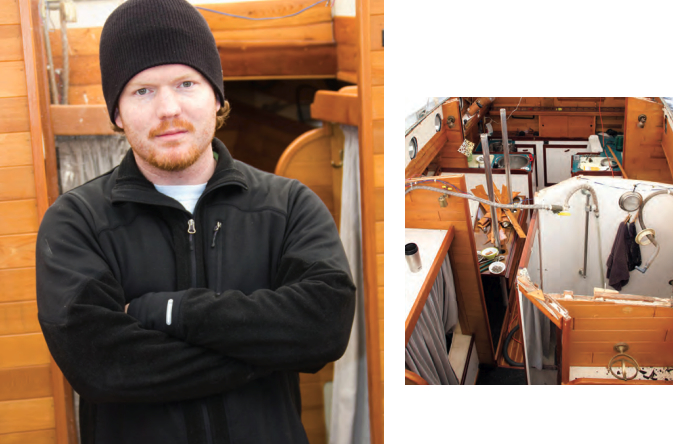
When I first saw her in Annapolis in February, Ault was still in the water but under a shrinkwrap cover with the rig pulled and the deck torn open. You could step from the sidedecks right onto the saloon table. The place was a mess. It reminded me of when St. Brendan was in a similar state of disrepair only a month or so before Matt set off on his historic journey. Matt knew this work was coming and he enjoys it. “I needed something labor-intensive, not money-intensive,” he jokes when explaining why he picked the Colvin.
Matt has help this time. Nicole Trenholm has become an integral part of the Ocean Research Project now that it’s fully operational. Nicole (Nikki) works for NOAA aboard a 55-foot aluminum catamaran that operates out of Solomons Island, Maryland, and is used for research on Chesapeake Bay. Each one of its three-person crew is equally responsible for all the systems on board, carrying out the research, and commanding the boat. Nikki has a rare combination of youthful exuberance, hard-earned scientific-research credentials, and big-boat operating experience that makes her a perfect fit with the Ocean Research Project. She has agreed to join Ault’s first expedition into the Atlantic and she is not afraid to get her hands dirty.
Rig modifications
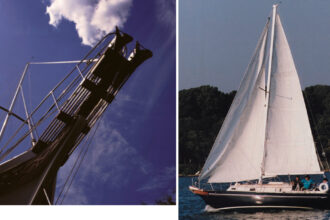
Ault was previously junk-rigged, as a lot of the Colvin designs were, with freestanding aluminum spars and a long bowsprit, of which only a short stump remains. Somewhere along the line, someone turned her into a cat-rigged schooner of sorts, keeping the freestanding spars but bending on Marconi-type sails. The masts are nearly equal in height with the foremast right at the bow. The sail plan could not get much simpler.
“I’m going to take the furler and jib off St. Brendan,” Matt said as he showed me around on deck. His plan is to have a new bowsprit fabricated in Annapolis and welded to the stump of the original to add about 150 to 200 square feet of sail. With a pilothouse aft (ideal for the high-latitude sailing Matt expects to do in 2014 and beyond), the boat appears to adventure be more of a motorsailer than it really is. “This thing will actually get up and go,” Matt says, “and that extra bit of sail forward should make a difference.”
The freestanding masts create complications because of the type of sailing Matt plans to do. Very long ocean passages and trips to the Arctic and Antarctic will put enormous stress on the rig.
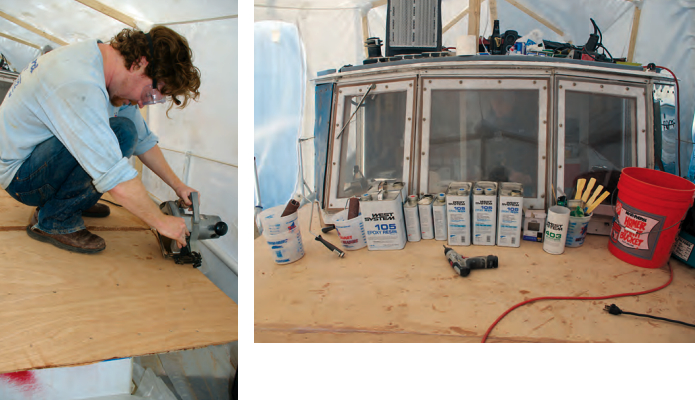
“We need to add running backstays and a few fittings on the masts to help reinforce things,” Matt says. “Riggers always tend to be on the cautious side, but they are especially so now.” Because the tapered round shape of the mast section and its ability to flex is what gives the masts their strength, any additional fittings will be welded on or attached with special collars. “We’ll also put Strong Tracks or something similar on the masts for the main and foresails,” he continues. “Hyde Sails is making us new fully-battened sails, each with three deep reefs, and all the sail controls will lead into the pilothouse,” he adds while pointing out a couple of winches on the pilothouse roof that will need to be relocated inside to accomplish that. “Plus we’ll get all new pilothouse windows made from high-strength plastic, the same stuff the Vega has.”
At this stage, Matt’s list was long and new items were being added faster than others were getting checked off. But that said, Matt should have a master’s degree in resourcefulness. The same persistence that made his Americas voyage successful on a shoestring has carried over to Ault and the Ocean Research Project. Scanmar has agreed to support him and will provide Ault with a Monitor self-steering system. PredictWind will again be his source for weather data and satellite communications offshore, and a number of local businesses in Annapolis are kicking in their own support, among them Port Annapolis marina where Ault is currently berthed.
Making a research vessel
Since science and education make up two-thirds of the Ocean Research Project’s mission statement (the third, Matt’s favorite, is exploration), Ault needs to be fitted out as a research vessel. To that end, he has secured sampling nets he’ll mount on the expansive deck aft of the pilothouse. He’ll store other scientific odds and ends in the aft cabin.
Extra fuel tanks will be fitted to extend the boat’s range under power to nearly 1,700 miles, an important factor when operating in the often windless mid-Atlantic in the center of the Azores High and the equally benign Northwest Passage in the summer. Thankfully, Ault’s engine, a Perkins 4-108, seems up to the task. “It runs like a champ!” Matt says. “By far the best motor on any sailboat I’ve ever sailed.”
“The plan is to do two expeditions,” he says of his itinerary, “one offshore in the Atlantic and one in the Chesapeake. The Atlantic garbage patch is fairly wide open in terms of research, or lack thereof,” he says, noting that its cousin in the Pacific gets all the attention. Matt and his crew on Ault will spend 75 days offshore starting in May, collecting data and filming their adventure, as he puts it, “dead smack in the middle of nowhere.”
“In the fall, we will do eight to 10 weeks of research right here in the Chesapeake Bay,” Matt says. Not only will that give him an opportunity to do something for the community that has made him a local hero, but it will also buy him time to plan for expeditions farther afield.
“By 2014, the documentary about my Americas trip will be out and my book will (hopefully) be out,” Matt says optimistically. “Plus we will have solidified a better scientific agenda.” That, he hopes, will get him back to the Arctic.
I asked what is harder: preparing for the great unknown and managing the fear of attempting something no one has ever done before, or managing an entirely new endeavor that involves a bigger boat, bigger goals, and more people.
“Back then, it was harder to raise money,” Matt says, “but there was less work. And it was just me; now there are a lot more elements to consider.”
When talking to Matt Rutherford, you get the idea that his Americas trip was part of a greater plan to draw attention to himself, not for his ego but for his desire to serve the greater good.
“To me, it’s not important to continue to be first to do this, first to do that,” he says. “I’ve been first to do something, you know, and that’s fine. I want to be able to continue to sail and do it in a way that’s going to give back . . . not just to the ocean, but to the education of people who care about the ocean. And especially to those who are landlocked in Kansas who have never even seen the ocean,” he continues, even more passionately. “At least nobody is wondering anymore if I can do it!”
Andy Schell is a professional sailor and writer. His wife, Mia Karlsson, is a photographer. Follow them on their website, www.59-north, where Andy has a podcast called Two Inspired Guys, recent episodes of which feature conversations with sailors Yves Gélinas and Matt Rutherford.
Thank you to Sailrite Enterprises, Inc., for providing free access to back issues of Good Old Boat through intellectual property rights. Sailrite.com