Be a model captain by acting like one
Issue 72 : May/Jun 2010
When you’re the skipper of a boat, you’re responsible for everything that happens on and to the boat. Nerve-racking, isn’t it? It’s hard to know everything about sailing. Even what you do know, you sometimes forget. Things go wrong. Equipment breaks. Sometimes the crew doesn’t know what to do. It’s enough to make you scream.
Don’t scream. Take a deep breath and ask yourself what a great skipper would do. Bad skippers scream and yell. Great skippers speak just loud enough so the crew can hear and understand, and they never insult or demean. If somebody does something wrong, these skippers suggest, “Let’s try it this way . . .” Great skippers take their time, even when things go wrong. They know that a classy response to a problem can make them look good. But they’re not obsessed about what others might think if they “look bad.” Great skippers know that others think better and work faster when they’re surrounded by calm confidence. Even when they aren’t feeling especially calm and confident on the inside, these skippers realize that being calm and confident on the outside can make things go better.
Stereotypical models
In the world of sailing legends, we can learn from two of history’s most famous characters. One name has become synonymous with “floating tyrant”: Captain Bligh of the Bounty. He was an incredibly skilled sailor. His boat-handling and navigation talents were exceptional. But when we hear his name, we think of the problems he had with crew morale and motivation. Nobody wants to be known around the docks as “a real Captain Bligh.”
On the other hand, Admiral Lord Nelson, the British naval hero of the Napoleonic Wars, was famous not only for his sailing skills but also for his ability to inspire the devotion and loyalty of all who served with him. We all know which one of these men we want to emulate on our boats, yet when we become nervous or unsure of our actions, we frequently end up looking more like a Bligh than a Nelson.
Plan ahead
How does the average skipper make that magical transformation to great? A good way to start is by always knowing what’s important, and having a Plan B. Knowing what’s important is easy: crew safety and boat safety. In that order. On my boat we have three rules: Rule 1. Be safe. Rule 2. Have fun. Rule 3. See Rule 1.
What is a Plan B? It’s what you turn to when your first plan falls apart. A stressful situation can develop as soon as something goes wrong: an engine stalls, a halyard breaks, or any mechanical or human failure occurs. When this happens, if you already have a Plan B, your response is likely to be a good one. Not having to improvise means you can implement Plan B with confidence and class.
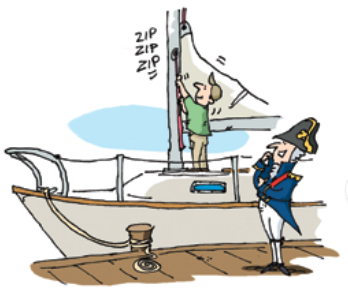
Picture Bligh-type and crew motoring upwind in the marina while raising the mainsail. Unfortunately, something gets stuck. Bligh-type immediately starts yelling at his crew to pull harder and, when that doesn’t work, he’s soon screaming, “What’s wrong?” Despite a lot of running and shouting, the problem goes unsolved and suddenly Bligh-type and crew find themselves out in the wind and waves with a sail that won’t go up and maybe won’t come down either.
Now put a Nelson-type in the same situation. Even on the best-run boats, sails get stuck sometimes. What does he do differently? First he runs through his mental checklist to see what might be wrong. If a quick fix doesn’t solve the problem, it’s time for Plan B: turn the boat around and motor back into the marina . . . pull up at the public dock, perhaps, and sort out the problem. This strategy gives the crew time to look things over carefully and try again at everybody’s leisure.
Nelson-type is not necessarily smarter. Neither skipper solved the problem with a blinding flash of insight. But which crewmembers had more fun sailing that day? Which boat was less likely to have had serious damage done to rigging and sails? Nelson-type might have been feeling just as confused and helpless as Bligh-type. But Bligh-type got so focused on the short-term goal — getting out sailing — he forgot his first priority: keeping crew and boat safe. Nelson-type had a Plan B at the ready and knew ahead of time what he would do if he had trouble setting sail. He also had a Plan B ready in case of engine failure in the middle of the marina as well as plans for other potential problems.
Having a Plan B is one of the key elements of good seamanship. Since we don’t do our best thinking under critical time pressures, having a plan into which we have invested some thought and even practice can make the difference between a graceful exit from a problem or an expensive disaster.
Examine the “what ifs”
Some common situations are worth considering in the light of “What we would do if . . .” For example, we are motoring straight into the wind in that narrow approach channel and our engine quits. What is the first thing to do?
The instinctive first response for most sailors who haven’t taken the time to develop a Plan B might be to try to restart the engine. It is very unlikely that the engine will simply restart. Some problem made it stop and we haven’t the time to fix that problem. We are far more likely to drift out of the channel and go aground while we have our head down fussing with the engine. So what’s our Plan B? If there’s room, it might be better to turn the boat downwind and start drifting under bare poles down the channel. Perhaps there’s room to put a jib up so we can gain some power and control. Is there enough sea room to sail? If so, we can keep going while we troubleshoot the motor. If not, we can ready an anchor so we can put the boat in a safe place while we fix the problem or call for help. Many of the details will depend on the local conditions and the way a specific boat handles. The whole key is in thinking out Plan B ahead of time.
Another time to have a Plan B at the ready is when docking. Everybody who has to put a boat into a narrow slip has had to deal with a crosswind or crosscurrent, making the timing of the turn into the slip critical and prone to error. If I miss the turn into my slip, I may try to back out or drift quietly to the other side of the fairway where I can hold position well fendered while I take stock of the situation. Maybe I’ll pull into the empty slip nearby.
Depending on the local conditions, any of these answers might work. You’ll be far more likely to make the right decision and to execute it with care and confidence if you’ve spent some time thinking it through carefully before the crisis.
Sometimes you’ll develop your Plan B on the fly in response to a situation. Every time a Nelson-type approaches another boat out on the water, he puts together a mental checklist. What will I do if he continues on this course? What if he turns left or turns right?
Calmness breeds confidence
I learned the importance of calm and control when I started teaching sailing on San Francisco Bay. During most of the year, we teach in winds of 20 to 30 knots that blow straight into our marina across San Francisco Bay with a wave-building fetch of 8 miles. Yet every day, we put three novice sailors, who may never have been on a boat before, on a 24-foot keelboat and let them take the helm. Then we send them out into what most sailors would consider rather challenging conditions off a rocky lee shore.
That first day of class has become my favorite. We take landlubbers and start them on the path to being sailors by making sure they don’t panic. How? By being calm. Instructors maintain a quiet voice, a tolerance for mistakes, and a basic understanding that there are really very few things that anyone can do that would put the boat and the people on board at serious immediate risk. We take care to protect the new sailors from situations where they could get into trouble (like accidental jibes), while letting them revel in the wind and waves and learn about sailing a small boat.
Explanations and questions
With your own crew, think of the relatively few things an inexperienced crew could do that would really be dangerous. Spend all of your effort preventing those things from happening. You may have to spend a few extra minutes explaining things and asking questions to make sure everyone understands. Maybe there are some things you don’t ask the crew to do, but do yourself. As for all those other things that frustrate you, if they don’t threaten crew or boat, they’re just potential learning situations.
No matter how irritating it may be to see one of your new crewmembers coiling a line incorrectly or stowing something in the wrong place, it’s not worth raising your voice. It’s far better to calmly suggest that you prefer an alternative approach. It might be even better to let something go until you’re quietly tied up at the dock at the end of the day before offering suggestions for alternative ways to do things. If you want someone to do something in a way that is new and different to them, it always helps to explain why you want them to do it your way. It’s OK to say that your way is not better than their way, it’s just the way you expect to find things on your boat.
Act the part
When things really go wrong, if you are frustrated, angry, or scared, it’s far better to act calm and quiet. Take your time when giving orders, be sure what you say is exactly what you mean. In a difficult situation, a few well-chosen words can be far more effective than a flurry of contradictory commands.
Think for a moment about the great old-time movie heroes played by the likes of Humphrey Bogart, John Wayne, and Clint Eastwood. They rarely raised their voices, yet they were still commanding presences. Yes, they were acting, but there’s a message in that. In moments of crisis, when things are going wrong, acting like a calm and competent skipper can, in a bizarre turnabout, actually make you one.
Bill Kinney has been sailing for 16 years and living on a 40-foot sailboat for 10 of them. After a career as an engineer in biotech, he now teaches sailing full time at OCSC Sailing in Berkeley, California.
Thank you to Sailrite Enterprises, Inc., for providing free access to back issues of Good Old Boat through intellectual property rights. Sailrite.com