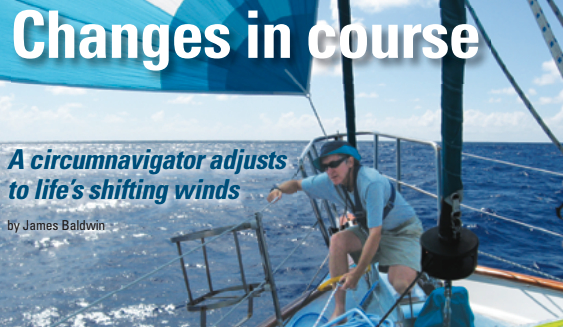
A circumnavigator adjusts to life’s shifting winds
Issue 72 : May/Jun 2010
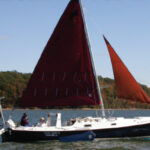
Last spring, a friend of ours sailed from our adopted homeport of Brunswick, Georgia, on the first leg of a planned circumnavigation. For three months, I worked alongside Kirk, preparing his Alberg 30, Salsa, for the voyage. We replaced the sails, rigging, and chainplates, installed new radar, SSB, windvane self-steering, anchor windlass, and solar panels, and we completed dozens of other jobs to make his boat more safe, functional, and comfortable.
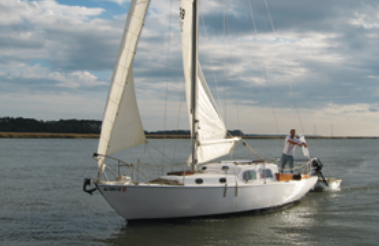
As we watched Salsa hoist sail for the first leg of her journey to Panama, I thought back to a time 24 years earlier when I began my first circumnavigation aboard my Pearson Triton, Atom. The contrasts between Salsa’s and Atom’s stories were many. While Salsa carried most of the equipment today’s sailors consider essential — from rescue beacon to refrigeration — Atom’s simplicity reflected her skipper’s extremely tight budget. Atom’s electronics consisted of a VHF radio, depth sounder, and an erratically functioning radar detector. Her newest sail was 15 years old and patched. She lacked even the basic comfort of a companionway dodger. I pieced together her oversized rigging from a boatyard’s junk bin.
Before I had the nerve to set out on a circumnavigation, I sailed Atom thousands of miles over four years, many of them in the course of several long solo offshore passages.
Salsa’s skipper had much less experience and hired me to fast-track his project. Ideally, he would have taken more time for shakedown trips, but he had started sailing 10 years later in life than I had, and I understood his desire to get under way right away before any more time was lost and life intervened to frustrate his plans. Yet, we were identical in our desire for an adventure under sail, to captain our little ships as far as we could, harnessing the wind to discover a new life . . . a purposeful voyage.
Back to the nest
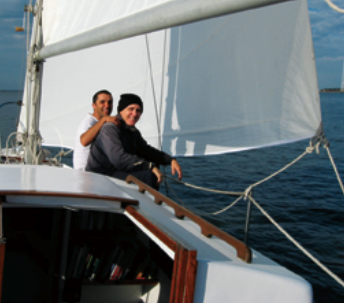
In 2002, I came home from two circumnavigations having fulfilled my youthful dreams, including finding my wife. Mei summed up my situation with the old Chinese saying, “Tired bird returns to nest.”
It was not so much weariness of travel but, rather, family obligations too long neglected and new goals that drove me ashore to acquire a house and start a small business. Suddenly I was navigating the thorny passages of a new life. To our previous low-cost life afloat we added monthly expenses for the house and shop, vehicles, tools, phone, and taxes. I was told to buy liability insurance before I could work and more insurance to keep my boat at the local marina. Buying insurance to protect other people is a strange concept I’m still trying to grasp. Everyone tells me it’s too late to go back to a system where people buy their own insurance to protect themselves from their own worries. It’s no wonder sailors feel a need to break free from society from time to time.
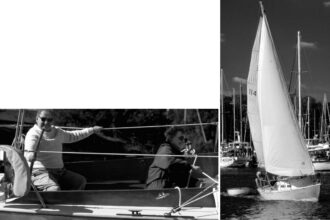
Despite a busy shore life, we still sail — locally and on one or two long offshore delivery trips each year. After a months-long refit of an elegant 20-year-old Liberty 49 center-cockpit cutter, we recently sailed her from Georgia to the Virgin Islands, then brought her back home the following spring. Everything the owner needed or wanted for a comfortable passage was aboard this boat, from an icemaker to hot showers.
I would not have thought it possible but, on our nine-day return passage, mostly under spinnaker with light following winds and calm seas, not a drop of seawater landed on deck. This yachting style is seductive and a world away from the early years I spent living close to nature on Atom.
Less awe and respect
Today, people typically begin a voyage with a shortage of experience and a surfeit of equipment. Technology has taken away some of the awe and respect for the sea, though I suspect every generation has sung this same tune. Three years ago, I was happily reminded that there are, and will always be, exceptions to the rule. A young musician from Spain, named Fernando, contacted me for advice on his plan to come to the U.S., buy a fixer-upper Pearson Triton as I had done, and sail her home across the Atlantic.
A year later, he sailed his new boat here to Georgia for final fitting out on a budget as tight as mine had ever been. With few possessions and fewer excuses, his goal was a challenging adventure, rather than a comfortable routine cruise. Fernando crawled all over Atom, eyes wide and head filled with ideas to apply on his own boat. Since he had not a single dollar more than he needed, we exchanged labor. He assisted me with the varnishing on two customers’ boats and I helped ready him and his boat for sea. It was as rewarding work as I’d ever had. He completed his solo passage to Bermuda and emailed me from the Azores, thrilled with the experiences of his voyage and eager to continue.
From an earlier devotion to my own voyages, I find satisfaction in assisting others as they realize their dreams. Compared to those past trade-wind passages, I now sail in the latitudes of variables, changing life’s course as the winds shift around me.
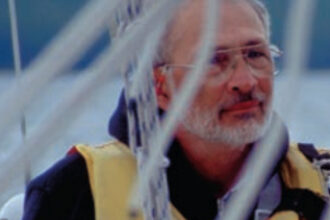
James Baldwin and his wife, Huang Huo-Mei, are based in Brunswick, Georgia, where they continue to fit out cruising sailboats for offshore passages. Their voyages and other boat-project articles are available on their website: www.atomvoyages.com.
Thank you to Sailrite Enterprises, Inc., for providing free access to back issues of Good Old Boat through intellectual property rights. Sailrite.com