Not every child is raised alongside a yawl
Issue 97 : Jul/Aug 2014
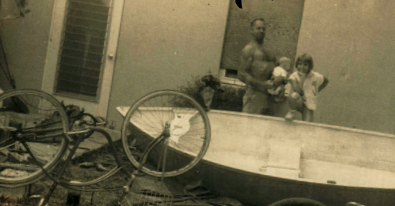
My brother, Boo Boo, materialized in a crib in the dining room in 1964 about the time Dad birthed a boat in the living room. Dad had to take the boat apart to get it out the front door. After reassembling the dinghy and proving it seaworthy, Dad went to work on a 40-foot yawl in the backyard. I was not impressed. He’d merely moved his lumber, power tools, and sawdust outside.
His job lifeguarding and managing Shenandoah Pool, however, scored mega points. When I was not in school, I pedaled to the swimming pool for a day of mermaid-dom. Chlorine was king, and I was pool-rat royalty.
At home, the boat rose from the yard like a bloated, capsized canoe beside my banyan tree. I watched Dad work from my tree “house” where my overactive imagination saw a front door, multiple rooms, and back stairs. When Dad’s radio opera music chased me away, I headed for my fort in the bushes behind the boat where I pretended I couldn’t hear Dad hollering for me to pick up wood scraps.
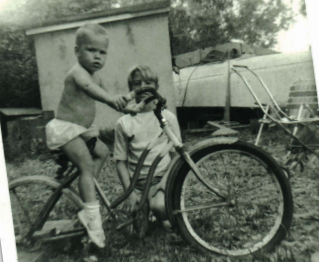
During the day, Dad hosted pre-school swim lessons, tested chemicals, and disinfected the locker rooms. Boo Boo went to the Cuban babysitter’s. Mom went to bed after her night shift as a nurse at Jackson Memorial Hospital. And I braided my hair for second grade where I threw up on my desk and earned “Daydreams too much” on my report card.
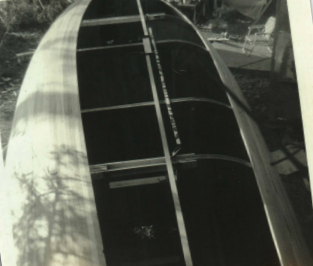
After the hull was completed, Dad papier-mâchéd fiberglass to the wood planks with resin. This was my least favorite part of the process. The cloth itched something fierce. When the lid on a five-gallon can of resin gave way, my left leg plunged knee-deep into the sticky, stinky goo. For years I thought that’s how I got that birthmark on my calf.
Dad layered fiberglass and resin on the hull until it was strong enough to withstand bashing into a coral reef and a seawall, multiple running aground episodes, and a hurricane.
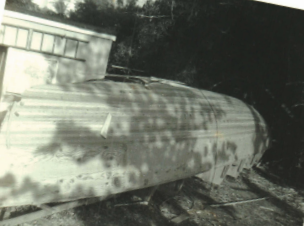
A crane mashed down the grass in our yard one day when I was at school and flipped the boat right side up, keel down on Dad’s homemade jack stands, an event that ushered in change. Dad quit his job to babysit and build the boat full time.
While he played with power tools, putty, and paint, I ran free in our half-Cuban neighborhood. The Cubans’ homes were easy to spot by their tidiness, but I didn’t realize how white-trashy they thought we were until Lourdes and Pupe’s mother polished my saddle shoes before taking me to the movies. Thanks to my Cuban playmates, I picked up an impressive blue Spanish vocabulary . . . though I never figured out which words were bad and which were really bad.
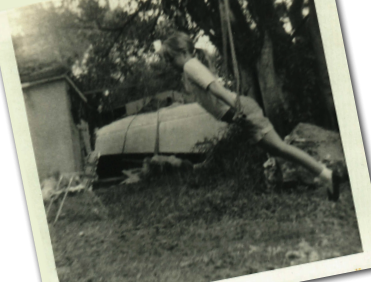
Even though Boo Boo had shown up with his devil-made-me-do-it grin, white angel hair, and affection for dirt, Dad didn’t wish any less that I’d been born a boy. No matter how high my puny, grade-school arms heaved me up the rope that hung from the banyan tree, I never made it to the top. I raced up and down the sidewalk on my Dad-crafted skateboard and scooter. I spattered my report cards with A’s and B’s. But I never won the carnival prize of Dad’s approval.
As I was finishing fourth grade, the crane rumbled back, puffing black smoke. The machine surged to life, groaned, and lifted the ark into the air. The jack stands collapsed onto the dirt like Pick-Up-Sticks as the boat crept skyward.
At the Miami River, the process reversed. The crowd of friends and well-wishers held a collective breath as the straps were released and the boat floated. A cheer went up. Dad whacked the bow twice before the champagne bottle broke, christening our boat.
Two weeks later, the boat bobbed beside Pier One at Dinner Key Marina. My church dress dried in the breeze, our only sail on the still mast-less boat. Dad handed me a box of large, black letters that might be used on a mailbox or sign. “Figure out what I’m naming the boat.”
I wrote down 38 possible names in an hour and a half, but Dad said I hadn’t come up with the name yet. I sighed. As usual, I hadn’t met Dad’s expectations. I jumped overboard and swam around to the end of the pier where other kids were doing cannonballs.
Later, I treaded water at the stern of our boat, blinking salt water out of my eyes, waiting for the black shapes to come into focus where Dad had affixed our boat’s name to the transom: The Annie Lee. My throat tied in a knot. Up on deck, Dad grinned at me.
But life is never smooth sailing. Come hurricane season, Laurie gusted across the Gulf of Mexico with 105 mile-an-hour winds headed for the Glades and South Florida. It was October 27, 1969, and my family barreled across Biscayne Bay under full sail, heading for a hurricane hole to wait out the storm.
I planted my 11-year-old self on the foredeck, scanning the distant shoreline for a gap that might be our cove. I was not afraid. Dad would keep us safe. But his tension bled into me.
Sailing was supposed to soothe but, even under clear skies, Dad stressed. He could have taken a lesson from the hippies he admired. They rattled around Coconut Grove in beater Volkswagen vans, on bikes, or on foot wafting Patchouli oil, incense, and I-don’t-care in their wake. They didn’t care about jobs, haircuts, or monogamy. They ingested bean sprouts by the pound and brownies when they got the munchies. The women burned their bras.
I glanced back at the cockpit. At the helm, Dad stood ramrod straight in his crew cut. Mom posed at his side, her white uniform tented to symmetrical cones by a sturdy bra. They were a hip American Gothic portrait of monogamy.
We were coming up fast on a buoy. I shouted to Dad and pointed. Dad levered the tiller hard to starboard and the boat swerved and came about. He yelled, “What color is the damn buoy?” the second I remembered he was colorblind.
“Red!” Mom shouted. He angled the boat into the wind and we drifted past the buoy. Dad raised his voice over the flapping of the sails. “Annie, check our depth!” I scrambled over the main cabin, readying for the thud of our keel hitting bottom.
Rigging clanged against the new-to-us aluminum mainmast. My fingers closed around the depth sounder, a long mop handle with notches carved at one-foot intervals. Patches of sand blinked through the seaweed below us, but we still floated. Dad angled back into the channel. The sails filled. I let the pole roll from my fingers, releasing a breath I didn’t know I’d been holding.
My five-year-old brother crouched in the corner of the cockpit, wide-eyed. These were the best days of his life, he’d tell me later. Dad white-knuckled the tiller, his calming yoga workouts not paying off.
I think Dad secretly wanted to be a hippie. But flower children were young. Dad was riding full-throttle toward 45. No hippie would coat his kids’ noses, cheeks, and shoulders in zinc oxide 24/7 when the rest of the world was frying itself in Johnson’s Baby Oil. Hippie dads wouldn’t make their kids check in every hour. They wouldn’t saddle their offspring with chores like painting a stretch of deck or stacking lumber in the aft cabin. A hippie dad would be too stoned to make his kid read aloud Euell Gibbons’ Stalking the Blue-Eyed Scallop and phonetically sound out all the 50-gallon words.
My stomach growled as my eyes swept across the seawall looking for an opening. I wondered if there was anything to eat on board that hadn’t lived in the bay. The bean sprouts Dad grew in the cupboard didn’t count. He ground conch in a hand-cranked meat grinder into chowder and fritters that had to be chewed 25 times and tasted like rubber hose. Clams were dug at low tide. We scooped shrimp — when they ran — in nets from the dock. Dad gigged, cast-netted, and spear-fished our food. Once in a while he poached a Florida lobster by reaching into a crawfish hole, ripping off its tail, and stuffing it into his trunks. He never got caught.
Dad hollered for me to take down the foresail. While I worked, my brother manned the tiller. Dad downed the mizzen sail, and Mom — binoculars to her eyes — yelled, “There’s the inlet!”
We slid into the mouth of the waterway, and I dropped the mainsail. Dad yanked on the lawnmower cord to our 10-horse, secondhand, Johnson outboard, swore, yanked, swore. My fingers clenched around the bowsprit as we coasted into the narrow inlet. Mom sat at the helm, my brother smashed up against her side. Finally, the motor coughed to life, and Dad muscled it down the stern into the water.
Ten minutes later we puttered into a virgin cove, surrounded on four sides by land and pines. Dad killed the motor and we glided into the perfect center. We dropped anchors fore and aft and stowed sail to the sound of our transistor radio blaring the weather. Hurricane Laurie hooked southwest and headed for Mexico. We cheered.
That night, in my bunk, I lay awake listening to the strange sounds of the cove. Dad wasn’t a hippie. Our car was a 10-year-old Plymouth Valiant he’d painted tan — with a paintbrush — over the original white. But a picture from half a life ago lapped against my ear from the other side of the hull. I’d been five when my parents quit their jobs, packed us up, and drove out west to pan for gold — in a Volkswagen van. I shouldn’t have been surprised several years later when Dad grew out his hair like Willie Nelson or that he never again worked a “real job.”
Dad protected me from skin cancer, unhealthy eating, and a sedentary lifestyle. He gave me books, boats, and the ability to write for 12 years without a paycheck. I have Dad to thank that I rebelled into conservatism and God. Conservatism may be expendable, but God I’ll keep.
Ann Lee Miller earned a B.A. in creative writing from Ashland (Ohio) University and writes full time in Phoenix. She grew up in Miami, Florida. This article is an excerpt from her memoir, Boat Days, due out in 2015. More than 100,000 copies of her debut novel, Kicking Eternity, have been downloaded from Amazon. Her other novels are Avra’s God, Tattered Innocence, and The Art of My Life. For fun, she guest lectures on writing at colleges, hikes in the mountains with her husband, and meddles in her kids’ lives. She blogs boat tales at AnnLeeMiller.com.
Thank you to Sailrite Enterprises, Inc., for providing free access to back issues of Good Old Boat through intellectual property rights. Sailrite.com