Performance in Starck-ly beautiful French style
Issue 97 : Jul/Aug 2014
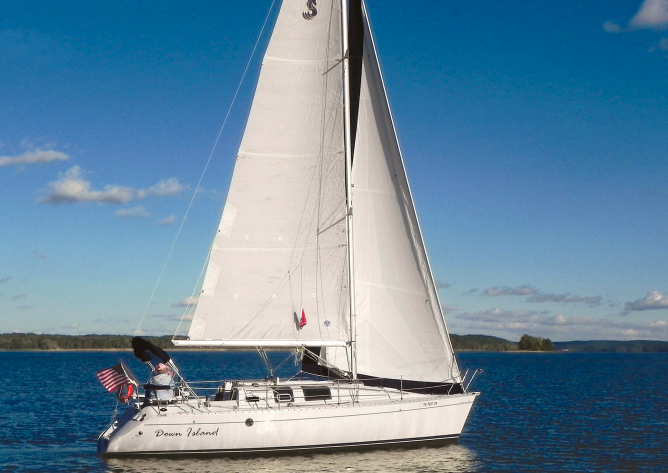
A problem many inland sailors face is that they eventually get tired of sailing the same water. Two years ago, that is what possessed Jim and Jessica McCann of Franklin, Tennessee, to move their 1990 Beneteau First 32s5, Down Island, from Percy Priest Lake near Nashville, Tennessee, 186 miles down the Cumberland River to a slip in Green Turtle Bay Marina on Lake Barkley in Kentucky. Jim says, “We got to where we had named every cedar tree on Percy Priest.” But before they made the move, they had enjoyed many years of sailing other boats, mostly Beneteaus, on those waters. They thought a Beneteau 210 would be nice to trailer about for exploring other places but didn’t follow through and instead bought a Beneteau 310 for its headroom. Their next upgrade was to a Beneteau 370, which Jim did not feel sailed very well. He described it as “a condo on the lake.”
“I wanted a boat with a length somewhere between the 310 and the 370,” Jim says. “After a lot of research, I felt the 32s5 would be exactly the boat I was looking for, and it has proven to be the perfect boat for me and my family.”
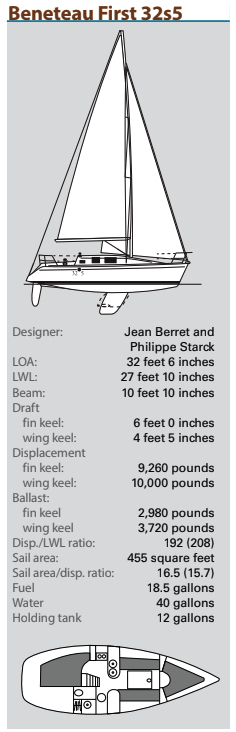
At 9,260 pounds, its displacement was halfway between the First 310 and the Oceanis 370. It gave him the room he wanted below and, because it is a First series, the performance he sought. “Additionally,” Jim says, “I found the interior striking — with the mahogany, white upholstery, and gray marble laminate countertops.”
Down Island has a wing keel that draws 4 1⁄2 feet, which Jim needs in the shallow lakes where he sails in Tennessee and Kentucky.
About 10 years ago Jim began to search for one of the 65 Beneteau 32s5s built. Starting with the online Beneteau sailing forum, he simply began asking owners if they wanted to sell their boats. Before long, he found Down Island on Lake St. Clair near Detroit, Michigan. They now sail her on Kentucky Lake and Old Hickory Lake.
History
Beneteau is a French company with deep family roots. Benjamin Beneteau started building wooden fishing trawlers in 1884. His son André took over the company in 1928 and the third generation, Benjamin’s granddaughter Annette (then 22 years old) and her naval architect brother André took charge in 1963. Within a year, they were producing fiberglass recreational boats that quickly proved popular. Annette later married, becoming Annette Roux, and she has held a major role in the company ever since.
Beneteau launched the First series of performance sailboats in 1972. Annette came up with the name after visiting a California Harley Davidson dealership where she observed their claim to “Numero Uno.” Ultimately, Beneteau would produce many more designs in the First series, as well as cruising boat lines called Idylle and Oceanis. They introduced a trend in sailboat appearance (sometimes called “Euro styling”) that other boatbuilders quickly adopted.
In 1986, Beneteau opened a manufacturing facility in Marion, South Carolina, to meet the demands of the U.S. market. In 1995, it acquired a former competitor, Jeanneau, and continues to produce and distribute boats under that name. That same year Beneteau also acquired the Lagoon catamaran brand. Beneteau today has dozens of dealers and several production plants worldwide and has a solid claim to being the largest builder of sailing yachts.
Design
French style and chic is on full display in the 32s5, which was introduced in 1988. The little “s” in the boat model stands for Philippe Starck, a prominent industrial and commercial designer who styled the deck and interior. The first Starck model was the “First S.” The First 35s5 was the second. Designed in collaboration with naval architect Jean Berret and introduced in 1987, it was considered an “audacious boat” by some observers. After the same pair designed the First 41s5 in 1989, Jean Berret said of Philippe Starck, “This unconventional thinker helped me distance myself from sailing archetypes. We built a daring boat — we still remember the surprise prompted by the vertical hull porthole! — with great elegance as much under sail as inside.”
The 32s5 is a moderate-displacement sloop with a fin keel and a spade rudder. With its displacement/length ratio of 192 (deep keel version) and a generous sail plan, it is quick around the buoys, earning it a PHRF number of 144 to 153 seconds per mile. That compares favorably with the J/30, which is most commonly rated at 144 in its fleets across the United States.
The 32s5 was available with either a deep keel (6-feet draft) or a shoal-draft wing keel (4-feet 5-inches draft). The sugar scoop transom, raked bow, and sloped coachroof give it a modern, racy look.
Construction
The solid fiberglass hull has a molded interior grid system of stringers and floors that is bonded and glassed to the hull. Following what was fairly standard practice at the time, the deck is cored with end-grain balsa, although some reports indicate the use of other materials in select areas. Beneteau is good about removing the balsa where there will be deck penetrations.
The 32s5 has a 7⁄8 sloop rig with double spreaders and discontinuous rod rigging (the cap and intermediate shrouds are made of lengths of rod connected at the spreaders). The backstay can be adjusted from either side of the cockpit with a single 12:1 tackle.
On deck
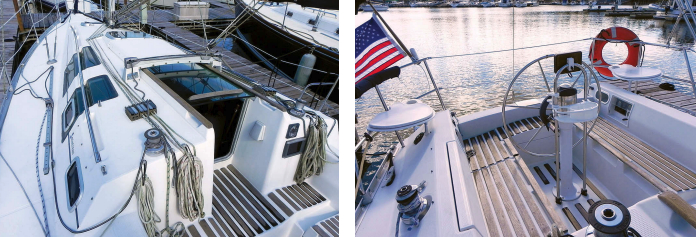
The shrouds are inboard, which makes going forward on the wide sidedecks quite easy. Plentiful handrails and double lifelines provide security. A nice sized self-draining anchor locker in the foredeck has an integral windlass pad. The companionway is recessed into the main bulkhead above a high bridge deck.
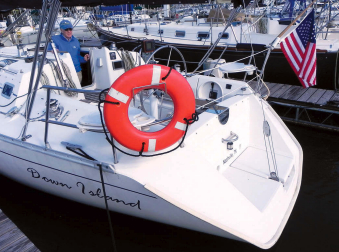
The Beneteau 32s5 has a true sugar scoop transom that is attractive and practical for boarding from the water or a dinghy. The swim ladder elegantly folds up for storage under the platform but can be deployed only from the sugar scoop, and the scoop transom, while neat, could use a handhold of some sort.
Because the hull tapers aft of amidships, the cockpit is narrow compared to those on more modern boats. This allows the seats to be a comfortable distance apart for bracing your feet while heeled, and the helmsman can sit comfortably on a coaming to steer. Teak strips on the cockpit sole and on the seating areas help keep you from sliding around, but may be hard to keep clean. The inner strip on each of the side seats forms a handrail, which raises the question, “Why don’t all sailboats have these?” While under way, the seats feel very supportive and secure, and the cockpit could be a very comfortable napping area.
Belowdecks
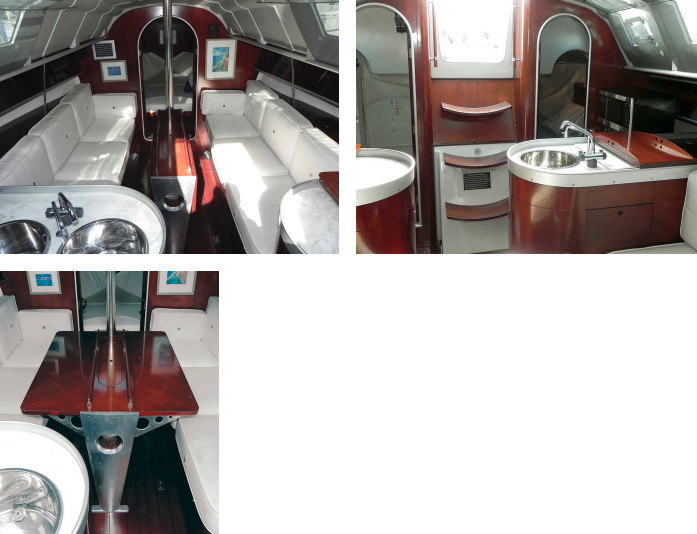
A beautiful and elegant interior awaits below. White upholstery and a splash of shiny aluminum fittings and trim contrast boldly with the dark mahogany of the cabin sole and curvaceous cabinets (a “classic” version with lighter teak finish was also available). Gray marble galley counters complete the décor. The white upholstery in Down Island appears to have stood up to the years very well. The windows curve up into the overhead. They shed lots of light on an otherwise dark interior and have built-in blinds for privacy. There is ample headroom, and aluminum rails on the overhead provide handholds.
A nice, large, well-lit and ventilated quarter berth on the port side area aft could be used as the master cabin. The head is conveniently located in the same area on the starboard side.
The galley, forward of the quarter cabin, is well thought out and a secure place to prepare food. An innovative tray/bridge that clips onto the rail and cutting board enlarges the preparation area when needed by covering one of the two round sinks.
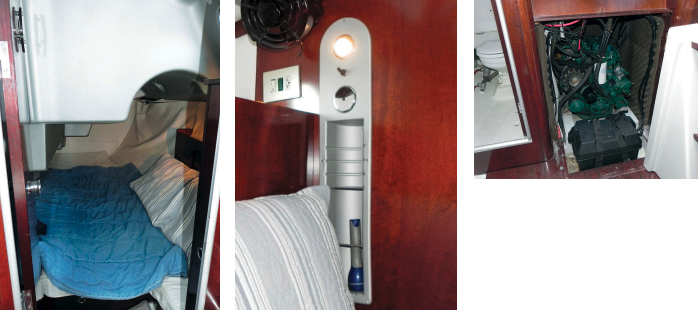
The water heater is located under the excellent nav station to starboard. The fuel and holding tanks are also located to starboard, and the water tank is on the port side.
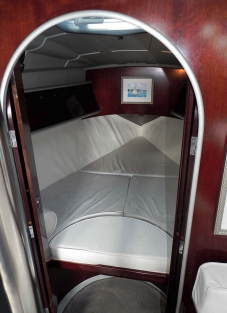
In the center of the saloon, the drop-leaf table contains plenty of storage. Forward, the comfortably sized V-berth can be closed off with folding doors. On Down Island, air-conditioning equipment is located under the berth.
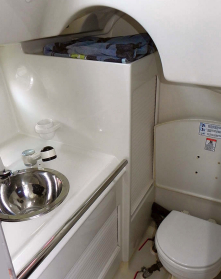
Ample storage spaces are provided throughout the cabin. Access to the 18-horsepower Volvo diesel engine, behind the companionway ladder, is quite good, and the dipstick can be reached through a smaller panel on the port side. Batteries are located in the aft cabin but are reasonably easy to get to.
Under way
You know a boat with such pleasing lines is going to sail well. And it does. The Beneteau 32s5 parts the water with little effort and points high with ease. The narrow cockpit offers comfortable steering positions behind the wheel and off to the side with excellent visibility forward. The steering is light and responsive, motoring or sailing, and the boat tacks quickly, even in light air. Most of the running rigging lines are led aft to the cockpit, where 12 clutches secure them, and the boat has two winches on the cabintop and one on each cockpit coaming.
The mainsail’s mid-boom sheeting arrangement is cumbersome, as it often is on larger boats, making quick adjustments difficult. Setting and handing the full-battened sail would be easier if the battens were on cars.
The jib (a 140 percent genoa) had a tendency to snag on its way across the boat when tacking in light air. It’s on an Isomat roller furler and the drum is below deck level, which impeded our efforts to resolve a problem we encountered while unfurling the sail.
Drawing 4-feet 5-inches, the shoal draft model is perfect for inland sailing and gunkholing. It would also make a good boat for Florida, where shallowdraft opens up many waters and makes grounding less likely. A wing keel, though, can sometimes be difficult to free once it is grounded. Down Island moved quite well in the light air we had on the day of our test sail. I don’t doubt she can exceed her theoretical hull speed of 7 knots.
Conclusion
It’s too bad that so few of these beautiful boats were made. I give it high marks on all counts for construction and design, and sailing it is a real pleasure. The 32s5 is of a size that can provide adequate creature comforts without requiring a big crew or a big budget to own and operate. I understand why Jim decided he needed to hunt one down.
The Beneteau 32s5 appears to have few flaws, and a well-cared-for one should offer no surprises. A thorough survey will reveal weaknesses that need attention on any particular boat. These boats are currently priced between $25,000 and $48,000. Some of them could have a suit of racing sails.
Allen Penticoff, a Good Old Boat contributing editor, is a freelance writer, sailor, and longtime aviator. He has trailer-sailed on every Great Lake and on many inland waters and has had keelboat adventures on fresh and salt water. He presently owns an American 14.5, a MacGregor 26D, and a 1955 Beister 42-foot steel cutter that he’s restoring.
Thank you to Sailrite Enterprises, Inc., for providing free access to back issues of Good Old Boat through intellectual property rights. Sailrite.com