The Oxford Dinghy lured a family into sailing
Issue 97 : Jul/Aug 2014
The last thing on my mind that Friday evening 34 years ago was buying a boat. With Peg beside me and our son Chris in the back seat, we headed into the curve leading into Oxford, Maryland, on our way to Grandmom and Grandad’s house. Oxford, an idyllic little town on the Chesapeake Bay’s Eastern Shore, was home to my parents and we were there for a weekend visit.
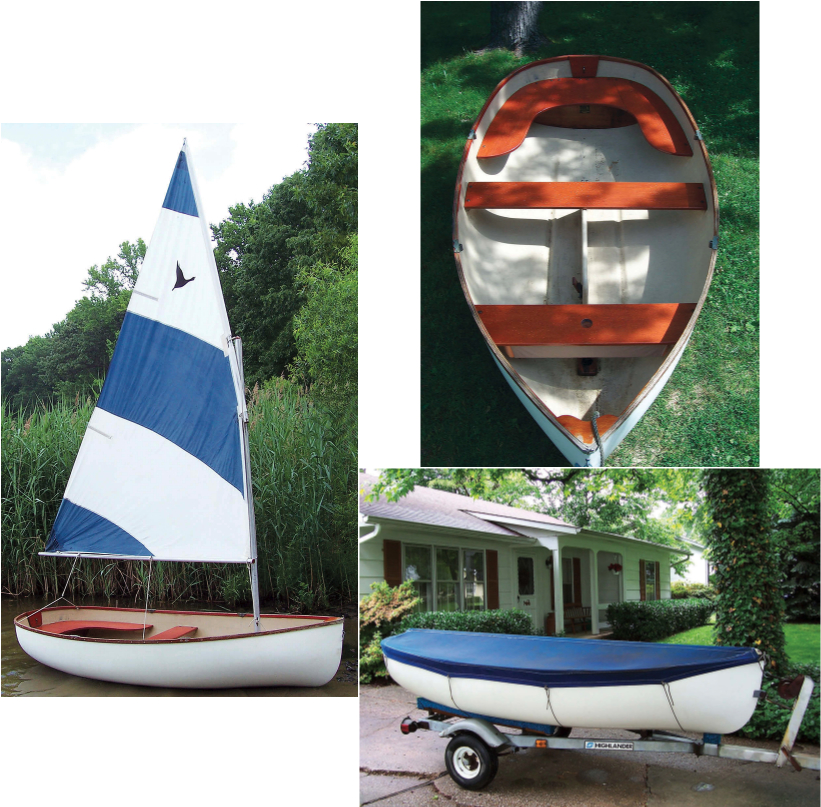
Before completing the curve, we saw a sight that would forever change how we’d spend our leisure hours. Sitting by the side of the road were two beautiful little sailboats with blue- and white-paneled sails. Near the head of each sail was the silhouette of a duck in flight . . . a duck that would in later years come to represent a Chesapeake Bay classic, the Oxford Dinghy.
The next morning, Peg and I stole away to check out the little sailboats. Since neither of us had ever sailed before and had little interest in learning, our purpose was more of an excuse to enjoy a little time away from our rambunctious 4-year-old.
The sailboats were breathtaking. Though I didn’t know a gunwale from a gudgeon, I looked at the two Oxford Dinghies, an 8 1⁄2 footer and a 10, from every possible angle. I was captivated by the incredibly high level of craftsmanship reflected, literally, in every turn and curve.
Voluptuous in varnish
First I noticed the gorgeous mahogany thwarts. The flawless mahogany boards of the forward and midships thwarts were so highly varnished they appeared to be encased in liquid plastic. It was like looking into a mirror. The stern thwart was even more impressive. Shaped like a horseshoe as it followed the rounded stern, its graceful line gave the boats a much larger feel.
The 10-foot model stole my attention. Her fiberglass hull was a beamy 57 inches, but her beam didn’t detract from her looks. With a flat bottom from the stem to the turn of the bilge, she sat rock solid on the 2 x 4 supports. A shallow wooden skeg ran aft from amidships, curving up the stern and ending just below the motor/rudder mount.
The rounded stern was beautiful. From astern, she looked almost like a legless antique bathtub, but in the best of ways. Hanging from bronze gudgeons and pintles on the motor mount was a traditionally shaped wooden rudder with a removable tiller. All of the woodwork glistened.
From abeam, the graceful look was heightened by her modest sheer, the canvas gunwale guard dipping noticeably from bow to stern. With a depth of more than 1 1⁄2 feet, however, the freeboard was more than ample to make any captain and crew feel secure. Two well-placed sets of bronze oarlock sockets rested along the inwale, allowing an oarsman to row from virtually any position in the boat. And, making up for the few inches of waterline lost by the curved stern, the line of the plumb bow plunged almost straight down to the water.
A 3-foot-long fiberglass centerboard trunk extended forward from under the midships thwart and a pivot handle at the leading starboard corner controlled the board’s depth. Farther forward, under the bow thwart, was the hardwood mast step. The wooden pivot handle and mast step were also highly varnished.
Gunter rig
The sailing rig, called a sliding gunter, carries 62 square feet of nylon sail on the 10-foot model. The mast is in two sections, and the top 7 feet of the sail’s luff is permanently attached to the shorter piece. When the mast is stepped, the halyard raises both the sail and the spar, which slides up the mast on a metal ring and adds 7 feet to the height of the mast. The 9 1⁄2-foot boom extends almost 2 feet beyond the stern. It is connected to the mast with another metal ring and the loose-footed sail is attached at the tack and clew. When unstepped, the entire rig fits snugly inside the boat.
The 2-inch-diameter mast and 1 1⁄2-inch spar and boom were made of aircraft aluminum with the ends plugged so the entire rig would float.
Meeting the master
As Peg and I continued to gasp at every new discovery, a gentleman appeared from a nearby workshop and introduced himself as Dale Denning, the designer and builder. A cruising sailor and retired mechanical engineer, he said he had never been happy with the dinghies he’d owned in the past. Either they didn’t row well, or sail well, or motor well . . . but more than that, they were all tippy.
So he decided to build a better dinghy for himself, a stable one that could do all of those things reasonably well. And he did. It wasn’t long before the cruising community caught wind of his creation and requests started rolling in. The end result was Dale Denning Inc.
Dale refused to let his cottage industry interfere with his cruising lifestyle, regardless of the backlog of orders. Every fall, he set sail for the Florida Keys, leaving only the warm months for boatbuilding. His yearly production was rarely more than 30 dinghies, but that was fine with him.
“Would you like to sail one?” he asked. “My 10 footer’s back on Town Creek and there’s a nice little breeze out there.”
I don’t know what came over me that morning in 1980, but there we were, Peg and I, sitting in the middle of Town Creek trying to figure out how to sail. After discovering that a sailboat wasn’t really a sailboat without a keel — or in this case a centerboard — off we sailed toward open water. Accidental jibes and uncomfortable angles of heel notwithstanding, Peg and I fell in love with sailing that Saturday morning. Since it was love at first sight with the 10-foot Oxford Dinghy, there was only one thing for us to do.
Confirmed sailors
Our order slip shows a date of August 6, 1980 but, due to the order backlog at Dale Denning Inc., we didn’t take delivery until May 30 of the following year. As atypical buyers (the vast majority of Dale’s customers being cruising sailors), the delay did not inconvenience us and gave us plenty of time to find a suitable trailer.
Since the Oxford Dinghy was designed to be a stable yacht tender first and a sailboat second, rowing ability was a major consideration in its design. With Shaw & Tenney spruce oars and bronze rowing hardware provided as original equipment, it was clear that Dale Denning was a strong believer in the art of oarsmanship.
In spite of the shallow skeg and broad, flat bottom, the boat tracks well when being rowed. And the ability to drop the centerboard in rough seas or windy conditions is a real advantage. The relatively heavy weight of the 10-foot model (135 pounds), combined with the improved water flow provided by the rounded stern, allows for a generous glide between strokes. The rounded stern also allows the boat to be rowed stern-first with much less resistance than a boat with a flat transom.
The Oxford Dinghy is fun to sail. Unlike so many small sailing tenders of its generation, its rig is much more than an afterthought. While most small boats look awkward carrying a sail rig, the Oxford Dinghy looks perfectly natural. Few 10-footers out there can carry more sail than her 62 square feet and remain upright, but she remains fairly stiff even in strong winds with the centerboard down, when she daws almost 3 feet.
Her only real weakness under sail is that she develops a pronounced weather helm when sailing upwind in heavy weather, making for an uncomfortable battle with the tiller. Centerboard and sail adjustments don’t seem to help appreciably.
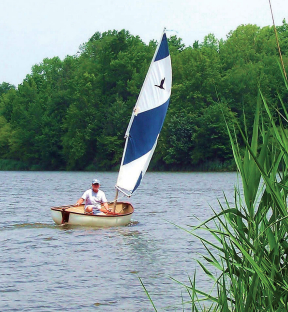
Not surprisingly, she sails best in 8- to 10-knot winds, where she can easily reach hull speed of 4 1⁄4 knots. While the boat can obviously be sailed by someone sitting on the thwarts, ducking under the 9-foot boom while tacking and jibing in a fickle wind can become tedious. If the wind is light to moderate, it’s more comfortable to singlehand while sitting in the bilge aft of the midships thwart.
Outboard test
In the 33 years we’ve owned our Oxford Dinghy, I’ve only hung an outboard motor on her stern once, and that was to test the outboard . . . not the dinghy’s ability to carry one. The motor was a 5-horsepower 4-stroke, which proved to be about 3 1⁄2 horses too big. With Peg sitting all the way forward on the bow thwart and me on the horseshoe, our little dinghy leaped up on plane at the first twist of the throttle. The slightest movement of the motor’s tiller resulted in an exaggerated change of direction. I was relieved to get back to port.
Based on that very limited experience, my guess would be that a tiny 2-stroke motor would provide ample power to move a full load on to its destination.
A rare find today
The Oxford Dinghy is the creation of a man who loves the water and the boats that sail on it. Designed and built as a “better dinghy” to hang from the davits of a large cruiser, ours became a trailersailer, introducing us to the world of sailing. For 15 years she was our only sailboat and plied the lakes and rivers and bays of the Delmarva Peninsula.
At a production rate of just 30 boats a year from the late 1970s to the mid-’80s, Dale Denning didn’t build many of these boats, but he built each one to the highest of standards, using only the finest materials. He couldn’t do it any other way.
Since so few Oxford Dinghies come on the market these days, it’s difficult to determine what an average asking price might be. The last 10-footer I saw for sale was back in November 2010 and the owner was asking $2,500. Based on that figure, it wouldn’t be surprising to see one in exceptional condition priced at over $3,000 today. That’s a handsome sum to pay for a 30-plus-year-old sailing dinghy, but maybe not so much for a Chesapeake Bay “classic.”
Alan Keene, a retired mental health professional and former Chesapeake Bay boating columnist, sails Tackful, his 1982 Catalina Capri 25, out of Havre de Grace, Maryland. His Oxford Dinghy, informally known as Odie, is currently in the early stages of restoration.
Thank you to Sailrite Enterprises, Inc., for providing free access to back issues of Good Old Boat through intellectual property rights. Sailrite.com