Waltzing with the same partner for 40 years
Issue 99 : Nov/Dec 2014
At the request of one of our faithful readers who has owned a Matilda 20 sloop since he bought one new in 1975, we decided to explore the seemingly timeless charms of this sturdy little trailer-sailer.
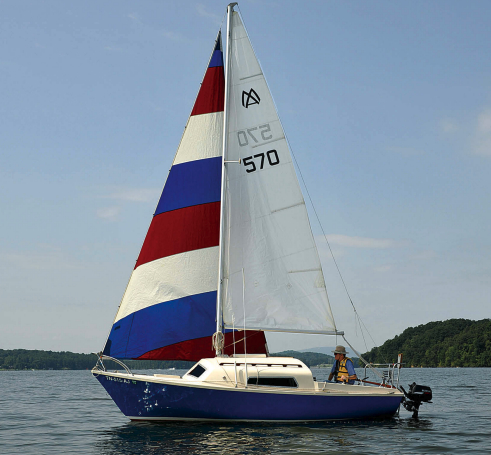
Brooks Northern is like many Matilda 20 owners who seem to keep them for very long periods of time and sail them in many different venues. Brooks, who is retired after a career in the U.S. Air Force, first saw this boat at the London Boat Show at Earl’s Court and decided he had to have one. The boat’s lineage and history spans a good part of the globe. At the time Brooks was shopping for one, there were several builders. The British-built version did not incorporate the molded-in hull liners, so Brooks opted to buy his boat, which he named Wing Ding II, from the best-known Matilda 20 builder in Canada.
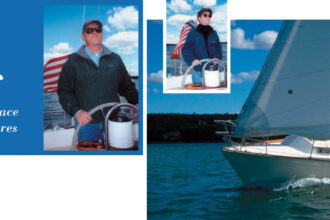
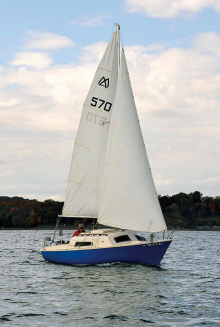
Wing Ding II is based near Chattanooga, Tennessee, on Lake Chickamauga, a large lake formed by one of the many TVA dams on the Tennessee River. Brooks and I took her out on a day with very light air but with decent weather for photographs. We used the beautiful facilities of the Privateer Yacht Club as a base and owe them hearty thanks for their hospitality and help. Later, we were able to meet at my home marina at Paris Landing State Park on Kentucky Lake for another on-the-water session in wind that required us to reef down for some real go-fast sailing.
A lengthy history
The Matilda 20 was developed from a Robert Tucker design that was originally made available as plans. Quite a few were “scratch built” in Australia, the United Kingdom, and other places around the globe. These early ones were built with epoxy over plywood and also in molded fiberglass. Currently, a related boat called the Pippin 20 is being built in the UK. This is a production descendant of the original Tucker design and is said to be a modernized version of the Matilda. (See “Resources,” page 13.)
The Matilda’s history in Canada begins with an East Indian immigrant of Chinese ancestry. Ti Ouyang arrived there with very few resources and a family to feed, but he was an accomplished woodworker and soon found employment at the Whitby Boat Works in Ontario, where he applied his considerable carpentry skills. Never one to be idle, he built a 16-footer at home, but ran afoul of Whitby management because the boat bore a rather too-close resemblance to Whitby’s Albacore 16. Ti was fired from Whitby for that bit of well-intentioned piracy, but was hired back about a year later because his skills were so valuable. A good thing that was, too, as he only managed to sell a couple of the knockoff 16-footers he called Cormorants. Later, Whitby fired him again over quality issues when Ti refused to compromise his woodworking standards.
This is when most of the Matilda 20s we know today came into existence. Having foresworn working for anybody other than himself, Ti began building a hull plug in a friend’s garage that eventually launched the production runs of the Matilda 20, 16, and 23. The 16 and 23 models are quite rare, as the vast majority of the boats built were the “middle sister” Matilda 20s. As one might expect from his past experiences at Whitby, Ti produced a very high standard of workmanship and solid construction. The Matilda 20s had molded headliners and a host of other production details that were just not found in lesser boats of the same size in that time period. Brooks’ boat is a testament to that and to this day could almost pass for new.
In the boatbuilding heyday of the early 1970s, Ti’s sons became involved in the company, which subsequently created the Aloha series of much larger cruising boats. Ouyang Boat Works ceased operations around 1986 due to financial and market pressures the family business could not withstand.
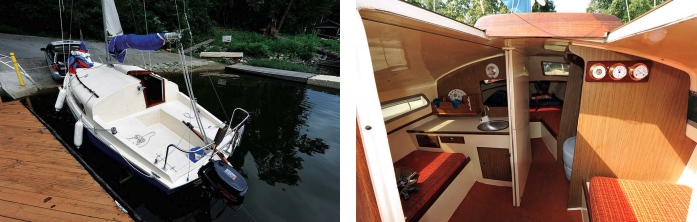
About the boat
By the standards of that time period, the build quality is very good. Ouyang-built Matildas have cored hulls and decks and the layup appears very sound. The deck core is end-grain balsa and the cockpit and cabin soles might be either balsa or plywood, depending on the schedule in use at the time a boat was constructed. The deck has molded-in non-skid on all traffic areas and very high quality gelcoat surfaces everywhere else.
Ouyang used a hull-to-deck joint of the shoebox type that, Brooks avows, has “never leaked a drop.” The joint is sealed mechanically and with an adhesive epoxy filler. Interior bulkheads and galley furniture are fitted into the molded one-piece overhead interior liner that has a slick and finished appearance and is easy to maintain.
The Matilda 20 has a conventional Marconi sloop rig with upper shrouds, single lower shrouds, a single set of spreaders, a split non-adjustable backstay, and a sturdy aluminum mast and boom. Wing Ding II has a pair of rather small primary winches on the cockpit coamings and a special ratchet-and-pawl winch for the stout steel cable that raises and lowers the centerboard. Her jibsheet tracks are mounted low and outboard and can accept a 1-inch car. Her mainsheet is attached at the boom end and leads to a traveler bar that is integral with the stainless-steel pushpit assembly and allows about 18 inches of lateral travel for the mainsail sheeting point. The mainsail has only one slab-reefing point but could use at least one more.
The stock rudder is of the kick-up variety and is a simple flat aluminum plate. It seems to me to be marginal in strength as Wing Ding II’s is bent a little to one side. A more modern and efficient foil shape has been shown to improve the pointing ability of sister ships. The centerboard is a flat, mild-steel plate with a ballast bulb at its tip.
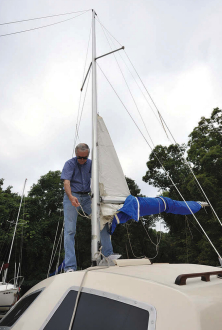
Brooks has kept Wing Ding II in pristine condition. Her teak trim and companionway doors show a rich patina of teak oil and her gelcoat is shiny and spotless. She is much the same as when she was delivered in 1975, with upholstery colors and carpeting typical of that period. Brooks has never added even a VHF, compass, depth sounder, or bilge pump to her mostly as-delivered state of trim and completion. He has, however, devised and constructed a very serviceable gin-pole rig for raising and lowering the mast that enables him, unassisted, to easily step the mast and rig the boat in a very short time. He mostly daysails Wing Ding II and has overnighted on her, by his own count, only a “couple of times.”
A vigorous lake sail
Our later session on Kentucky Lake was under gusty conditions with winds in the 15- to 25-knot range. We sailed a triangular course not unlike a club race with reaching, running, and beating legs. We used a hanked-on working jib and Brooks took in the single reef on the mainsail. The lake was showing whitecaps and a 1-foot “sea” was consistently present. We had the bulb keel assembly fully down on all points of sail under these fairly boisterous conditions and it quickly became obvious that Wing Ding II had her best time on a reach, where she easily came up to her hull speed of about 5 knots and remained under control.
Sailing directly downwind was another matter entirely. Because of her relatively flat-bottomed underwater profile, she demanded a lot of attention to her tiller — and a bit of muscle — to keep her from broaching or rounding up, even with her bulb keel fully deployed. This hull design seemingly does not track well when going downwind even in a modest blow. Extending the small transom skeg would probably bring some improvement.
I had taken along my handheld GPS to measure speeds and was able to get course bearings from the compass built into my binoculars. I asked Brooks to trim as best he could going hard to weather, and we did several long tacks to get average bearings on shoreside reference points directly ahead of the boat and after the boat had come up to speed and settled on each new course. It was a bumpy ride, but not overly wet. However, the tacking angle averaged only about 140 degrees over several tacks. Wing Ding II was going to weather — barely — but not enough to overcome the effects of the current, which runs about 3 knots in this section of the river. Though not very weatherly, she did exhibit good stability and heeled relatively little while working to windward. “Working” is the operative word, as she carries quite a bit of weather helm that could not be fully trimmed out with the sails in use.
The shape of a dinghy
Owners are unanimous in praise of the Matilda 20’s platform stability as the waterplane footprint is akin to that of a large dinghy with a relatively flat bottom. Lack of much deadrise also makes for a lower profile when trailering and easier ramp launching and retrieval. The form stability means you’d not be likely to dump your visiting landlubber in the drink when he steps aboard at the dock; the boat is that stiff. A hull with these characteristics performs best when sailed fairly flat — as the heel angle increases, so does weather helm.
It’s unusual to see a clipper-style bow in a boat this size, but it is said to make the Matilda comparatively dry in a chop and I found that to be true. Since the cabin trunk extends to the sheerline, there are no sidedecks forward of the cockpit, so going forward for foredeck chores requires some agility. The upside to that design feature is much increased interior volume and storage possibilities. After all, this is a family-oriented cruising sailboat and the design choices reflect that mindset. It is also a sturdy one. The construction scantlings, and most of the deck hardware, are of a very high standard for a boat of this size.
Chris Holderness, who cruised a Matilda 20 for years in Canada, characterized the hull as having the shape of a giant pumpkin seed. He added that he never felt the boat could not easily and safely handle the challenging conditions his family encountered on occasion when sailing on Lake Huron, and they sailed in some fairly severe weather.
Lifting keel
Personally, I think the feature of the Matilda 20 that stands out most is its retractable bulb keel. What is old always seems to show up new again somewhere, and here is a 40-plus-year-old design happily sailing around with a retractable bulb-keel assembly that at least one well-known present-day builder describes as “innovative” in a current production form.
The Matilda’s torpedo-shaped ballast bulb is a casting that weighs around 300 pounds. There are two versions of this casting. In one, the bulb is cast iron and extends both forward and aft of the mild-steel keel plate it bolts onto. In a later one, the bulb is cast lead. This bulb is even with the forward edge of the plate but extends aft of it. The center of gravity of the later version was farther aft, which resulted in more wear and friction on the guides that contain the keel’s lifting tackle. Some owners of the newer models have moved the lifting points on their keel plates to restore the balance. There does not seem to be any appreciable difference in sailing performance between the two versions.
The keel is raised and lowered by means of a wire cable and a simple block-and-tackle arrangement inside the top of the enclosed keel trunk. The cable is led to a really nice alloy winch mounted adjacent to the main hatch where it can be easily operated from the cockpit.
Creature comforts
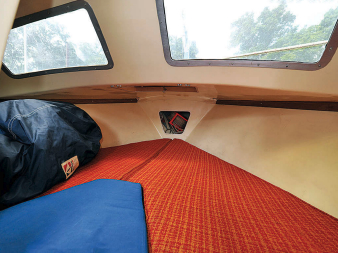
The companionway hatch on the Matilda 20 is offset from the centerline to permit a straight lead aft for the keel-lifting cable. The keel’s trunk divides the forward part of the saloon. A fairly large galley area is fitted at the main bulkhead to port of the trunk. The passage forward is to starboard and leads to a quite usable V-berth in the bow. A small compartment opposite the galley to starboard contains the head. As noted, Wing Ding II still sports her original 1970s décor and color scheme with orange indoor/outdoor carpeting and burnt-orange plaid cushions.
Two fixed portlights in the forward face of the cabin trunk and an opening hatch on the foredeck let in a lot of light and air. The pair of deadlights, when viewed from outside, are a hallmark identifier of the Matilda 20, and her two “eyes” seem to invite you to take a closer look.
The original galley configuration had an athwartships counter against the main bulkhead with a small icebox and a sink with an overboard drain at the base of the keel trunk. Wing Ding II has a little window above this counter through which food and drink can be passed directly to the occupants of the V-berth.
The toilet on Wing Ding II is of the removable variety, but some owners have retrofitted small holding tanks and deck pumpout fittings. The location of the head would seem to be well suited for that, as a flexible waste tank could easily be installed under the V-berth and a vent and discharge line led up to a skin fitting on deck.
On the road
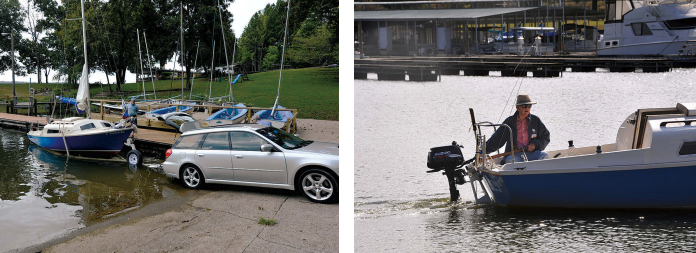
A Matilda 20 is easy to tow and launch as most mid-size passenger vehicles can handle its towing weight of less than 2,500 pounds. A tongue extension is not necessary on the trailer, as almost any ramp will easily accommodate the Matilda’s very shallow draft — it’s only 9 inches with the keel retracted. The boat on its trailer will also fit in a garage that has about 24 feet of linear space available.
Matildas on the market
A Matilda 20 in good shape with a decent outboard and on a trailer can usually be found in the $3,000 to $5,000 range depending on its equipment inventory. A “fixer-upper” might be found for $1,000 or even less.
Rob Hoffman says he’s much like his own good old boats . . . aging and in constant need of restoration. He learned to sail from a Cuban instructor in Guantanamo Bay while in the Navy patrolling the Windward Passage during the Cuban missile crisis. He’s hooked on restoring and sailing older sailboats.
Thank you to Sailrite Enterprises, Inc., for providing free access to back issues of Good Old Boat through intellectual property rights. Sailrite.com