. . . and a pair of pocket trailerables
Issue 99 : Nov/Dec 2014
Jim Luce, a good friend from the Nyack Boat Club, once described cruising in small boats as camping but with the added risk of drowning! That allusion to camping could hardly be more apropos than in reference to the Matilda 20 and the two trailer-sailers I have chosen for comparison. The Canadian Sailcraft 22 and the Sirius 21 are from the same era but slightly larger.
Cruising in small boats is a British and American sailing tradition dating to the 19th century, as recorded in the writings of John MacGregor, who made extensive cruises in a variety of Rob Roy sailing canoes of his own design, Albert Strange, who popularized canoe yawls and, in the U.S., Charles Kunhardt in his 1890s book, Small Yachts. Since the invention of the automobile and the creation of a continental road system, boats have become mobile enough on land to allow sailors to explore even distant cruising grounds with ease.
The Canadian Sailcraft 22 was the first “large” boat built by Paul Tennyson’s Canadian Sailcraft company, which became CS Yachts. The Sirius 21 was built by Vandestadt and McGruer in several different configurations over its lifespan. It became a 22 with the addition of a reverse transom, and the centerboard was eventually eliminated in favor of a fixed keel. I can’t speak with authority about the trailering exploits of the CS 22, but I know of one family that towed and cruised a Sirius 21 as far afield as the Canadian West Coast, Great Slave Lake in the Canadian Arctic, and the Bras d’Or Lakes in Nova Scotia. Two adults and three young children were on board during the latter cruise. The kids slept below and the adults slept under an awning over the cockpit so, for them anyway, the camping analogy is pretty accurate.
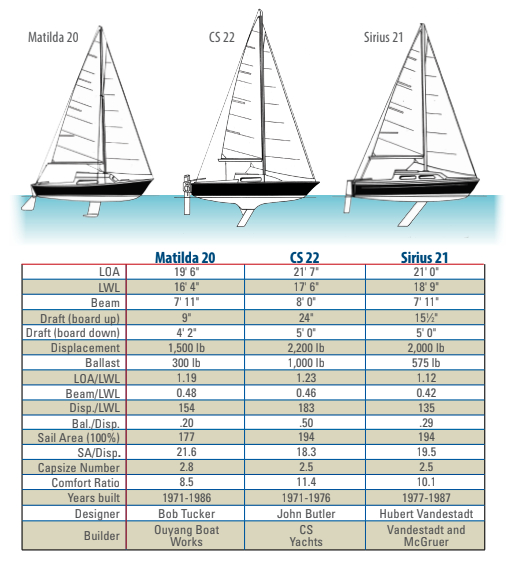
Note that all three boats push the maximum 8-foot beam allowable in all states and provinces. This is the same beam restriction, by the way, to which the C&C Mega 30 was designed, but on a substantially longer length. While the Mega ended up as a very narrow boat for its length, these three boats are relatively wide, with the smaller Matilda having a beam of almost half her length. These proportions indicate the large degree that beam, for form stability, and crew hiking weight contribute to righting moment.
All three of these boats, being centerboarders (the Matilda actually has a lifting bulb keel much like the Mega), can be said to fall into the large dinghy category, with the Matilda, displacing 1,500 pounds and carrying only 300 pounds of ballast (20 percent), being the most extreme. The CS 22 at 2,200 pounds displacement, of which 1,100 pounds (50 percent) is ballast mounted in a small stub keel that houses the centerboard, is certainly the most stable of the group. The Sirius, displacing 2,000 pounds and carrying 575 pounds of ballast, falls between these two.
In any small boat, one cannot overestimate the positive effect of crew weight on stability, since the possible 500 pounds of movable crew weight is a substantial portion of the total combined weight of boat and crew. One has to assume, however, that crew weight is not included in the published displacement figures, which would actually represent the trailerable weights of these boats. Adding crew weight would have a detrimental effect on the displacement/length and sail area/displacement ratios but would certainly benefit stability.
Each of these boats is lugging around from 300 to 1,100 pounds of fixed ballast, which is nothing but dead weight when on the road. Removable water ballast certainly has its advantages in boats of this type and I hope to address similar-sized boats with water ballast in the future.
In a chase around a racecourse, you would have to favor the CS 22 and the Sirius 21 over the smaller Matilda in heavier air, due primarily to their longer load waterlines and higher displace- ments and thus stability. The CS 22’s greater stability would overcome the longer waterline of the Sirius upwind, while the longer waterline would have the edge on reaches. However, the Matilda’s much lighter displacement, higher sail area/displacement ratio, and undoubtedly lower wetted surface would probably give her the edge in lighter wind, especially if the crew could slide forward to get the stern out of the water. Of the three, though, I’m only familiar with the CS 22 doing any sort of racing. The other two are designed almost exclusively for family daysails and short cruises, for which they are admirably suited.
Because of the constraints on available volume, the design of small boats often presents special challenges that require compromise on headroom, berth length, galley and head arrangements, and storage capacity. The resulting experience, as I said in the beginning, is not unlike camping.
Rob Mazza is a Good Old Boat contributing editor who, in his long career with C&C and in other design offices, contributed enormously to the enjoyment of those who sail and own good old boats.
Thank you to Sailrite Enterprises, Inc., for providing free access to back issues of Good Old Boat through intellectual property rights. Sailrite.com