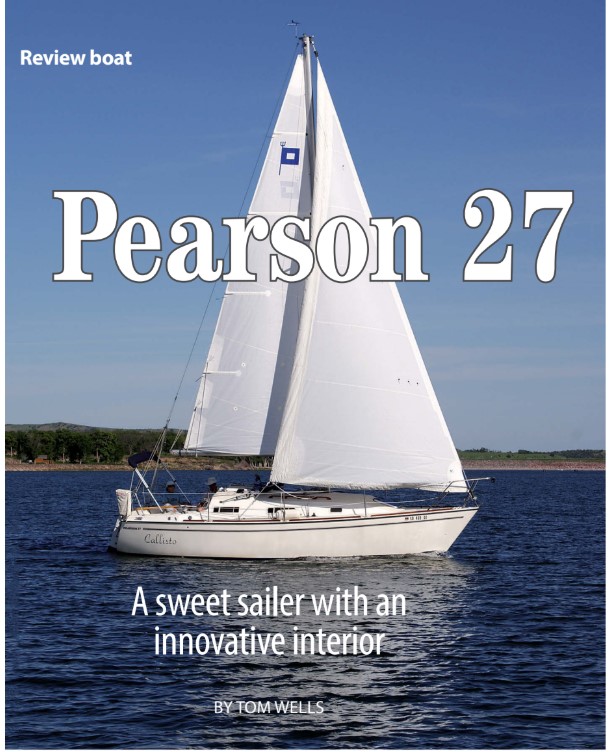
A sweet sailer with an innovative interior
Issue 98: Sept/Oct 2014
Dave and Aileen Gruendel are one of those rare and fortunate couples that does everything together. They met in graduate school at the University of Nebraska and their 47 years together have included a partnership as clinical psychologists. They live in Grand Island, Nebraska, on a small lake where they first explored the wonder of sail. In 1983, they bought an old Key Kat catamaran. Before long they had moved to a Clipper 23, sailing her in a larger reservoir nearby, and they also kept a Laser at home. When a Beneteau First 235 followed the Clipper, they knew they needed to expand their sailing horizons.
They chartered in the British Virgin Islands several times and began to sail their Beneteau on Lake Francis Case, a large impoundment on the Missouri River in southern South Dakota. The lake provides well over 40 miles of great sailing above the Fort Randall Dam. A marina near the dam can handle larger sailboats. They began to seek a boat with roomier accommodations and in the fall of 2002 they found the answer, a beautifully kept Pearson 27, in Sturgeon Bay, Wisconsin. Before long, Callisto had become a common sight on Lake Francis Case.
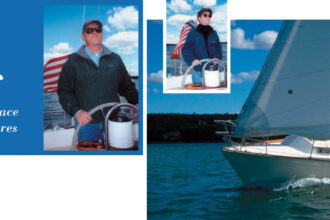
In June 2013, my wife, Sandy, and I visited Dave and Aileen to do the test sail and photography for this review. They were gracious hosts and Callisto proved to be a more than worthy review subject.
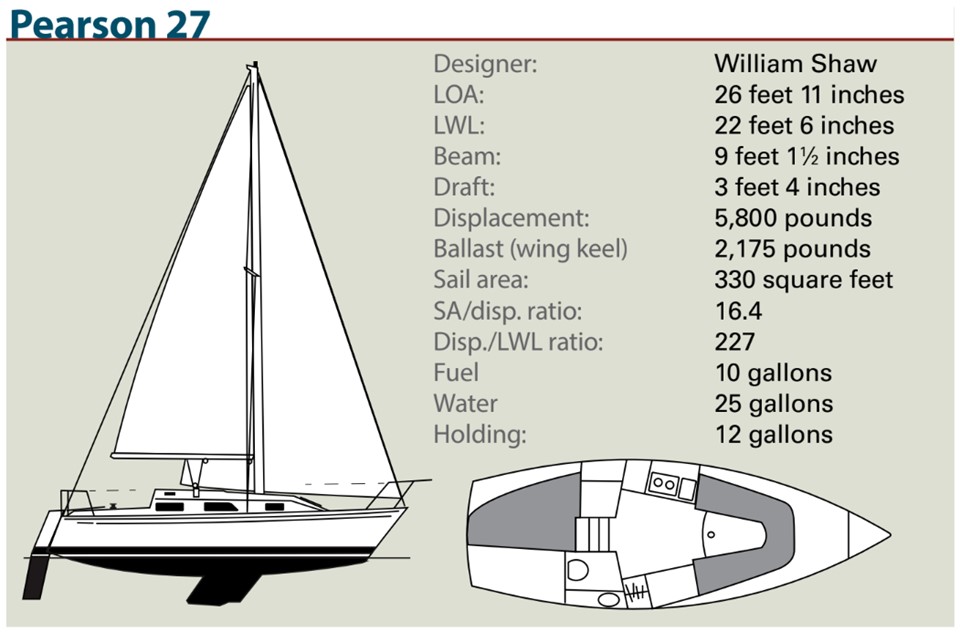
History
Clint and Everett Pearson founded Pearson Yachts in 1956. In 1959, they introduced their first fiberglass cruising boat, the famed Carl Alberg-designed Triton. Pearson Yachts was acquired by the Grumman Allied Aircraft Corporation and in 1964 designer Bill Shaw came aboard just as Clint Pearson left to form Bristol Yachts. Everett Pearson left Grumman in 1966 and Bill Shaw took the helm. Through the 1970s and into the early 1980s, the company was a prolific builder of cruising sailboats, most of them designed by Bill Shaw. The general decline in the industry took its toll and by 1986 Bill and some investors bought Pearson Yachts from Grumman. They made a quick move to bolster the brand, buying 25- and 27-foot Doug Peterson designs from U.S. Yachts. The larger boat was introduced as the Pearson Triton 27, in an effort to capitalize on the fame of the familiar Triton name.
In 1987, Pearson Yachts introduced a new 27-foot design by Bill Shaw that it named the Pearson 27. Some brokers began to call this new model the Pearson 27-2 to distinguish it from the earlier model designed by Peterson. However, while use of this unofficial designation persists, no Pearson literature refers to Bill Shaw’s design as the 27-2. The model name at the end of Callisto’s cove stripe is simply “Pearson 27.” Approximately 250 were built before production ended in 1990.
Bill Shaw designed three more boats under the Pearson name before the company closed in 1990.
Construction
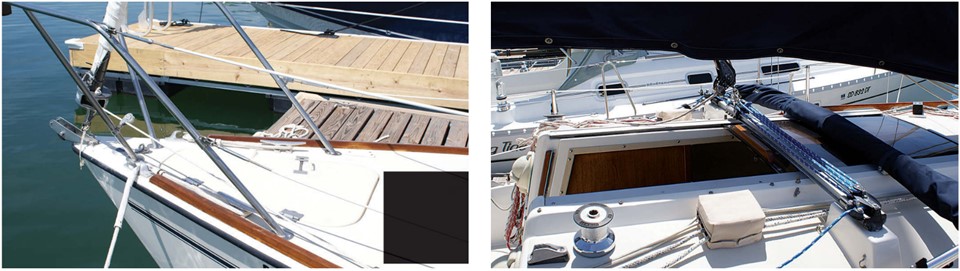
The Pearson 27 hull was hand laid as a solid laminate of fiberglass fabrics and polyester resin. The deck has a balsa core with plywood sections in high-load areas. The hull-to-deck joint is made on an outward-turning flange and it is secured with adhesive and through-bolts. Attractive teak toerails are attached to the deck above the joint. A white plastic molding covers the joined flanges and is capped with a black vinyl rubrail. This typical Pearson hull-to-deck joint has proven to be very strong and relatively leak-free. The only caution is that the cap and protruding joint are more easily damaged in strikes against pilings or piers.
Pearson used a fiberglass pan to form the sole and the foundation for berths and furniture. Hull and deck rigidity is augmented by partial bulkheads tabbed to the hull at the forward ends of the galley and navigation station and by the compression post beneath the mast step. A fiberglass headliner was also installed, but it does not add much rigidity.
The cast-lead wing keel is bolted to the hull. The wing keel allows shoal draft while maintaining decent windward ability, especially when the boat begins to heel and the winglets increase lateral resistance.
The fiberglass rudder is transom-hung on stainless-steel pintles and gudgeons. Its upper section matches the rake of the reverse transom, but the immersed section is more vertical for better control. An outboard rudder eliminates a hull penetration for the rudder stock and is easy to service.
The rig
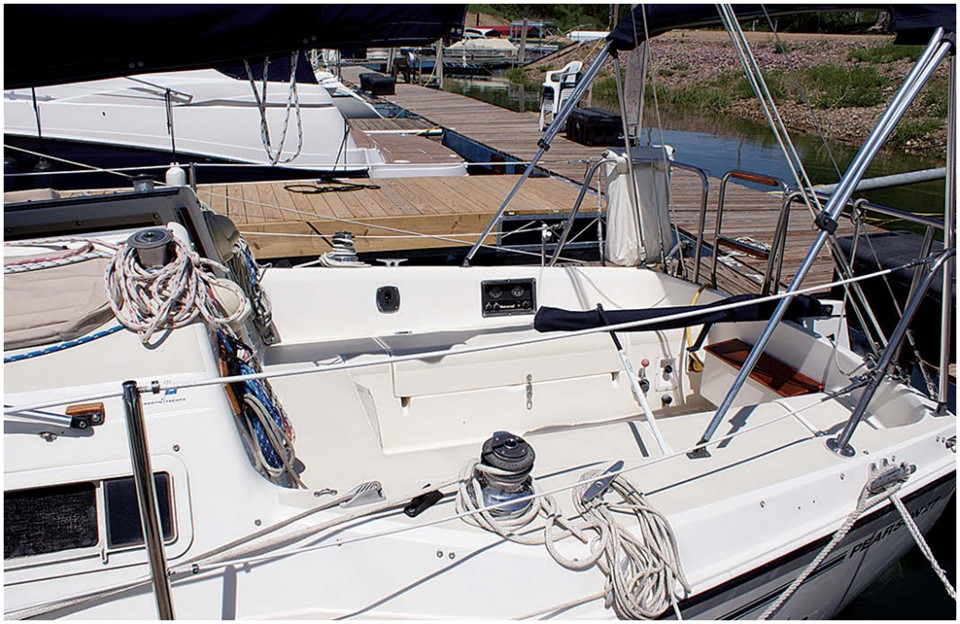
The Pearson 27 has a deck-stepped aluminum mast with single spreaders. The upper shrouds and the single lowers connect to a common chainplate that’s located inboard on the sidedeck next to the cabin trunk and slightly aft of the mast to match the aft sweep of the spreaders. The backstay is split to accommodate the tiller, which was standard. The boom has mid-boom sheeting and internal jiffy reefing.
Lewmar 30 self-tailing primary winches are standard, mounted well forward on the cockpit coamings. Lewmar 8 utility winches are mounted on the cabintop to port and starboard of the companionway, serving halyards and lines led aft through deck organizers.
Deck and cockpit
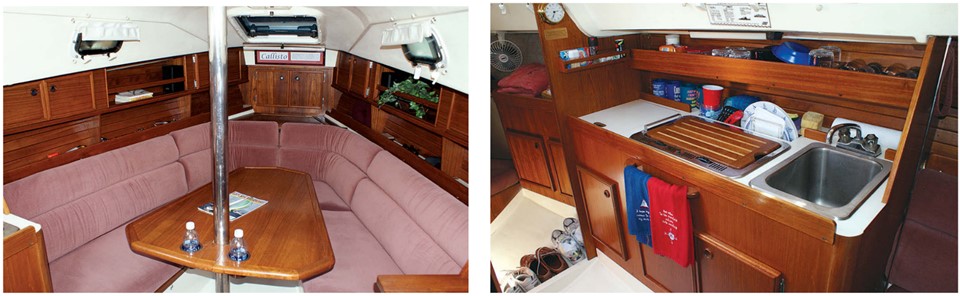
An anchor roller on the bow was standard and there is a generous anchor locker. The locker has a drain that should be checked regulary. If it becomes blocked, as it has on some boats, water can rise in the locker until it flows down into the forepeak area.
Hefty cleats are fitted to port and starboard of the locker cover, aft of chocks mounted well forward. Double lifelines lead from the stainless-steel bow pulpit through three stanchions to the stainless-steel stern pulpit. Pelican hooks in the aft lifeline sections allow the lines to be lowered for boarding.
There is a large Lexan hatch on the sloping forward end of the cabin trunk. The top of the trunk is gently rounded. Teak handrails along both sides also provide some foot support for crew working at the mast, but they do not extend forward of the mast step. There are no vents on the cabintop.
The companionway hatch has a Lexan panel and slides well forward but has no sea hood. For a 27-foot boat, the sidedecks are relatively wide and, as the chainplates are inboard, the shrouds do not impede crew movement.
The cockpit is very well configured. The seats on both sides extend its full length, providing ample space for a nap in the cockpit, even for a 6-footer. Although wheel steering was an option, the cockpit seats were unchanged on boats so equipped. A bridge deck joins the seats at the companionway, lessening the chances of a boarding sea flooding below.
A generous cockpit locker is accessible under the starboard seat and a small cooler is located under the aft end of the port seat. High coamings provide good back support.
Belowdecks
In a pleasing departure from the conventional layouts found on most competing models of the period, the Pearson 27 has an open cabin — with headroom of just over 6 feet — that creates the feel of a much larger boat. It has no private V-berth cabin. Instead, long settees to port and starboard sweep forward, where they wrap around a tapered table that can be lowered to create a large double berth. The compression post beneath the mast passes through the aft end of the table.
Opening ports along both sides, together with the forward hatch and companionway, create ample light and ventilation below. The fiberglass overhead liner completes the bright and airy feel of the saloon. The boats were delivered with upholstered liner panels on both sides of the saloon above the seats.
Aboard Callisto, I found an attractively modified saloon. Dave and Aileen explained that a prior owner had replaced the upholstery panels along both sides of the saloon with teak ceilings. Above them, under the sidedecks, he installed very functional shelving, both open and with sliding panels. He also fitted a double-door storage cabinet forward. The work was done with a cabinetmaker’s skill and matches the original joinery so well it’s hard to believe it was an addition.
The galley lies to starboard, framed by the bulkhead at the companionway and a partial bulkhead at the aft end of the settee. It features a two-burner Origo alcohol stove with a cutting board cover and a single stainless-steel sink plumbed with pressurized water. Dish storage pockets are fitted behind the stove and more storage is provided on shelves above the counter and in lockers beneath it.
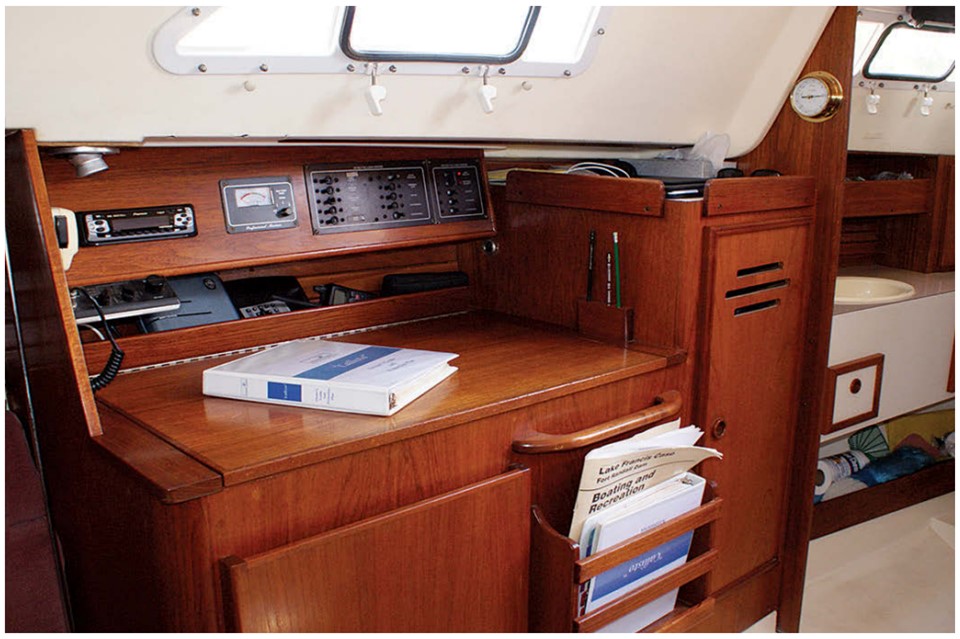
The navigation station is along the starboard side, aft of the partial bulkhead at the end of the settee. It has a sizable chart table facing the hull, with a 3-cubic-foot icebox under it and the electrical panel and shelf storage above and outboard. Toward the stern there is a small hanging locker.
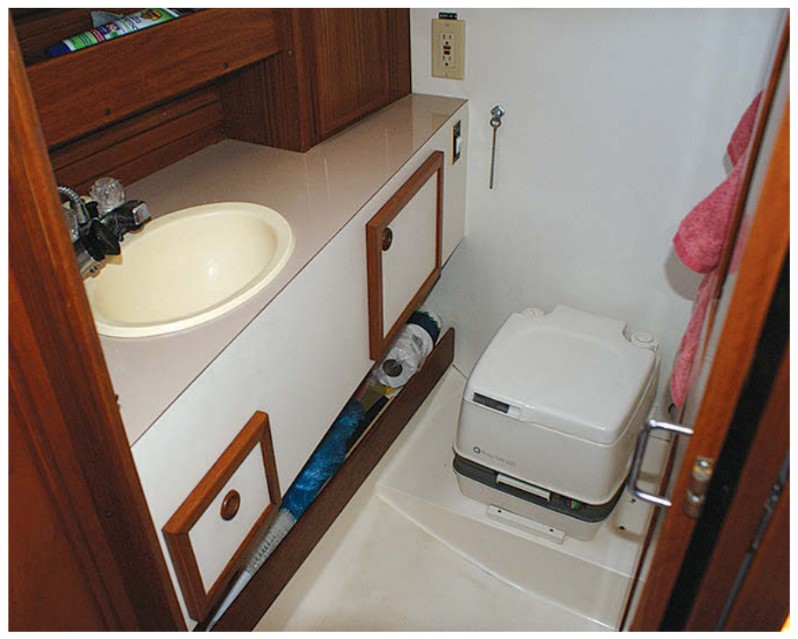
The head compartment is behind a full-height teak door to starboard, aft of the navigation station. Standard boats have a forward-facing marine toilet and a 12-gallon holding tank. Because of the lack of pump-out facilities at the lake, Dave and Aileen have fitted Callisto with a portable toilet. An oval sink in the vanity along the hull is also served by the pressure water system. Shelf storage is provided above and below the vanity. An opening port provides light and ventilation.
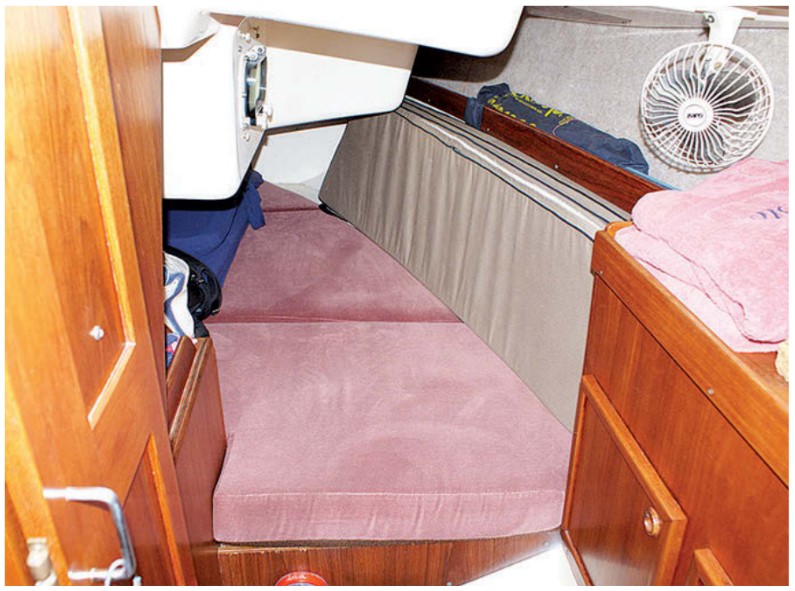
A surprisingly large aft cabin is to port and aft of the galley, separated from the main cabin by a tri-fold teak door. The forward end has a dressing area and storage drawers plus another opening port. The double berth extends aft beneath the cockpit seat. A second opening port installed in the inner side of the cockpit well provides cross-ventilation for the aft cabin.
Under power
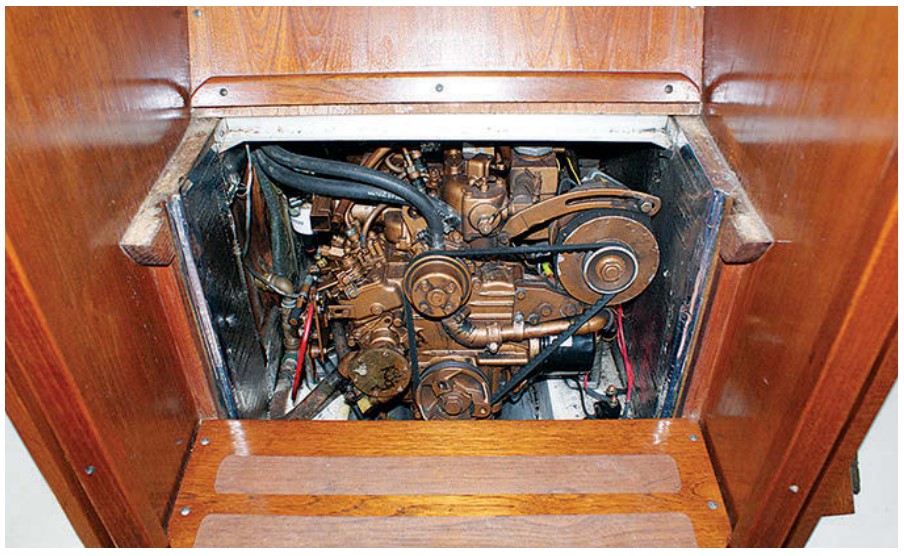
Callisto’s Universal M-12 diesel lies below the cockpit sole and aft of the companionway ladder. Removing steps and risers on the ladder allows decent access to it. The boat moves smartly under power with the tiller and transom-hung rudder providing good control. Tracking is precise and there is no apparent tendency to wander from a straight course when the tiller is centered. Backing is also easy, with some prop walk.
Sailing
Our hosts Doug DeGooyer and Deb Lumendahl welcomed us aboard our chase boat, a beautifully restored O’Day 25 named Dacotah. We left the marina and watched as Dave and Aileen raised sail and got Callisto under way. Doug and Deb kept us in good photography range as Callisto moved around us on all points of sail.
At last it was time for us to give her a try. Sandy and I stepped aboard to join Dave and Aileen. Winds were not strong, but there was ample breeze to test the helm and feel the response. The tiller was a refreshing change for me since it reminded me of smaller, more responsive boats, and the rudder, located well aft, provided quick and nimble steering. Callisto pivoted nimbly on her short keel and was easy to control. Going to windward in a gentle breeze, we noted some leeway being made since the shoal keel doesn’t offer much lateral resistance. However, when the breeze picked up a bit and we began to heel, the winglets on the keel dug in and windward tracking improved. In the lighter breeze, we were optimized at a bit under 40 degrees apparent. Performance might improve a little as the wind picks up.
We cracked off onto a beam reach and she quickly picked up the pace while gaining a slight amount of desirable weather helm. Adjusting sail trim was easy and quick. The cabintop-mounted traveler makes it more difficult to singlehand the boat, but sailing with just one crew is a pleasure.
Once we bore off the wind, Callisto settled into an easy run, responding well even in the light conditions. There was not enough breeze to really judge whether she will exhibit any roll, but she felt solid and stable.
Sailing the Pearson 27 is much like sailing a larger boat, albeit a tiller-steered one. The solid feel and quick response make it a very able performer and one that will likely do well around the buoys in PHRF club racing. The base rating for these boats is 204 in New England, and that’s a better rating than the O’Day 272 at 225 or the Hunter 27 at 219.
Price and availability
A recent check of available boats found four listed for sale at prices from $15,000 to $26,500 for an average just over $20,700. There is no apparent reason for the wide range other than condition. Both tiller- and wheel-steered boats were among those available.
Tom Wells is a contributing editor with Good Old Boat. He and his wife, Sandy, have been sailing together since the 1970s and own and sail a 1979 Tartan 37, Higher Porpoise.
Thank you to Sailrite Enterprises, Inc., for providing free access to back issues of Good Old Boat through intellectual property rights. Sailrite.com