Storing life’s essential element
Issue 78 : May/Jun 2011
Water is necessary for living aboard a boat. Since a gallon of water weighs 8.3 pounds, full water tanks can be very heavy and should be installed as low as possible in the boat, preferably on the centerline. In practice, this is often impossible. It’s not an option in most small boats or in boats with shallow bilges. Alternative locations are beneath the V-berth, which is on the centerline, or under saloon settees or quarter berths. If tanks must be located far from the centerline — such as under settees or quarter berths — a good solution is to fit a tank on each side of the boat to maintain trim. The weight of an off-centerline tank might also be balanced by the galley or by heavy stores, such as canned goods, on the opposite side of the boat.
Water tank materials
Water tanks can be made of many materials including stainless steel, aluminum, Monel, fiberglass, polypropylene, polyethylene, high-density polyethylene (HDPE), and polyvinyl chloride (PVC). Each has its advantages and disadvantages. Tanks are available in many shapes and sizes and they can be made to order to fi t oddly shaped spaces.
Plastic water tanks are considerably lighter (about 40 percent) than metal tanks, and have the added advantages of being seamless and corrosion-free. They also cost considerably less than metal or fiberglass tanks of comparable size.
It is important when building a water system from scratch, or when modifying an existing one, to use only materials approved by the Food and Drug Administration (FDA) as safe for use with drinking water.
Water tank size
Although the largest water tank possible would seem to be ideal, this is not necessarily so. The weekend sailor who uses his boat only one or two days a week, and takes showers ashore at a yacht club or marina, might find that the water in a too-large tank will become stale before it can be used up or replaced. Under these circumstances, a smaller tank, or more than one small tank, will be more practical.
Hundreds of pounds of water surging back and forth as the boat pitches or rolls can put undue strain on the water tank and its mounts. It’s important, therefore, for large-capacity tanks, whether rigid or flexible, to be fitted with baffles to restrict the water’s movement.
Water tank fittings
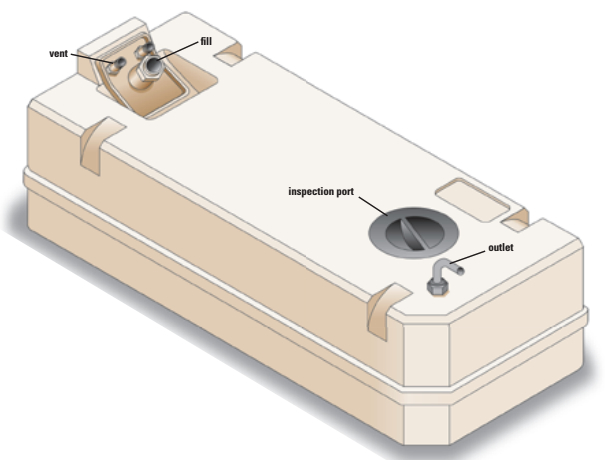
The typical rigid water tank has four openings.
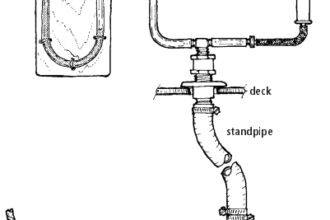
- Fill – Most boats are fitted with fill plates on deck. A large-diameter hose connects the deck plate to the fill fitting on the water tank. Often this hose has a Y-valve for directing the water to either of two tanks. The deck fill should be prominently marked “WATER” and preferably be located as far as possible from the fuel-fill deck plate so there’s no chance of confusing the two.
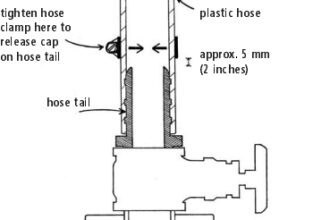
- Outlet – The fitting for the outlet, or supply, is usually located at the lowest point in the tank. It is commonly a 1/2 -inch hose barb.
- Vent – A fitting in the top of the tank is for attaching a vent hose. The vent allows air to replace the water as it is withdrawn (and air to escape when the tank is filled). The vent line is routed to a high point inside the boat. Avoid leading the vent to a fitting on the outside of the hull, since outside water could come in when the boat is heeled or when waves strike the hull. An air vent is not necessary with flexible (bladder) tanks.
- Inspection port – A large screw-type hatch at the top of the tank (usually 3 inches or larger in diameter) makes it possible to inspect and clean the tank (not all tanks have this fitting). This is also where an internal water-level sensor can be mounted. (External tank-level sensors are also available). A large tank with baffles might have more than one large access port.

Doing it yourself
If you have to replace a tank that was installed when the boat was manufactured, chances are you’re in for a very messy and frustrating job that could entail tearing up the cabin sole or interior furniture. Installing a new tank in place of the old one is usually a major undertaking.
Don Launer, a Good Old Boat contributing editor, built his two-masted schooner, Delphinus, from a bare hull and has held a USCG captain’s license for more than 34 years. He has written several books, including Navigation Through the Ages and The Galley: How Things Work, and frequently gives talks on the history of navigation.
Thank you to Sailrite Enterprises, Inc., for providing free access to back issues of Good Old Boat through intellectual property rights. Sailrite.com