How to eat well despite a lack of space and equipment
Issue 37 : Jul/Aug 2004
Eating well is an integral part of boat safety. A hungry crew is more prone to seasickness, lethargy, and lower morale. Any one of these conditions can adversely affect the cruise. However, many owners of trailerable boats overlook this aspect because, I suspect, their Spartan galleys make food preparation a daunting task. This does not have to be the case. Like any other aspect of sailing, a little forethought, preparation, and proper equipment can add to the safety and enjoyment of the outing.
A trailersailer’s galley can take many forms depending upon the type of sailing it does. If you usually daysail, your galley may be nothing more than a picnic basket, cooler, and insulated thermos. While this is the simplest galley, it can be versatile, producing meals from cold-cut sandwiches to wine, caviar, and paté using paper plates or leaded crystal and linen napkins. You are only limited by your imagination. You may choose to dine on board or, depending upon your sailing area, in a secluded cove, on a picturesque beach, or in a picnic area. Its versatility is what gives this galley its appeal.
Trailerable pocket cruisers used for weekend adventures or longer usually have a dedicated galley of sorts, and your planning and creativity will be centered on it. For a couple of days on the water, you can rely more on perishable, home-prepared, and otherwise bulky food stocks. Weekenders often have the added versatility of having a lot of activities on shore. Grilling and picnicking ashore allows you to use your standard backyard barbecue techniques for meals and also provides you with unlimited preparation space, a commodity not available on your boat.
A new dimension
For trailersailors who spend most of their cruise on the water, the galley takes on a new dimension. Just because your galley is small does not necessarily mean that your meal options need to be limited. However, as the amount of time you spend on board increases, you will want to decrease the amount of perishable, home-prepared, and bulky food stocks. Your onboard galley equipment will also change with increased time on the water. Don’t be envious of the daysailer with his wine and caviar. With careful planning and equipping the galley ahead of time, you can also be enjoying those finer things. Think “out of the box” — or in this case “out of the boat.”
Cruising on a 22-foot trailerable, we have developed a galley that allows us maximum versatility and variety in minimal space. Our approach to the galley on board Splash is not that much different from our approach to backpacking. Having close to 30 years of Scouting experience, we merely modified our woodland techniques to account for our change in venue. While we’re talking about backpack provisioning, we’re not talking about trail mix, beef jerky, and freeze-dried foods. Rather, we enjoy meals like rice scampi, calzones, and beef pot pie.
Our technique for selecting galley equipment (also sailing gear and provisioning, for that matter) is based on our “three-pile method.” Everything (and we mean everything) that goes on board goes through the same selection process. The first pile consists of those items that we absolutely, positively, must have on the boat. In the second pile are those things that would be nice to have along, making life easier or more comfortable. The third pile contains those items that can be broadly classified as “luxuries.” Once we have our piles established, we stow everything from the first pile, skip the second altogether, and select one or two things from the third pile. How else could we reasonably include our wine glasses and corkscrew? Once things are stowed, we check for space. This is our opportunity to stow a few things from the second pile.
Non-skid bottoms
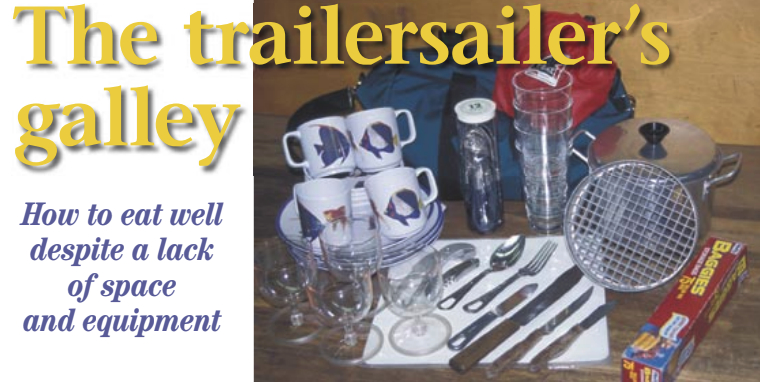
Instead of relying on disposables, we use real, unbreakable dishes, cups, glasses, and flatware. These have non-skid bottoms or have been modified by the addition of silicone beads to their bottoms. Another way to make these items non-skid is by using rubberized non-skid drawer liners as placemats. Using real eating utensils makes us feel more at home and decreases the amount of trash that we need to store on board. Going back to one of our backpacking corollaries (“what you bring in, you need to bring back out”), if we bring in a minimum amount of disposables, we’ll have a minimum amount of trash at the end of the cruise. It is possible to generate a lot of trash if you do not plan carefully. Once the trash is generated, it becomes unwanted cargo until you reach a port where it can be tossed out.
Refrigeration on a trailersailer means an ice chest. Ideally, depending on your space, two ice chests would be better: one for frozen items, which is opened up maybe once a day, and a second one that you go into more frequently. But most trailersailers will only allow space for a single ice chest. In any case, consider keeping a separate, smaller, soft-sided cooler containing cold drinks and snacks readily available in the cockpit. The fewer times you open your galley ice chest, the colder the food will stay.
Food preparation usually requires some degree of slicing or dicing. An assortment of knives and a cutting surface are essential in the galley. Our knife assortment consists of a small paring knife, a mid-size serrated-edge knife, and a large chopping knife. With these knives we can prepare fruits, vegetables, meats, and fish. Some pocket cruisers are equipped with a cutting board that covers the galley sink when not in use, but ours is not. We have had good luck using an inexpensive plastic cutting mat purchased from a marine retailer.
Backpack kit
Our collection of pots and pans has been scaled down to a stainless-steel nesting backpack kit. The kit consists of a frying pan and three pots. For serving and cooking pieces, we have found that the oversized fork and spoon from a stainless-steel, government-surplus mess kit are sized just right. Our Scouting adventures gave us a lot of experience cooking in heavy cast-iron Dutch ovens. While we don’t consider a Dutch oven to be a good choice in your trailersailer’s galley, we find that Dutch-oven pliers come in very handy. These versatile pliers are meant for grasping hot cooking vessels, either with the pliers portion itself or by using the hook on the opposite end to loop the bail on a pot or kettle.
We wash our galley gear in the water around us, using dish soap, and then rinse things with a spray bottle of potable water to which a few drops of chlorine bleach have been added. The rinsed gear is placed in a mesh bag and hung outside to air dry. When the gear needs to be quickly stowed below, we dry it with a chamois. We have found that a synthetic chamois works just as well as the more expensive natural chamois.
Even though you can minimize cleanup by not using real dishes, cups, and flatware, the cooking utensils still need to be cleaned. However, we have discovered a cooking technique that spares us ever having to scrub our cook pot.
Novel cook pot
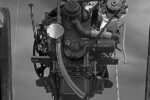
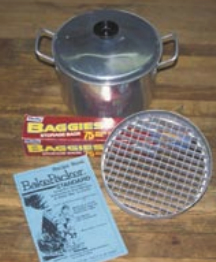
The BakePacker is the most novel galley item we discovered while backpacking, and I have found it to be very useful aboard our trailersailer. This is a cook pot accessory in the shape of a 7 3⁄8-inch-diameter vertical aluminum grid (see photo on Page 14). It was developed and originally promoted as a way to help American soldiers reheat prepared foods in winter conditions. The BakePacker became popular among outdoorsmen as a better way to prepare their food.
This cook pot accessory is designed to cook solid foods, although it is not a steamer or pressure cooker. It is an aluminum grid that fits into your 7 1⁄2- to 8-inch cook pot and functions as multiple mini-heat exchangers. Water is poured into the cook pot to the top level of the grid. The food to be cooked is placed in a 1-gallon freezer/storage plastic bag or an oven roasting bag and then set inside the pot on top of the grid. The cook pot is then covered with its lid, and the water is boiled. The rate of heat transfer from the water via the BakePacker grid to the food in the plastic bag is higher than that of traditional cooking techniques. This is accomplished at a relatively low temperature of 212° F. Cooking is done by means of the grid, not from the boiling water.
Since the food is cooked in a plastic bag, it does not get scorched or dried out. Due to the high heat transfer rate, foods cook faster, and you can actually bake in the cook pot! The BakePacker Standard version cooks enough food to serve three to four people. Furthermore, with the Bake-Packer, cleanup of the cooking vessel is non-existent. What you are left with is a cook pot containing about an inch of hot water, which you can use to wash your eating utensils, unless you decide to use it for coffee or tea.
As the length of our time out on the water increases, it is important to have cooking versatility. We wouldn’t want a steady diet of one-pot meals from the BakePacker. By combining traditional cooking methods (with our stainless-steel nesting backpack kit) along with the BakePacker cooking method, we can vary our diet and meal types.
No experimenting
Since both of us have scientific backgrounds, we tend to take a rather analytical approach to life in general. When it comes to meal planning for our trailersailing, an analytical approach helps to decrease the number of unwanted surprises and disasters in the galley. Another one of our corollaries is: no experimenting with a new recipe on board. All recipes are tried first on shore, even using the same pots, pans, stove, and utensils that will be used aboard. This not only determines the viability of the recipe, but also its complexity, timing, and whether or not we even like it.
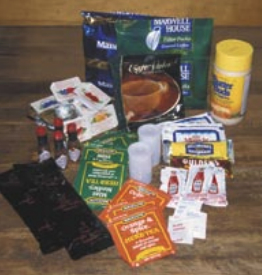
When planning a sail, we also plan the meals. Once the menu is set on paper, we figure out what ingredients are needed. Keeping in mind that space is limited, we usually don’t have a full-sized container of anything aboard, unless we know that the whole amount is necessary for the planned recipes. Typically, we take just enough onion powder, garlic, flour, or paprika called for in the recipes. We use little vials and pouches specifically designed for small amounts of spices (available at outdoors stores), 35-mm fi lm canisters that are labeled, and even labeled zipper-type bags to hold what we’ll need. Fast-food restaurant packets of condiments are great, unless a recipe calls for a larger amount. Many food products that you buy will be exorbitantly packaged. Eliminate any unnecessary and bulky packaging before you stow it in the galley.
The galley aboard a trailersailer is what you make it, and meals can range from a brown bag to a gourmet meal. All it requires is a little forethought, imagination, and the right equipment. Of course, knowing a little bit about how to cook is also helpful.
Bon appétit!
Thank you to Sailrite Enterprises, Inc., for providing free access to back issues of Good Old Boat through intellectual property rights. Sailrite.com