As Einstein pointed out, it’s relative — but even for lesser mortals who sail good old boats, it’s relatively complicated
Issue 10 : Jan/Feb 2000
I received a radio license in the mail some time ago, and it gave the renewal date as “09.” It took me by surprise, as I realized that this meant the year 2009. As the millennium approaches, computer programmers are scurrying to modify software for the year “00,” and programs for business and government computers are being examined for potential disasters. This all results from mankind’s having arbitrarily divided life into discrete intervals of time — so let’s take a look at how these segments evolved.
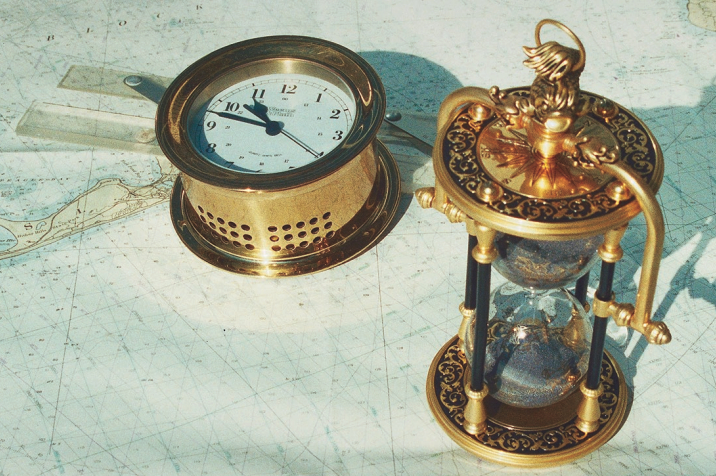
When we check the time while we’re afloat, we normally just look at a watch or a marine chronometer in the cabin — that’s all there is to it. If we need more accuracy for resetting clocks and watches, our GPS provides a convenient reference to “true” time, or we can tune in to the radio signals of the National Institute of Science and Technology (NIST) in Fort Collins, Colo. The time signals they broadcast originate in their atomic clock, which deviates less than one second in a million years.
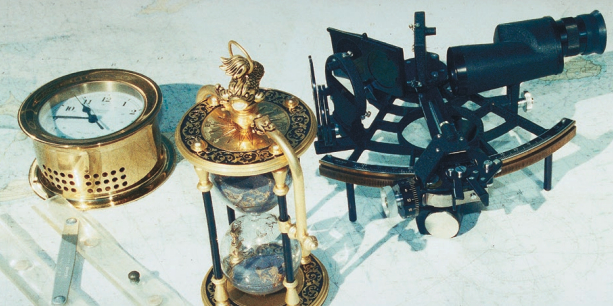
Of course, there are those time/speed/distance calculations that have to be done occasionally. And for the offshore sailor, time correct to the second is essential for celestial navigation. For most of us, however, our only concern when it comes to time is resetting our clocks, watches, tape recorders, and answering machines twice a year between Standard Time and Daylight Saving Time. As for determining the date, we just look at our calendar or wristwatch without a thought.
The more we examine the subject, however, the more we realize that the time of day and the dates of history are not the stable mileposts we once thought they were, but rather mankind’s sometimes inept way of linking a written calendar with the movement of heavenly bodies.
Three basic guideposts have been used by diverse cultures throughout the ages to determine time and dates:
- The day: one rotation of the earth on its axis.
- The week: loosely, one fourth of a lunar month.
- The lunar month: the time it takes the moon to revolve around the earth.
- The year: the time it takes for the earth to orbit the sun.
Oldest observatory
Scientists theorize that the monuments at Stonehenge, England, constructed about 1500 B.C., may be the oldest solar observatory surviving today — one that was based on measuring special events in the passage of the sun.
What is the problem, then, with basing our time and dates on the heavenly bodies? Well, for one thing, the exact time and the dates we learned in history class are not necessarily what they seem. If you look at your calendar, George Washington was born on February 22, 1732. But if you were to ask George when he was born (no mean feat), he would say, “February 11, 1731,” — a different day and a different year. How come?
The big problem in measuring time began when man first started to record events based on the lunar month. The early Roman high priests regulated the calendar, but they did their job poorly. By 46 B.C., those lunar calendars had become so hopelessly confused that Julius Caesar ordered a new calendar system — the Julian Calendar, named after him — to be inaugurated. The Egyptian calendar, devised by Egyptian astronomer Sosigenes, was much more accurate than the Roman calendar, and this is the system Caesar adopted. It seems that Caesar found more than love in Egypt.
The new Julian calendar specified that there would be 12 months in the year (roughly based on the lunar cycle), alternating between 30 and 31 days each, with the exception of February, which would have 29, except on every fourth year, when it would have 30. This “leap-year” day was added whenever a year was divisible by four, to make up for the fact that it took the earth 365 1/4 days to rotate about the sun.
Robbed a day
But when Julius Caesar inaugurated the new calendar, things didn’t quite match up with the heavens, so during that first year they had 15 months. Later, Emperor Augustus felt slighted because the month bearing his name had only 30 days, so he robbed a day from February to make August as “big” a month as July, which was named for Julius Caesar. Already, you can see that we’re in trouble.
But once all the confusion was straightened out, it seemed that everything was progressing nicely. All was right with the world. Or was it? Actually, 365 1/4 days was 11 minutes and 14 seconds short of the earth’s orbiting time. This didn’t seem to be a big deal — but minutes and seconds add up year after year, and some 1,600 years later, in 1580, the spring equinox on the calendar was 10 days before the actual time when the sun crossed the equator. This was unacceptable to the Vatican, since Easter’s date is based on this spring equinox as well as the lunar phase. Again, things were starting to become messy.
In 1582, Pope Gregory XIII assembled a commission, which included the best astronomers of the age, to solve the problem. As a result of that commission, the Gregorian calendar, named for the Pope, was adopted. The calendar for that first year was rather unusual. The day after October 4 was October 15. This was a neat way of skipping 10 days, and bringing the Christian world’s calendar in step with the solar system once again. To make sure this error didn’t happen in the future, the calendar was once more modified with the rule that every 400 years, the extra day in February would be eliminated on a leap year. Wow, they finally had it all straightened out.
Queen’s orders
But even with this modification, the Gregorian calendar is not perfect. It has an error of one day every 3,300 years — and we haven’t reckoned with religion and politics. The new calendar originated in Italy, a Catholic nation, and was quickly adopted by other Catholic nations. But England was a Protestant nation in the middle of a religious reformation. They wouldn’t be told by a Catholic nation what calendar they should use. So, by order of Queen Elizabeth I, England remained on the old calendar. Not a big deal? Wrong!
As time passed, the disparities between the two calendars grew. If a Canadian trapper left Quebec on a one-day trip to New York on January 15, 1690, after he paddled his canoe across the St. Lawrence River and landed on the New York shore, the date would be January 5, 1689. Seemingly, he would arrive in New York more than a year before he had left Canada. Talk about a time warp.
How could this happen? Well, French-speaking Quebec used the calendar of Pope Gregory. New York, on the other hand, was using the old Julian calendar. In the Julian calendar, New Year’s Day is March 25, so that January, February, and most of March were part of the previous year. You can see the fix they were in.
Finally, by the early 1700s, most countries changed over to the Gregorian calendar — but England was still a holdout. Since international trade was beginning to proliferate, and the confusion was mounting, something had to be done. At last, in 1752, England and her colonies decided to go with the “New Style” calendar (they resisted calling it the Gregorian) that put them in step with most other nations. That year, in England, September 2 was followed by September 14, and New Year’s Day became January 1.
For historians, the use of different calendars during that period presents a dilemma when relating the dates of historical events. An event described in English history does not necessarily have the same date as that event described in the history of another nation.
Stumbling block
As we’ve seen, determining the date has always been a problem, but it wasn’t only the calendar that caused problems. The measurement of time during each day has been a great stumbling block, too, especially for mariners.
Less than 250 years ago, ocean voyages were chancy at best because captains couldn’t determine their longitude accurately. To calculate longitude (unless you’re prepared to spend hours using the Lunar Distance method) you need to know the exact time of day, and no clocks of that period could keep accurate time aboard a ship. To reach their destinations when traveling east or west, skippers would “sail a latitude,” that is, go to the latitude of their destination and keep sailing on that latitude until they ran into their destination (sometimes literally).
Pirates and warring nations, on the other hand, were delighted with this arrangement. They would hang around the latitude of a popular destination, awaiting some unfortunate ship that was sailing the latitude to that port. Some poorly educated skippers couldn’t do basic arithmetic and were even unable to do a simple noon sun-sight with a sextant. For them, even latitude was a mystery. There’s the story of an unschooled New England sea captain who would regularly make trips to Bermuda. When asked how he did it without a sextant, he replied: “Well, I just head south ’till the butter melts, then turn east.” The story is probably apocryphal; things were definitely not that simple for old-time sea captains.
Too primitive
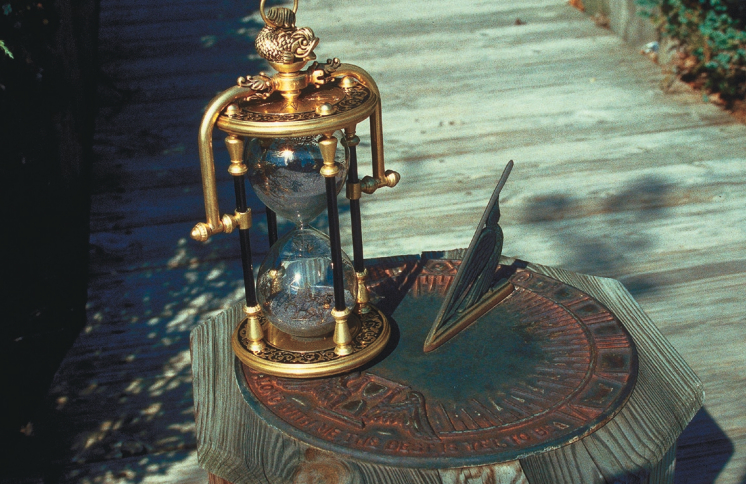
Ships throughout history have kept track of time while at sea but by a method too primitive for determining longitude. During a voyage, time was measured with an hourglass. Actually, it was a half-hour glass. The sailor on watch would ring a bell whenever the sand ran out and the half-hour glass was turned over. The two bells, which indicated the top of the hour, were grouped together to eliminate confusion. The sailors’ four-hour watch was thus broken up into “eight glasses,” and at the end of their watch, it was eight bells. Then the new watch took over, and the process was repeated. The same ship’s bell measurement of time is still being used aboard vessels today, but the hourglass has been relegated to the mantelpiece at home.
The hourglass was a very important fixture aboard ships of that period. It literally governed the sailors’ lives, so much so that many 18th-century pirates, including the notorious Blackbeard, used it as a symbol on their flags, in a defiant gesture to show that they knew their time was running out. Today, about the only time we see an hourglass is on our computer screens when we’re waiting for the machine to perform a complicated function.
In the 1700s, vessels were beginning to travel the world frequently, and the inability to determine longitude was a problem that had to be solved. Finally, England’s Parliament offered the unprecedented sum of 20,000 pounds (about $12 million in today’s buying-power) to the person who could develop an accurate method of determining longitude at sea.
Lunar distance
At that time, there were clocks of great accuracy, but they all depended on a pendulum, which was unusable aboard a pitching, rolling ship. In addition, temperature, humidity, and changes in atmospheric pressure played havoc with the mechanisms. Because clocks seemed impractical, it was assumed that longitude would eventually be determined by observing the movements of celestial bodies. In fact, a method was finally devised, the Lunar Distance method, which measures the angle between the moon and certain stars. This method could determine longitude — but only if you successfully completed more than four hours of complex spherical-trigonometrical calculations. This was not the practical answer to the problem.
A self-educated carpenter proceeded on a different tack. Englishman John Harrison taught himself clock making and set out to build an accurate timepiece made with wooden gears. After 40 years of work, and many political and mechanical frustrations, he developed an accurate shipboard chronometer that used a spring and balance wheel instead of a pendulum. With Harrison’s marine chronometer, longitude could finally be determined by ships at sea, and after many years King George III awarded him the prize. One of his wood-geared clocks, built in 1722, is still operating and keeping good time, but Harrison’s marine chronometer, although incredibly accurate for its time, couldn’t hold a candle to today’s quartz-oscillator watches costing less than $10.
Several definitions
In specifying time, a day is broken up into 24 hours (which originated with the ancient Egyptians). This, in turn, is broken up to 60 minutes in the hour, and 60 seconds in the minute (a development of the Babylonian culture). For measuring periods of less than a second, we (thankfully) use the metric system, with prefixes of milli, micro, and nano. This is all fine, but just determining how long a day is gets complicated. Though we innocently assume that a day is the time it takes the earth to revolve once on its axis, there are several other definitions, which make a day longer or shorter depending on which celestial body is used as a reference point.
The solar day is measured by the meridian passage of the sun — “high noon” — but our orbit about the sun is elliptical, so the speed of the earth changes in its orbit. Thus, the length of the solar day changes constantly throughout the year. This is inconsistent with evenly running clocks so, to solve this problem, the length of a solar day is averaged over the period of a year, and the result is the mean solar day. The difference between the solar day and the mean solar day, is “the equation of time.”
We’ve all seen on globes in school a big figure-eight (usually overlaid on an empty expanse of the Pacific Ocean) called the analemma, a diagram of the sun’s daily declination north and south of the equator, from which the equation of time may be deduced. Our backyard sundial measures the true solar day, which is why it is sometimes a quarter-hour or more off from our clock time, the mean solar day. It is accurately measuring sun time, not the averaged-out time our watches are giving us. By using the analemma graph on our globe to establish the fudge-factor, we can use our sundial to determine the time as we experience it.
Sidereal day
In addition to the mean solar day, we also measure a day in several other ways. There is the sidereal day, which measures the earth’s rotation relative to the stars, rather than its rotation relative to the sun. The sidereal day is about four minutes shorter than the mean solar day. The sidereal day is of vital importance to astronomers and of some interest in celestial navigation. Had enough? There’s more. To name a few other ways of measuring the time of day, we have: Greenwich Mean Time (GMT), Zone Time (ZT), Local Mean Time (LMT), Ephemeris Time (ET), Dynamical Time (DT), Coordinated Universal Time (which is abbreviated with the mixed-up letters UTC), International Atomic Time (TAI), Pulsar Time, Radiometric Time, and, of course, Daylight Saving Time (DST), among others.
Greenwich Mean Time (now almost universally replaced by Coordinated Universal Time) is based on the prime meridian (0 degrees longitude), which passes through Greenwich, England. We use this prime meridian to establish longitude and the 24 time zones around the world. Unfortunately, in the late 1800s there were several different prime meridians. Each country wanted the prime meridian to go through its own territory. England wanted it at Greenwich, France wanted it at Paris, and other nations had their own agendas. Again, time and politics clashed.
In 1884, a conference of 26 nations assembled in Washington (presumably we were a neutral nation) to determine where the prime meridian should be, but the assembly broke up without unanimously agreeing. Most, but not all, of the countries in the world now use Greenwich as the prime meridian, but there has never been any worldwide agreement on the subject.
Millennium greeters
The Millennium First Sail Organization (MFSO) is sponsoring an around-the-world rally to celebrate the new millennium. The sailors plan to be on the International Date Line in the south Pacific Ocean (180 degrees from the Greenwich meridian) when the year 2000 arrives and thus become the first people in the world to greet the new millennium.
Of course, their enthusiasm doesn’t take into account that this new millennium is measured by a calendar that has been modified many times by political and religious factions; that New Year’s Day is arbitrarily January 1; that it’s only the year 2000 because we have 10 fingers on our hands, and count things by 10s; and that it’s only a new millennium for those cultures that use the Gregorian calendar; and that scholars now believe Christ was born several years earlier than we previously thought, so that the millennium actually occurred several years ago. This is the fault of Dionysius Exiguus, a Catholic monk of the 6th century, who made an error in calculating Jesus’ birth year. There’s also the argument that the beginning of the new millennium is actually at midnight on December 31 in the year 2000, a year after their planned rendezvous. Oh well, it should be an interesting cruise anyway.
I’m reluctant to even mention the fact that the earth’s rotation on its axis and its time to orbit the sun are both slowing down, due to the gravitational effects of other heavenly bodies in our solar system as well as the friction produced by our tides. This also requires modifications to a constant time system. And I guess people aren’t too concerned about the “leap-second” that we have nearly every year, when the last minute of December 31 has 61 seconds.
Not constant
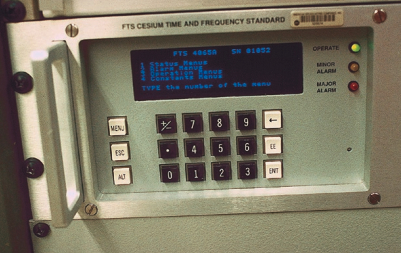
As you can see, all through history we have tried our best to establish the “correct” time and date — and it has been a struggle. When we finally thought we had things pretty well straightened out, along came Albert Einstein to throw a monkey wrench into our best-laid plans. The laws of Galileo and Newton, now called classical laws, considered that time was a constant. But in the first decade of this century, Albert Einstein’s theory of relativity postulated that time is not constant, but varies with speed, gravity, and mass. This theory was proven in the most basic of terms when atomic clocks, based on the resonance of a cesium atom, were taken aboard high-speed jets on around-the-world flights in 1971. When they were returned to earth, their time-difference, as compared to identical atomic clocks that had been on the ground, was just as Einstein had predicted; while traveling at high speed, time had slowed down and the clocks no longer matched those on earth. This was just another of the many proofs of Einstein’s theory that time is not constant. Of course, Einstein’s predictions don’t affect us much, unless we plan an extended trip into outer space, so let’s just be happy with those dates and times that we experience in our everyday lives — our fragile Gregorian calendar, and the fiction of constant time, our Coordinated Universal Time system. Now, would you like to know about the 39 other calendar systems that are in use around the world?
Donald Launer holds a USCG captain’s license and is a frequent contributor to boating periodicals. He has taught celestial navigation and is author of the book, A Cruising Guide to New Jersey Waters. He sails his schooner, Delphinus, out of Forked River, N.J.
Thank you to Sailrite Enterprises, Inc., for providing free access to back issues of Good Old Boat through intellectual property rights. Sailrite.com