At the Wooden Boat Challenge in Georgetown, S.C., a world record falls as a hurricane approaches
Issue 10 : Jan/Feb 2000
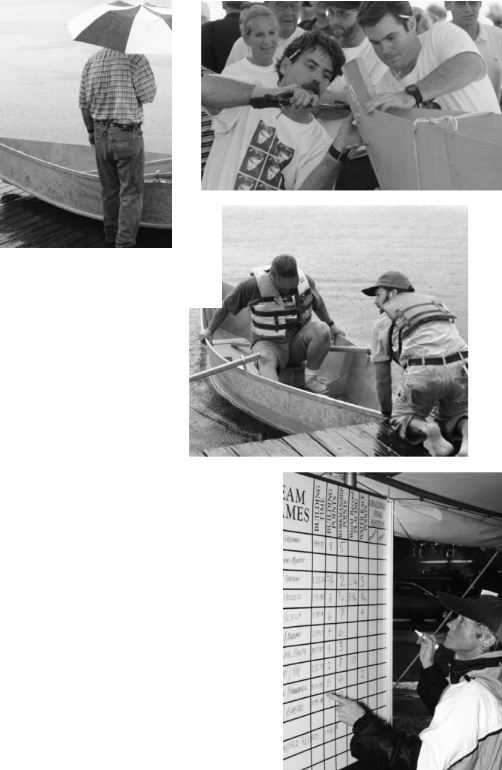
By the time the sawdust had settled beneath a banquet tent by the Sampit River in Georgetown, South Carolina, one Saturday last October, a new world record had been set in competition boatbuilding, and a late-season Atlantic hurricane was well on its way.
As it turned out, on this part of the coast, midway between Charleston and Myrtle Beach, Hurricane Irene blew through the next day as a tropical storm, wet but well offshore . . . not the kind of storm anyone here will remember much about this time next year. As for the boatbuilding, visitors to this year’s Georgetown Wooden Boat Exhibit — and the 12 two-person teams who competed for top honors in the show’s centerpiece, the annual Wooden Boat Challenge — won’t soon forget it. For one thing, sawdusty as it was, that tent was one of the few dry places in a wet, windy town; for another, these guys were fast.
Willie French and Jim Harmon, two local cabinetmakers, built their 12-foot Teal dory in one hour, 27 minutes and 26 seconds, besting Marc Wrenn’s 1998 record by almost a half hour. Two more teams finished within two hours, and almost all the others were done in three.
Times are important in the world-record competition, but quality is equally so: not just because a team of crackerjack boatbuilding veterans examines the worthiness of every seam, joint, cut, sheer, and fastening in the finished boats, but also because the building of these dories is followed immediately by their baptism — a relay race across the Sampit River and back to the town docks. And as one competitor observed, the Sampit — with a steel mill upstream and a paper mill just above that — might not be your first choice for a river to swim.
Standardized contests
Held each October the past four years in Georgetown, the Wooden Boat Challenge had its beginnings in the early 1980s when John Hansen introduced a boatbuilding competition to the Newport Wooden Boat Show. The emphasis of the early, “quick and dirty” contests was on speed, with quality a minor consideration; and since competitors could build almost anything and call it a boat, one early winner built a 15-minute surfboard. Rob Dwelley, a boatbuilder and nautical entrepreneur from Westport, Mass., began to orchestrate more standardized contests in 1987, beginning at the Norwalk Oyster Festival in Connecticut.
“I wanted to establish a world-record event,” he explains, “and to do that we had to have all the competitors build the same boat and meet the same criteria for quality and craftsmanship.”
Dwelley chose the Teal, a 12-foot rowing/sailing dory designed by Phil Bolger, as a boat that a competent backyard builder could finish in a day. For the competition, the Teal is equipped for rowing only. The builders start with uncut marine plywood and lumber, identical sets of plans they’ve received in advance, plenty of marine caulk — all of these provided by corporate sponsors — and whatever tools, power or manual, they bring along. They must adhere closely to the plans, with one exception: they can make their oars any way they like. Once the clock starts under the big tent, each team works in a cordoned-off section as spectators mill from team to team and Dwelley, perched on a high ladder above it all, keeps up a running play-by-play.
Relay rowing
In Georgetown, when the boatbuilding ends, the competition crosses Front Street to the river. After carrying their dories aloft through the crowd, the teams vie for a $500 cash prize in the Goat Island Challenge, which combines the scores for speed and quality of boat construction with the relay rowing race — an event that, to the spectators at least, is equal parts high competition and low, sometimes soaking, comedy.
“When we started the wooden boat show 10 years ago,” says Sally Swineford, a Georgetown restaurateur and key show organizer, “we wanted something that would bring visitors in the fall. Georgetown has been an important seaport since the early 1700s. We wanted to emphasize that heritage and raise money to establish a maritime museum. Since wooden boats are living history, the show was the perfect way to do that. When you add in the boatbuilding, you give the event a whole new dimension — action, competition, fun. We’ve had wives and husbands compete, fathers and sons. We’ve gotten bigger crowds, more interest, every year.”
At day’s end the boat construction tent was converted into a banquet hall for competitors, exhibitors, and sponsors. Rain squalls lashed the sodden waterfront, and what might otherwise have been a lackluster boat show — only a half-dozen or so of the 40 expected in-water exhibitors chose to sail here with a hurricane coming — was hailed a success. Competitors toasted and roasted one another, vowing victory next October.
As for Jim Harmon and Willie French, beaming with the new world record and the “Golden Gun” trophy — a gilded caulking gun, actually — they admitted they’d never match that time next year.
“We’ll be back,” said Harmon, “but we’re talking about doing the whole thing with hand tools, just for fun. We ought to be able to finish a boat inside four hours. Then again, 12 feet is a long way to rip marine plywood with a handsaw.”
“That’s the way of it, these days,” laughed French, a New Zealander. “Soon as a guy takes one world record, he wants to change things just a bit — so he can take another.”
Chip Smith is a writer, photographer, and small-boat sailor living in Murrells Inlet, South Carolina.
Thank you to Sailrite Enterprises, Inc., for providing free access to back issues of Good Old Boat through intellectual property rights. Sailrite.com