Issue 10 : Jan/Feb 2000
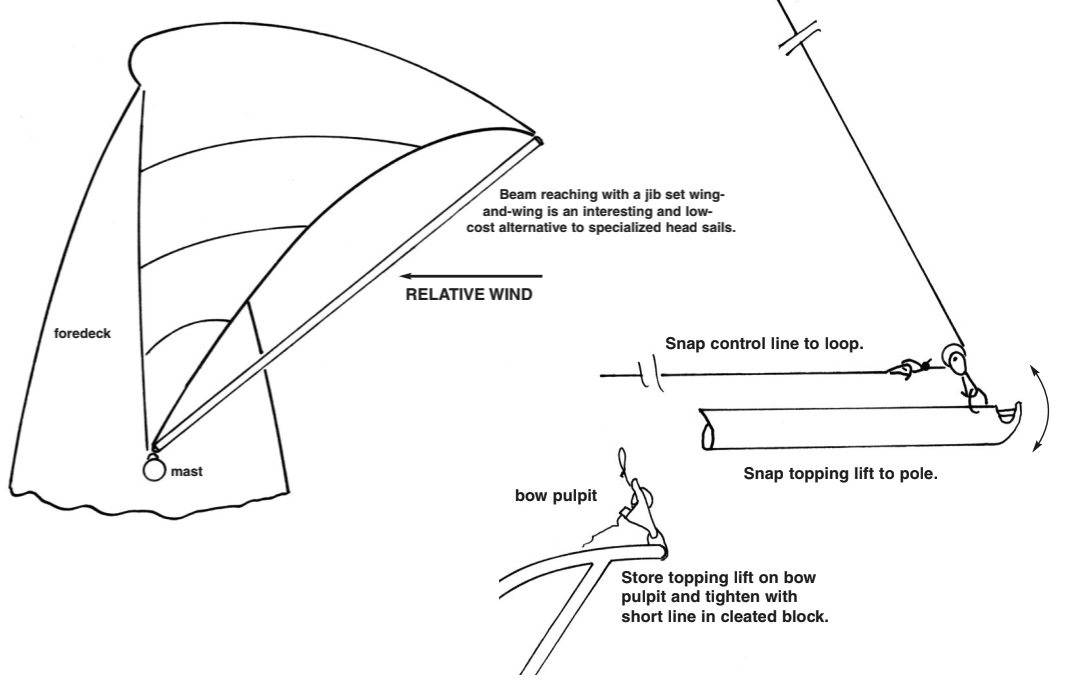
While normally thought of as a downwind technique, it is possible to sail wing-and-wing as high as relative wind abeam. Not only is it possible, it is quite desirable to do so. The boat will be very fast, and there will be a nice overlap in the highest sailing angle using wing-and-wing and the lowest effective sailing angle with the jib eased off and carried to leeward. Near wind abeam, the boat will be quite fast with the jib on either side.
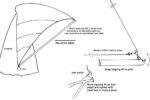
You need a topping lift and some form of downhall to achieve this high pointing angle wing-and-wing. Neither of these needs to be complicated or expensive. When sailing at high relative wind angles, the pole must be quite far forward. The normal luff of the sail becomes the leading edge, and proper sail shape requires that the pole be topped quite a bit to allow the leading edge of the sail to form a fairly deep smooth curve all forward of the forestay.
The trailing edge of the jib (what is normally called the luff when flown conventionally) will look very bad, being hooked back out of the fair curve of the middle of the sail into the stay. Don’t worry about that too much; there is nothing you can do about it, and the jib will pull very well even with this imperfection. Sheet the main in to something more like a close reach. It is sailing in the flow from the jib, and that flow will be from much farther forward.
Steer the boat as high as possible until the sail is on the verge of backing. There is no great loss of control if it goes aback, and a slight alteration of your course will bring it back. If you must sail higher than wing-and-wing will carry, head up, let the jib back, and then ease the windward sheet and let it blow through the foretriangle. This is a nice easy transition. Pull the pole last, or leave it up, if you think you may be able to roll down again soon.
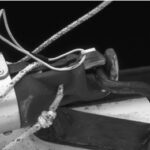
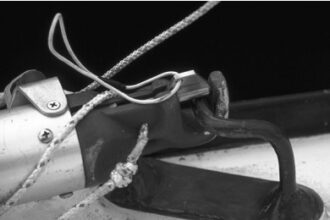
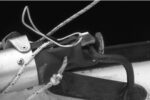
The normal way to install an adjustable topping lift is fairly invasive. I don’t like to drill new holes in my spars because over the years most of the spar failures I’ve seen on most boats have started at holes that were added for new gear. Instead, we ran a line from a spare attachment point on the masthead crane down through a small block attached to a snap shackle. This line is stored on the bow pulpit ahead of the forestay (see illustration above). When we set the pole, we snap the shackle to a loop on the pole end and snap another control line to a loop in the line from the masthead where it comes out of the block. This effectively extends the line from the masthead.
This second control line is led to a cleat on the mast or through a fairlead at the mast base to the cockpit depending on just how serious we really are about flying the pole. If a lot of pole adjustment is anticipated or we expect to be able to sail wing-and-wing for a long time, we run the control to the cockpit.
As the force of the wind increases, it pushes the middle of the sail forward and to leeward and makes the pole rise. This changes the sail shape and causes some loss of control and performance. We move the windward jib block well forward when sailing wing-and-wing so that it is more in opposition to the topping lift. The higher we point, the more forward we move the block. In this way it acts more like a foreguy downhaul on a spinnaker rig. This is particularly important in giving good control at high pointing angles.
I really enjoy flying spinnakers on racing dinghies, but in my opinion a spinnaker on a 30-foot boat would be a handful for the two of us, while sailing wing-and-wing on a beam reach is easy, safe, simple, and almost as fast.
Thank you to Sailrite Enterprises, Inc., for providing free access to back issues of Good Old Boat through intellectual property rights. Sailrite.com