While the rest of the boatyard slumbers beneath a blanket of snow, he steals aboard to reminisce
Issue 10 : Jan/Feb 2000
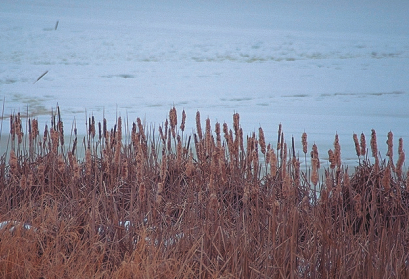
Barnegat Bay lies on the New Jersey coast between Manasquan and Atlantic City. Annually, it changes, like a chameleon, from the bright colors of a summer resort to the slate gray of a no-man’s-land in winter. It is here that I visit my schooner, Delphinus, in the winter months, to provide her comfort and to give her the assurance that there are warm breezes and sunny skies to come.
The road leading to the marina where Delphinus winters in the water passes through the old town of Barnegat on the edge of the New Jersey pine barrens. Heading seaward from town, the woods slowly recede into tidal marshes and streams. There’s an artesian spring just off the road before the marina. Although it’s only a few feet above sea level, it gushes fresh and clear, winter and summer, providing the assurance that not far below, the earth is oblivious to our winter storms. I stop and fill a water jug I’ll use for coffee on board.
Just around the next turn in the road, the scene comes to life. Ahead is an old wooden bridge, arching across a tributary to the bay. The many tidal streams that cut through the meadows and woods are ice-covered and scoured of snow by the malevolent northeast winds. Beyond the bridge, a forest of masts identifies the marina. To the right, the half-submerged sedges that, in warmer seasons, provide the breeding grounds for this interface of land and water, now have their marsh grass combed flat by gale winds and snow.
Standing sentinel
Off the channel, a boat that had lived too long lies submerged, canted on the sloping bottom, her plumb bow proclaiming her years. Beyond the elbow of land where my schooner hibernates, the bay opens up. On the horizon is the island of Long Beach, where Barnegat Lighthouse, dressed in the red-and-white of a British Grenadier, stands sentinel over treacherous Barnegat Inlet.
I drive across the bridge and turn in at the marina. As I move through the trackless snow along the slips, I see unfrozen water around the boats, dimpled by air bubbles rising from the bubbler system. Some boat covers billow like spinnakers in the northeast wind. Others, weighted with ice and snow, hug the contours of the decks, while still others, through either age or neglect, flap in the wind, tattered and ravaged by the gales of winter. Looking farther up the slips, I see my schooner. The winter cover is intact, and she’s floating on her lines. Though I expect no problems, it’s always a relief to see her safe.
I stop the car in front of my slip and get out. Even in daylight, there’s that certain slant of light in the sullen mid-winter sky that gives it an ominous pewter color, subordinating the dimly visible sun.
Mournful song
The shrouds whistling in the wind, the moaning of stretched mooring lines, and the timpani of halyards striking spars fragment the solitude of the marina and transmute nature’s message into a mournful song.
As I stand alone amid the effusion of sounds, I look across the open water in the bay. Wavelets, irritated by the wind, show their teeth as they chew away at the edge of the ice, creating a scimitar of white. The private channel markers — cedar saplings with red triangles and black squares tacked on top — have disappeared, lifted inch by inch by the ice at each tidal change.
Dusting snow scuds across the ice until it falls into oblivion in patches of dark, unfrozen water, where old squaws swim and dive, their black-and-white plumage mimicking their environment.
The cold wind is penetrating. I turn and crawl under the cover of my boat. The gray of the sky enhances the darkness below. In the cabin, I light the kerosene trawler lamp above the table and pour some alcohol into the preheat cup of the stove. As I wait for the coffeepot to steam, I check the through-hulls, hoses, and stuffing box. I pump the bilge dry and add antifreeze.
Closer identification
I pour my coffee and sit down at the settee in the self-enclosed world of the cabin, wrapping both hands around the coffee mug for warmth. To be on board again is a comfort to the soul.
My eyes roam the cabin. There is, for me, a closer identification with my boat than for most sailors, for I built her from a bare hull. I alone know what unseen bulkhead reinforcements, electrical wiring, and backing plates for my deck fittings lie beneath the mahogany paneling. The time-consuming hull insulation, also unseen, was well worth those extra weeks of work, designed to fashion my schooner into a comfortable cruising home.
On the bookshelf my log, charts, and cruising books, although almost new, have the smell of attic-kept books. I pull down the log and leaf through its pages. Last year’s tide table marks my final entry, decommissioning day in November. I thumb through the pages of past cruises, remembering that day in June when we left New York Harbor in a dense fog and 11 hours later turned toward land and saw the entrance buoy to Barnegat Inlet emerge from the mist; and the hot, humid day in the Gulf Stream off Florida, when we took the sails down and jumped overboard for a swim.
Anticipation
Those blank pages of the logbook, yet to be filled, provide the anticipation of cruises to come. This year we plan to explore the estuaries and islands of Chesapeake’s Eastern Shore, and for next fall we plan a trip to the Florida Keys.
The ship’s clock on the aft bulkhead strikes seven bells. I glance up — it’s time to head home. In spite of the cold, as I leave the cabin I feel relaxed and renewed, already looking forward to my next visit. Then there will be only scanty patches of snow, darkening with age, as spring moves north to reclaim the shoreline. The marina will no longer be deserted and the metamorphosis will begin to take place as, one by one, the boats, like living things, emerge from their tarpaulin cocoons, ready to spread their wings of sail.
I lock the cabin door and crawl out from under the winter cover into the cold and gray of reality. Or have I just left it?
Thank you to Sailrite Enterprises, Inc., for providing free access to back issues of Good Old Boat through intellectual property rights. Sailrite.com