Reducing the black art of design to light weight and long waterline
Issue 37 : Jul/Aug 2004
Bill Lee, who introduced ultralights into the sailboat race circuit in the 1970s, calls designing racing sailboats a “black art.” Commenting on the collapse of the carbon fiber mast on Team New Zealand during the last America’s Cup races in Hauraki Gulf, he says the designers pushed the safety limits past the breaking point.
“How close you can get to safety’s edge without failure is always the question,” the Hall of Fame designer explains in his Wizard Yachts brokerage office in Santa Cruz, California. “Building light, but strong, is the issue. And building today’s carbon parts is trickier than using more traditional materials. The orientation of the carbon fibers, their straightness, the resin mix and cure temperature . . . all these are important. You can experiment with those materials in the lab, but if there’s the slightest disconnect in the shop, masts and booms fracture.”
In his own designs, which focused on ultralight-displacement boats (ULDBs), Bill believes he always stayed within the structural safety margin. “Few of my boats had failures,” he says. His approach to sailing became his motto: “Fast is fun,” a philosophy shared by other revolutionary designers like Hobie Alter, who equated his fast catamarans with “fun on the water,” and contemporary designers like George Olson and Ron Moore.
Bill Lee’s brokerage is located in a two-story clapboard building on the edge of Santa Cruz Harbor; his two-room office overlooks a conglomeration of sailboat masts, their halyards making their percussive music in the Pacific breeze. As is typical of California, greenery and flowers are profuse. The houses across the street are as jammed together as in an old-fashioned European village, albeit with a wonderful view of the ocean. One house is listed for sale at $1.6 million — an indication of just how desirable Santa Cruz is as a place to live.
Bill is wearing his trademark red socks and has brought his friendly black dog to work. His bike hangs from ceiling hooks, and a massive painting by Jim DeWitt of Merlin, Bill’s signature yacht, hangs above his untidy desk. Bill is known as an offbeat person as well as an iconoclastic boat designer, with a different cut to his jib, not an easy person to talk with.
Magician’s hat
The term “black art” seems to be part of Bill’s personal and professional life. He refers to himself in the third person as the “Wizard” and often appears in a magician’s hat and a cape covered in stars. Photos from the past and today depict his bearded visage with thick, horn-rimmed glasses that magnify his eyes into bulging globes. His nonconformist approach to boat design, which disdained the “deformities” imposed by the IOR rule and concentrated instead on creating fast boats, was seen by some as demonic, by others as enchanted.
Yet by breaking the bonds of conventional wisdom and standard design rules, he broadened people’s minds on the outside limits of fast boats. As fellow yacht designer Robert Perry says, “Bill just refused to be drawn into the B.S. of letting others tell him what a boat should be.”
In 1971, calling his firm Bill Lee Custom Racing Yachts, Bill built his first racer, called Magic, a 30-footer cored with balsa and weighing only 2,500 pounds. Bill has described it as “too light” and resembling a longish sailboard. Next, he designed and built a 35-footer, Witchcraft, which sailed the South Pacific. After accompanying an owner on a Cal 40 in the 1971 Transpac, he received a commission for a faster boat for the 1973 race. He built two boats, the 40-foot Panache and the 35-foot Chutzpah, which both entered the next Transpac race. The latter took corrected-time honors in 1973 and 1975.
But the innovative, long and skinny “sled” that’s still Bill’s personal favorite, the one that made his name synonymous with dash — some say rash — was Merlin, 68 feet long, 12 feet wide, and weighing only 25,000 pounds (about half of other 68s at that time), with speeds topping out at 25 knots. In 1977, he himself tested this radical boat in the first singlehanded race to the Farallon Islands and won it easily. Later that year, the boat he named after the sorcerer of Arthurian legend outsailed every other boat in the 1977 Transpac by completing the race in a record-breaking 8 days, 11 hours, and 1 minute. Bill arrived in Honolulu to tumultuous acclaim and, for the first time, wore his star-covered magician’s robes — a most unyachtie outfit.
Aerial photograph
Merlin won the Transpac again in 1981, 1987, and 1995. On Bill’s website http://www.fastisfun.com, a 1977 aerial photograph shows the yacht running with main, jib, and spinnaker fully deployed but the bow wave nearly submerging the hull and superstructure — a submarine with sails. “Just one boat winning this most competitive race over a 20-year period says a lot,” says former Santa Cruz production manager Stewart Waring (now at the Westlawn Institute of Marine Technology). “With Merlin, Lee was ahead of his time. And with this pioneering boat he rejuvenated the Transpac.”
The boat’s success eventually led to Bill’s being named “Sailor of the Decade 1977-1987” by Latitude 38 magazine and his elevation to Sailing World’s Hall of Fame in 1992. Merlin was chartered by a number of racers over the years and remained the boat to beat. It’s been sold and altered several times and was for sale at Bill’s brokerage for $219,000 when this article went to press.
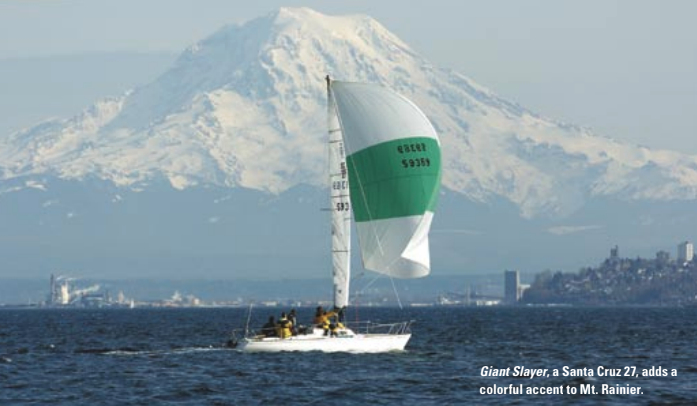
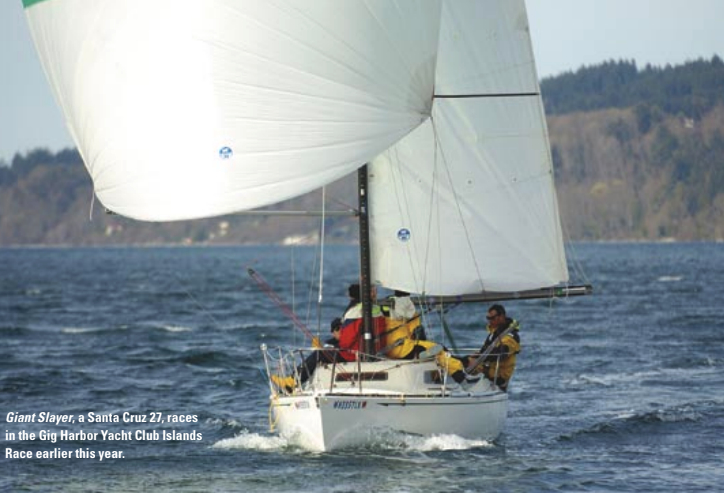
The fast racing sleds were not Bill’s first designs, however. In 1973, a customer walked into his shop (a 200-foot converted chicken coop, which itself grew famous — or notorious — over the next decades) and asked for an IOR Quarter-Tonner like Chutzpah, but in a size he could afford. After studying the racing rules, Bill drew the ultralight Santa Cruz 27 with its 24-foot waterline and 8-foot beam. Its slimness and flat, almost dinghy-like, bottom contrasted markedly with the bulbous, beamy IOR boats in vogue at the time. “Racing rules have ‘go-slow’ factors in them that improve handicaps but reduce speed,” says Bill. “I eliminated the go-slow factors.”
Under the right conditions, the boat can surf in mid-teen speeds. He liked his 27 so much — as did several of his employees, including yacht designer George Olson — that the idea for a production boat bubbled up, and tooling for this one-design class was created. Constructed of roving, mat, and balsa core, the first hull was aptly called Vanishing Point and, although it had a modest 400 square feet of sail area, it could surf in 15 knots of wind. Several owners have singlehanded their 27s from California to Hawaii. Bill calls the 27 a “breakthrough boat, quite conservative, structurally sound, and easy to sail.”
Downwind race
Over the next five years, Bill built 145 Santa Cruz 27s. They became especially popular in the 225-mile Santa Cruz-to-Santa Barbara downwind race, which passes Point Sur and Point Conception, two of the roughest spots on the California coast. To survive the challenges, Bill states he designed the boats to be strong, seaworthy, and offshore capable, with a small self-bailing cockpit, low freeboard, small hatch, and functional — albeit Spartan — accommodations below. “I had some very wild and exciting rides on this course in a Santa Cruz 27,” says Bill. “We learned the answer to the question, ‘How fast can you go in the middle of the night in 35 knots of wind and 15-foot breaking seas?’ Well, just wear your safety harness and be sure to take your spinnaker down before Mother Nature does it for you.”
This highly successful boat is still racing in three fleets: the Pacific Northwest group in Puget Sound and the California fleets in San Francisco Bay and Santa Cruz. The 2003 National Championships were held at Port Townsend, Washington; the 2004 National Championships will be held in San Francisco in August. And in 1997, the SC 27 was inducted into the American Sailboat Hall of Fame. Interestingly, the boat’s base price in 1975 was $8,995; today the prices for used boats listed at the SC 27 National Association’s website range from $5,000 to $19,500.
Santa Cruz 27 offspring
The SC 27 also had offspring. Hobie Alter says that before he designed his monohull Hobie 33, his company bought a SC 27 and analyzed the boat to learn how she could go so fast. “Bill did a great job,” Hobie says. “We knew this boat was the forerunner of the downhill sled. We raced it against another lightweight design, the Olson 30.” On his website, Bill makes a wry comment on the Hobie knockoff. “The Santa Cruz 27 is a much better boat,” he writes, “and they should have come to the Wizard in the first place.” Bill’s love of the water and boats was not part of family tradition. Both his parents were reared in Idaho, and Bill was born there in 1942 in Coeur d’Alene. He remembers being on a boat on an Idaho lake when he was just a tyke, but his real introduction to boating came when the family, with its four offspring, moved to California after World War II. “My father was in law, and the economic opportunities were just so much better in California,” says Bill. “I became interested in boats as soon as I was old enough to notice them. We were in Newport Beach, and next door Costa Mesa was an enclave for boatbuilding: Islanders, Cals, Columbias, and Ericsons were all being constructed there. I was surrounded by boats.”
Like many salty characters, teenaged Bill got his weather legs in the Sea Scouts. He recalls that many postwar Navy veterans were more interested in powerboating, but he got into “the dinghy racing business.” First to test his mettle were the Lehman 10s, fiberglass catboats designed and built by Barney Lehman in the 1950s.
During this time, Bill also acquired a taste for bigger boats. “I’d go around the docks,” he says with a small grin, “and chat people up. Throughout high school I’d get rides on every kind of racing and cruising sailboat. Great experience.” After high school, he enrolled at California Polytechnic State University in San Luis Obispo, studying mechanical engineering because “that’s what I had a feel for.” He graduated in 1965.
During his first job at the Mare Island Naval Shipyard about 20 miles northeast of San Francisco, he built submarine parts. He then performed stress and weight analysis for armored personnel carriers for agriculture and chemical giant FMC Corporation, experience that aided him later in his boat design calculations. He also did a stint working in the food machinery industry. By 1968, he’d moved to Santa Cruz and taken a job with Sylvania. But all along, he “tagged along sailing on other people’s boats and participating in the Wednesday night races.”
Yacht design career
While racing and hanging around docks, he continually analyzed how boats were built, how they sailed, and what impeded their swiftness. Although he never formally studied yacht design, his mechanical engineering training, combined with reading and discussing design with others obsessed with speed, led naturally to his seeking a career in yacht design. The opportunity came after sailing his first Transpac in 1971, on Art Biehl’s Cal 40, Quasar. He received the commission to design Chutzpah.
Unfortunately, Bill was not aboard that boat. “I came in tenth and missed the best parties,” sighs Bill, who’s renowned for his enjoyment of social events and their grog rations. “That’s why I designed Merlin, to get there in time for the parties,” he continues, his tongue only partly in cheek. “The Santa Cruz 27s were the way to pay for it. It was good to be in the boatbuilding business, better than, say, filling teeth.”
Nevertheless, it wasn’t all smooth sailing. Bill had fun building boats, but he had to be a businessman too. “The government makes it expensive to have employees, and I had to meet payroll for up to 40 people every two weeks. So after keeping Merlin for five years, I sold her. She was expensive to maintain. It had turned into a question of the fun-to-dollars ratio.” He turned to building other fast boats. From the Santa Cruz 27, he leapt to a 50-footer, of which 27 were built. Fifteen 40-footers were also completed. The Santa Cruz 33 was another, less-successful design. In 1983, Bill began a series of 70-footers that became a racing class. One of the 20 built became a cruiser; the other 19 were dedicated racers, first competing on the California coast, then moving to the Great Lakes with fleets in Chicago and Detroit.
Maximum waterline
In his ads, Bill described his 70-footer in these words: “We took all of the fast things we knew about and blended them as gracefully as possible with the IOR rule — no bumps, no hollows; just maximum waterline, maximum power to carry sail, minimum wetted surface, and instant boat speed. Just add water. Heavy wind, light wind, upwind, and of course downwind, these new flyers easily do a horizon job on what used to be thought of as fast yachts.” He added that sailing these sleds will “give you that well-justified feeling of superiority.”
In 1983, Bill married Lu, whom he’d met on a sailboat. They have an 18- year-old daughter, Hillary.
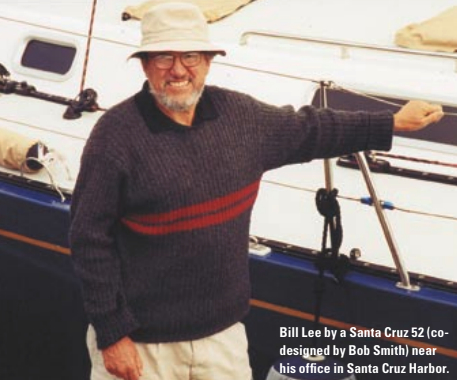
Throughout the 1980s he continued to build boats and race, and in 1992 he and Bob Smith co-designed the Santa Cruz 52, which turned out to be another triumph and was named Cruising World magazine’s 1996 Overall Boat of the Year. It was also the first Santa Cruz that combined cruising and racing elements, even including a proper stateroom with berths. Unfortunately, the success of the 52, of which 28 have been built, did not benefit Bill.
The story of what happened to Bill Lee Yachts and why the firm closed its doors remains sketchy. Bill is vague about the event, saying simply that it was time to move on. According to one source, disputes with an owner over the change orders of a Santa Cruz 70 led to nasty lawsuits in 1994. To avoid bankruptcy, Bill closed down his production facility. When an offer to buy the firm came from San Diego resident Paul Ely, Bill sold the plant.
Running a brokerage
With his boatbuilding days evidently behind him, Lee also stopped designing and switched to running a yacht brokerage. Besides selling yachts, he still keeps his oar in the sailing world. His expertise is sought as a judge of new boats for Cruising World, in the development of Transpac rules and a level class rule for 86-footers, and as a consultant for yacht projects. Does he miss designing? He pauses a few seconds and then says, “You know, there’ve always been more yacht designers than customers. If someone asked me, I might consider designing another boat. It’s not that likely. But I still strongly support sailing, and ‘fast is fun’ continues to be my slogan. But to be out there testing all the time? It’s very wet. Very cold. I’m a bit older now.
“I recently spoke to the Cal Poly graduating class and told them how different things are today than when I attended there,” he says. “New materials are so exotic and completely change how we run and design things — carbon fiber, for example. Instead of a car as a machine, it’s an electronics factory. But I told them there are still lots of opportunities and left them with one idea: ‘The world is not out of things to invent.’ ”
Bob Perry describes Bill Lee with these words: “Honesty, intellect, intuition, and chutzpah in the personality trait sense, not the boat.” High praise from Bob, from whom kind words are difficult to earn. Bob recalls meeting Bill in San Francisco and seeing his designer’s eye at work. “I was hanging out on a dock at the San Francisco Yacht Club Stag Cruise with Bill and some club luminary. A 40-foot Pacific Seacraft went by: shiny and blue. The luminary said, ‘Now there’s a beautiful boat.’ Bill quietly replied, ‘All I see is a boat with no waterline length.’ We all owe Bill a debt. Any sailor who doesn’t revere Bill Lee hasn’t done his homework.”
Thank you to Sailrite Enterprises, Inc., for providing free access to back issues of Good Old Boat through intellectual property rights. Sailrite.com