. . . and two more true double-enders
Issue 87 : Nov/Dec 2012
In the September 2012 issue we looked at three “second generation” cruising boats that had fin keels and separate rudders on handsome canoe-stern hulls. In the same issue we acknowledged the role of the full-keel Westsail 32 in launching the concept of boats designed and built with the real potential for making long voyages while cruising.
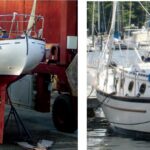
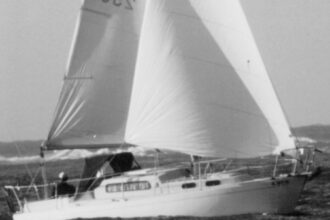
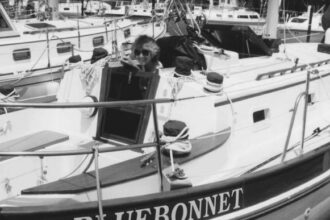
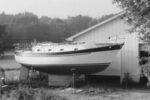
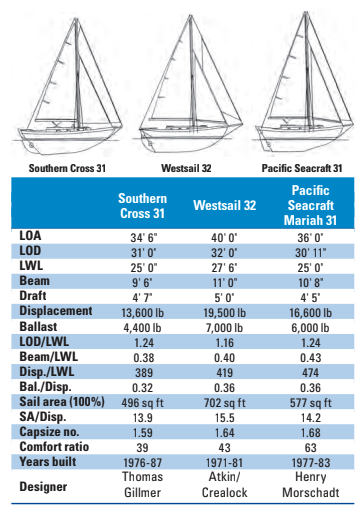
This time, we are looking at those “first generation” fiberglass cruising designs that have true double-ender hull characteristics of a tiller-steered stern-hung rudder on a full keel, high displacement, and a cutter rig with a pronounced bowsprit. It is only fitting, therefore, that we include the 1971 Westsail 32 in this comparison with the Southern Cross 31 of 1976, along with the Pacific Seacraft Mariah 31 of 1977.
It so happened that, in the last issue, we also looked at a Southern Cross and a Pacific Seacraft, both of them with canoe sterns. This further illustrates how the cruising-boat market of this period transitioned from the full-keel Colin Archer double-ender to the higher-performance separate-keel-and-rudder underbody that Bob Perry introduced in the Valiant 40 of 1973. One can only assume that the Valiant 40 influenced these builders when they were developing the later models discussed in the previous issue.
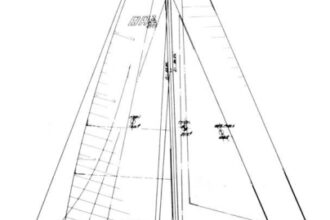
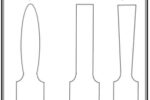
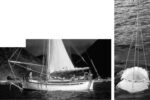
All three of these boats have similar hull forms, with the Southern Cross 31 and the Pacific Seacraft Mariah 31 cutting a little forefoot away to improve tacking and maneuverability. They also all have what has become known as a cutter rig, with a fixed bowsprit to support the headstay and a fixed forestay attached at the stemhead. Although this is not the original version of the cutter rig (see “What is a Cutter?,” page 30), this modern adaptation became established as the preferred offshore-cruising rig on boats of the type we are discussing here. Certainly, Apogee’s remarkable 17-year odyssey reinforces that presumption.
The Southern Cross 31 has the shortest bowsprit, and a plank style at that, which would be safer than the much longer bowsprit on the Westsail 32. Although picturesque, the long bowsprit (called on fishing schooners the “widow maker”) and plum stem have, for obvious reasons, given way to longer bow overhangs and shorter bowsprits. Indeed, it is typical nowadays to see boats labeled as “cutter rigged” that have no bowsprit at all. At C&C, it was not uncommon for us to add an intermediate or staysail stay aft of the forestay and call this the “cutter” option, which is stretching the concept a lot.
Comparing these boats designed for offshore cruising on the basis of around-the-buoys criteria would not be productive. Note that the D/L ratio of the Southern Cross 31, at a hefty 389, is still substantially lower than the Westsail 32 at 419 and the Mariah 31 at 474. Their SA/D ratios are also conservative, with the Southern Cross 31 an anemic 13.9 and the Mariah not much higher at 14.2. The Westsail 32, with its longer bowsprit, fares better at 15.5, but that neglects the fact that its actual double-headsail sail area was usually less than the 100 percent fore-triangle area. Remember, too, that Apogee was floating 4 inches lower than this designed displacement on her voyage, so her actual D/L would have been substantially higher and her SA/D much lower.
The important numbers to look at for these offshore cruising boats are the capsize number, all in the respectable 1.6 range, and comfort ratio, near 40 for the Southern Cross 31 and Westsail 32 and a very high 63 for the Mariah 31, due primarily to its high displacement on a shorter LWL.
All three of these boats have earned reputations as good sea boats, and Apogee’s voyage only enhances that esteem. Whatever we think the numbers may tell us, the results speak for themselves.
Rob Mazza is a Good Old Boat contributing editor. A sailor by passion and yacht designer by vocation, his long career around sailboats began at C&C Yachts back when now good old C&Cs were cutting-edge new.
Thank you to Sailrite Enterprises, Inc., for providing free access to back issues of Good Old Boat through intellectual property rights. Sailrite.com