They grew from similar philosophies but have roots an ocean apart
Issue 86: Sept/Oct 2012
When selecting comparison boats for the Pacific Seacraft 34 (see “The Pacific Seacraft 34 . . . and canoe-stern contemporaries”, Issue 86), I differentiated, in my mind at least, between double-enders and boats with the canoe stern. I did this because I believe each has its own and distinct origin.
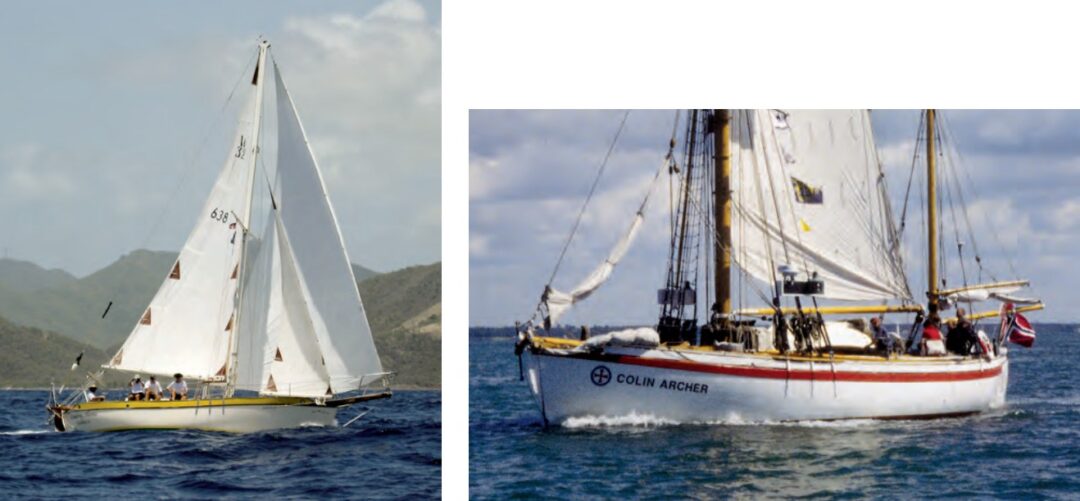
The double-ender is a Northern European design tradition that traces its past to the Vikings and the ships of England’s Cinque Ports. After the the stern-hung rudder replaced the steering oar in the early 13th century, these craft evolved into the Hansa Cog. Stern castles were introduced a little later and transoms soon followed, but the double-ender tradition still continued. It is best known in more modern times through the designs of Colin Archer, a Scot transplanted via Australia to Norway where, in the late 19th and early 20th centuries, he designed rescue craft and pilot boats. (Colin Archer also designed Fram, Roald Amundsen’s vessel for his North and South Pole expeditions.) It was through these pilot and rescue vessels that the “classic” Colin Archer double-ender evolved, with wide beam, heavy displacement, stern-hung rudder, short overhangs, and full-length keel.
Several reasons are cited for the advantage of the double-ender configuration in this capacity, including that in really rough conditions, especially in a following sea, “the stern often becomes the bow” (Bill Crealock). The most logical explanation I have heard is that Archer’s pilot boats and rescue boats often had to go alongside larger vessels to either drop off pilots or rescue crew. When parting company with these vessels, the coxswain wanted to quickly put the helm up and turn away without the transom making contact with the larger vessel and impeding the turn. The double-ender suited this purpose beautifully. This is one reason that all lifeboats are also double-enders.
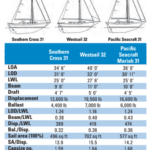
However, it was only after William Atkin adapted the Archer form to smaller boats to produce his 32-foot Eric design in the 1920s for William Nutting, his editor at Motor Boat magazine, that the concept gained a firm foothold in North America. Atkin’s Eric concept was further popularized in the late ’60s with Robin Knox-Johnston’s voyage in Suhaili, an Eric built in India. The production fiberglass Westsail 32, with design input from Bill Crealock, quickly followed and became the model that started the trend to double-ended sailboats designed expressly for cruising.
Canoes for cruising
At about the same time that Colin Archer was designing his Norwegian rescue and pilot boats there emerged, primarily in Britain and later in the U.S., a fascination with canoe yachting. This was yachting for “everyman,” the beginning of small-boat cruising. It started in canoes and, later, sailing canoes, and was popularized by the writings of John MacGregor, who in 1865 had built an English version of a North American canoe. He named the boat Rob Roy and wrote four very popular books over the next several years describing his many voyages through Britain and Europe in that boat and various other Rob Roys.
I said an “English version” of a North American canoe, since these canoes were far removed from their birch-bark ancestors. They quickly evolved into ballasted yawl-rigged sailing vessels but, although they retained their canoe sterns, their rudders were mounted under water on the stern post. (My esteemed predecessor in the Boat Comparison pages, Ted Brewer, designed his own version of the canoe yawl in the Rob Roy 23 for Marine Concepts in Florida in 1983 (see Good Old Boat, May 2003).
The sailing canoe also evolved separately into a purely racing vessel with sliding seats, with which the famous English designer Uffa Fox is most identified. But in the late 19th and early 20th centuries the canoe yawl and the canoe yacht served an important role in opening “yachting” to the middle classes, with the noted American yachting historian W.P. Stephens being an early proponent and builder and a founding member of the American Canoe Association. This “canoe stern” in yachts evolved into a pointed aft overhang, with the rudder mounted under water on the stern post forward of the aft overhang and completely separate from it. These craft had nothing to do with Norwegian pilot boats.
The designer most closely associated with this concept was the Englishman Albert Strange, who popularized the canoe stern on small yachts with yawl rigs before the First World War. Again, the only similarity to the original canoe concept was now the pointed stern. In all other aspects, with their wider beam, deeper draft, and either internal or external ballast on full keels, these were now small yachts designed to be sailed by the owner either singlehanded or with a small crew.
From canoe to cruiser stern
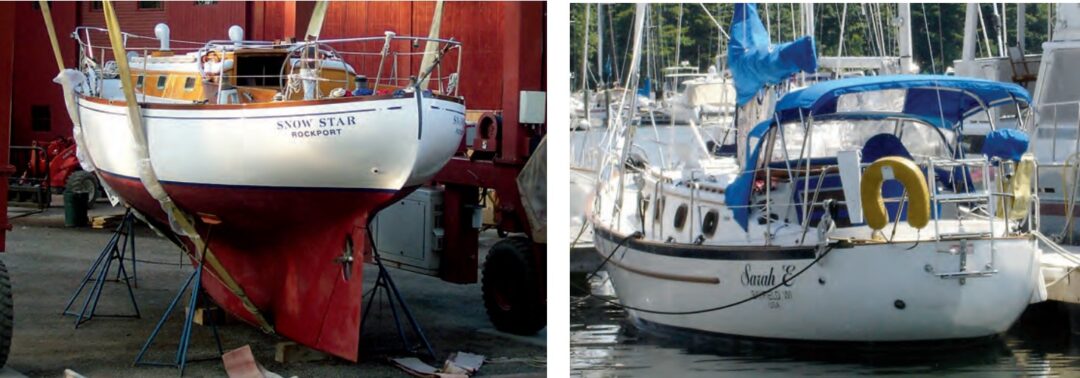
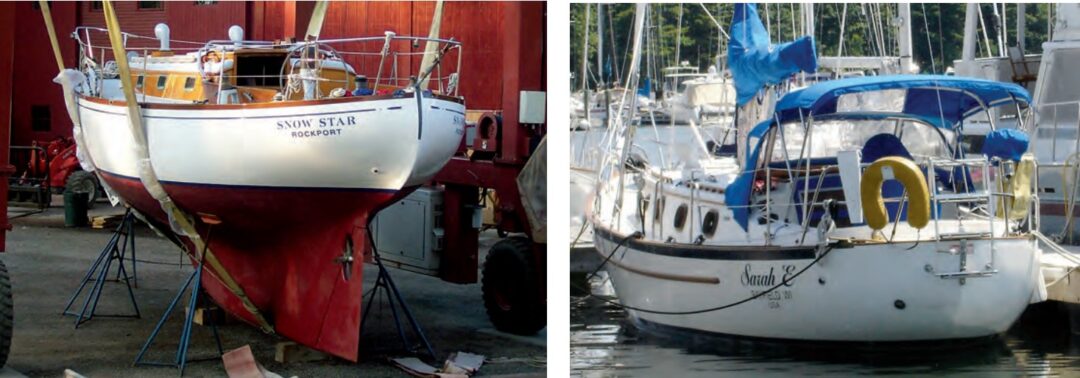
These canoe sterns were relatively fine, providing room only for a lazarette or a place to step the mizzenmast. The cockpit was located forward of the stern post, and steering was almost always accomplished with a tiller. However, in more recent times, as the canoe stern has been adopted by larger designs, the use of wheel steering has allowed the cockpit, with no mizzenmast in the way, to creep aft into what would have been the lazarette. This necessitated the widening or rounding of the canoe stern into a cruiser stern or even a counter stern configuration to gain more width at the back end of the cockpit. Bob Perry, in particular, mastered this concept, and added his own touch by introducing tumblehome into the design. But even Bob ascribes “marketing” as the primary motive for his introducing this stern shape on the Valiant 40.
Natural extension
Another subset that is also sometimes captured in the double-ender category is the extended aft overhang.
The lines plan for any yacht with a transom is originally drawn with the lines extended past the transom to ensure fairness in the after end. The transom is then drawn in and the lines aft of it are left as dashed lines, indicating that they exist in imagination only. If, however, the designer wished the boat to be built with this non-truncated aft overhang, the result is a special flight of fancy in yacht design. These are seldom seen today, but the heyday of long overhangs, most notably under either the Universal Rule in North America or the International Rule in Europe in the ’20s and ’30s, produced some fascinating “pintail” sterns, often coming to a pronounced point. L. Francis Herreshoff is associated with a number of these designs. These double-enders were certainly never conceived as globetrotting cruising boats in the modern definition.
I have to say that, in my many years in the profession, I have never been associated with a designer or a builder of any double-ender or canoe-stern sailboat. This concept is now exclusively applied to offshore cruising boats or to boats designed to look like they are capable of offshore cruising. I think the jury is still out, among designers at any rate, whether “pointy ends” really do achieve all they are supposed to, but there is no doubt that people now associate them with long passages on the open ocean.
Rob Mazza is a Good Old Boat contributing editor. A sailor by passion and yacht designer by vocation, he began his long career around sailboats with C&C Yachts back when now good old C&Cs were cutting-edge new.
Thank you to Sailrite Enterprises, Inc., for providing free access to back issues of Good Old Boat through intellectual property rights. Sailrite.com