Three boats built expressly for speed and fun
Issue 71 : Mar/Apr 2010
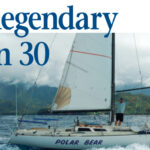
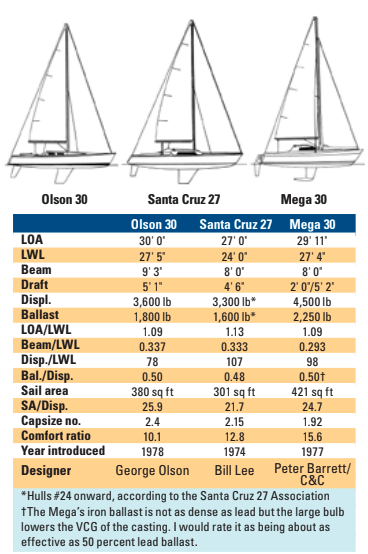
George Olson designed one of the first successful ultralight-displacement boats (ULDBs), the one-off 24-footer Grendel, in 1970. In 1972, in partnership with Roger Moore, George modified Grendel’s extreme design with increased beam and produced the Moore 24, still with an extremely low displacement/LWL ratio of only 89. The Moore 24s proved to be sporty and fast and the little yachts race as a class in several areas even today. In 1977, while on a delivery run from Hawaii aboard Bill Lee’s very quick and successful 68-foot ULDB, Merlin, which had just sailed a record-setting win in the Transpac race, George began to dream about a new 30-foot design. The first of many Olson 30s was launched in 1978.
Bill Lee had come out a few years earlier with the Santa Cruz 27 which, with ultra-light displacement and generous sail area, was considered to be an extremely radical boat in 1974. She was also extremely fast off the wind, capable of surfing, and a proven serious contender in such events as the 225-mile Santa Cruz-to-Santa Barbara Race and the Swiftsure Race. Indeed, several of the 27s have sailed in singlehanded races to Hawaii.
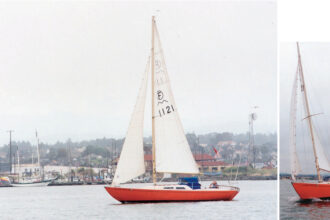
The new Olson 30, sporting a displacement/LWL ratio of only 78 and spreading about 80 square feet more sail on just 300 pounds greater displacement, was even more radical than the Santa Cruz 27. Her 9-foot 3-inch beam also provides slightly greater form stability than the 8-foot beam of the Santa Cruz and the Mega 30, and there is no question of her surfing ability when the wind is free. The Olson 30 is capable of exhilarating speeds when surfing, as well as spectacular crashes when things go wrong! The 30s have proven surprisingly seaworthy, though, and hardy souls have sailed them in the Bermuda Race, numerous Transpacs, and a race across the Atlantic.
Top trailersailer
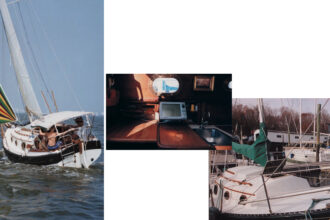
The third boat in this review, the C&C Mega 30, was never designed as a serious racer but, rather, as a top-performing trailersailer with a retractable cast-iron ballast fin. The Mega’s ULDB hull and very generous sail area ensure that she will not be a slouch off the wind, especially in light air. Still, I expect the Olson 30 and SC 27 would walk away from her when the conditions favor their surfing capabilities. The Mega’s displacement and modest beam may prevent her from surfing in less-than-optimum conditions, but her narrow beam combined with a long waterline and slightly huskier displacement could give her a bit of an edge over the other two in punching to windward through a stiff chop when it breezes up.
Where the other two boats have just sitting headroom, the Mega has standing headroom, and she can creep into those delightful shoal gunkholes and harbors simply by retracting her fin. Both the Mega and the Santa Cruz are legally trailerable without a special permit but will require a husky truck to sail them down the highways. Only the Mega, however, is launchable without a crane.
These three ULDBs are going to appeal to different classes of sailors. The Mega 30 will be the choice of the cruising man who wants a fast and fun boat to sail and to race occasionally but who is also looking for a bit more cruising comfort combined with trailerability. TheSanta Cruz 27 and Olson 30 are definitely the boats for the serious racing sailors. They have proven to be very competitive in club and distance races, as well as MORC and PHRF events. If one-design racing is your thing, the Santa Cruz is more centered in Southern California, and that may limit her appeal. The Olson 30, on the other hand, has fleets in the Great Lakes, the Chesapeake, the Southeast, California, and the Pacific Northwest and will give true one-design aficionados all the serious competition and sport that they can handle.
Ted Brewer is a contributing editor with Good Old Boat. He is one of North America’s best-known yacht designers and has designed scores of good old boats.
Thank you to Sailrite Enterprises, Inc., for providing free access to back issues of Good Old Boat through intellectual property rights. Sailrite.com