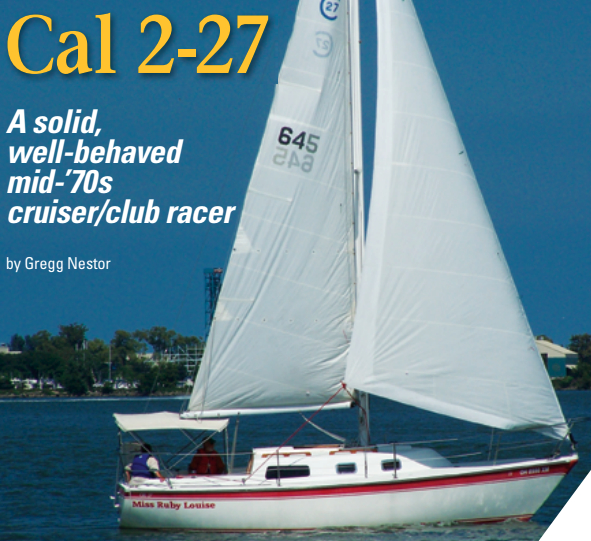
A solid, well-behaved mid-’70s cruiser/club racer
Issue 69 : Nov/Dec 2009
Around 1956, Jack Jenson started one of this country’s most successful fi berglass boat-building companies. Located in Costa Mesa, California, which in the 1960s and 1970s would become the Mecca of fiberglass boatbuilders, Jensen Marine brought fast, comfortable, ocean-going sailboats to the American working class.
At first, Jensen built his boats outside, in an open field. The near-perfect Southern California climate lent itself nicely to construction outdoors and the company soon earned the nickname “backyard boats.”
Jensen Marine’s meteoric rise began with the introduction of the California 24, designed by C. William “Bill” Lapworth. This fl at-bottomed centerboarder seemed to blow the doors off most of the competition. Originally named for Jensen’s home state of California, the name was shortened to “Cal.” It stuck, and eventually Jensen Marine and Cal yachts became synonymous.
The Jensen-Lapworth collaboration lasted many years. In fact, Bill Lapworth designed all of Jensen’s boats. These ranged from the flush-decked Cal 20 to the Cal Cruising 46. Included in this selection were three different 27-foot models, each of them distinct although all from the same drawing board.
The company was sold to Bangor Punta in 1973, which moved it first to Florida and then to Massachusetts. The doors closed in 1987.
Design evolution
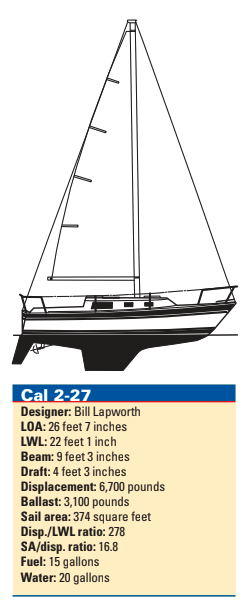
The first Cal 27, launched in 1970, was the smallest of the three, having a 9-foot beam, a convertible pop-top, and a displacement of 5,400 pounds. Introduced in 1974, the Cal 2-27 sported a 9-foot 3-inch beam, standing headroom, and more creature comforts, including a decent galley with an icebox and an alcohol stove. The last of the Cal 27s was the Mark III, often referred to as the Cal 3-27. It was launched in 1983. Compared to the Cal 2-27, the Cal 3-27 was narrower, 1,500 pounds lighter, had a longer waterline and a deeper fin keel, and carried less sail area.
Unlike its sister 27s, which had relatively fl at underbodies, the Cal 2-27 was designed with a beamier and fuller hull. With a displacement of 6,700 pounds, its displacement/length ratio increased from 218 to 278, while its sail area/displacement ratio dropped from 18.2 to 16.8. Combining these elements with a beam 3 inches greater and a waterline 3 inches shorter, the Cal 2-27 was well situated in the “family sailing” category. Even with its conservative sail plan, the boat still performed well enough to appeal to the club racer. In fact, the Cal 2-27 was the major competitor to the Catalina 27. Under PHRF, the largest Cal 2-27 fleet rates 198, while the Catalina 27 rates from 204 to 219, depending on fleet.
Other design elements include a deck-stepped mast, fin keel, and spade rudder. In common with many of Bill Lapworth’s designs of that period, the rudder on the Cal 2-27 is partially supported by a vestigial skeg.
Construction
The hull and keel of the Cal 2-27 were molded with solid hand-laid fiberglass as a single unit. A 3,100-pound lead casting was lowered into the keel and encapsulated with additional fiberglass and polyester resin. The deck is of sandwich construction with a core of marine plywood, which adds strength without adding unnecessary weight. The hull-to-deck joint is sealed with adhesive putty, glassed over on the inside, and covered on the outside with a two-piece rubrail of vinyl and fiberglass.
In the interior, a partial fiberglass pan comprises the sole and various hull stiffeners, including the support structure for the compression post under the mast. The plywood-and-teak bulkheads are bonded to the hull and to the deck, stiffening the boat significantly. Overhead, the headliner is padded vinyl in the saloon and fiberglass forward of the main bulkhead. All the exposed surfaces of the hull are covered with teak except outboard of the V-berth, where the liner is carpeting.
The vinyl headliner allows for easy access to deck fittings. On our review boat, the stanchions and pulpits are mounted with backing plates; however, most of the other deck hardware — cleats, winches, and genoa tracks — lack such reinforcement. The stainless-steel chainplates are quite impressive and are fastened to the bulkheads with 14 bolts each.
Deck features
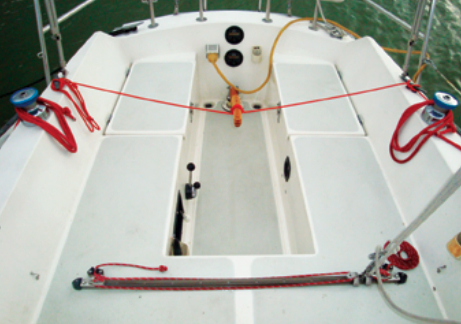
The combination of a turtle-shell-shaped coachroof, the lack of an anchor locker, and mooring cleats mounted well outboard results in a large, obstruction-free foredeck. The two-tone deck is easy on the eyes and the molded-in non-skid and toerail make for sure footing. For added on-deck security, there’s a bow pulpit, dual lifelines, and four teak handrails.
The sidedecks are 14 inches wide and the cabintop, aside from the handrails and the forward hatch, is free from clutter. There is no sea hood. Exterior wood trim is limited to the handrails, the companionway hatchboards, and the companionway slides.
The cockpit is a generous 6 feet 6 inches long, is surrounded by 12-inch high coamings, and has a substantial bridge deck forward. The coamings are properly angled to give good back support and the footwell is narrow enough to offer solid foot bracing. It drains through a pair of 2-inch scuppers. Beneath each of the cockpit seats is a cavernous locker offering access to the stuffing box, the engine, and the batteries. A stern pulpit with an integral centerline swim ladder encloses the aft end of the cockpit.
Accommodations
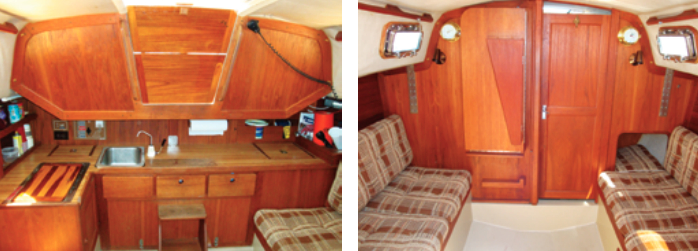
Our review boat Miss Ruby Louise, a 1980 Cal 2-27 owned by Ken and Vern Cline, is an excellent example of the major interior improvements found in the 1974 and later models. The interior is quite roomy, and attractive teak woodwork and joinerwork abound.
The forward cabin is truly a mini-stateroom, owing to the fact that it incorporates the head compartment. As such, it is much less claustrophobic than cabins found in other boats of similar size. Separating the V-berth from the head compartment is a partial bulkhead, with a wooden “basket weave” accordion door that provides a degree of privacy. The V-berth measures 6 feet 4 inches deep by 6 feet wide and has a generous 44 inches of sitting headroom. At its foot, a solid teak door closes off a small locker that could easily be converted to a chain locker with the addition of a deck pipe. Above and outboard are shelves with teak sea rails, and beneath are storage bins and the 20-gallon potable-water tank.
On the port side of the head compartment is the forward-facing toilet and a teak vanity featuring a white plastic-laminate top, stainless-steel basin with manual cold water, and several stowage spaces. Directly across from the vanity is a hanging locker and a large stowage alcove or sail bin. A pair of deck prisms, a translucent fiberglass overhead hatch, and a pair of opening portlights provide excellent illumination and ventilation.
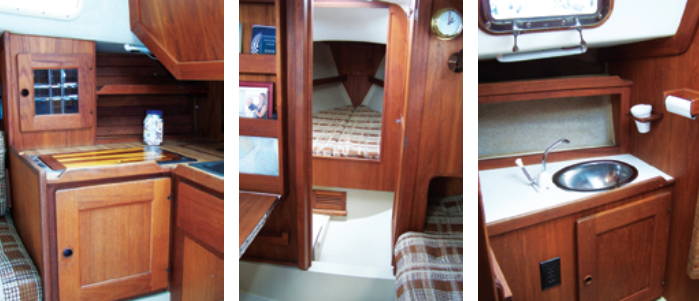
A teak-veneered bulkhead and teak door separate the forward suite from the saloon. The solid-teak compression post is incorporated into the bulkhead and cleverly performs double duty: it provides support for the deck-stepped mast and serves as the jamb for the teak-paneled door. Mounted to the bulkhead is a drop-down table, behind which are three shelves. The two-position marine-plywood table is veneered with teak on one side and faced with a white plastic laminate on the other.
Opposing settees take up the bulk of the saloon. The port settee measures 6 feet 4 inches. On the starboard side, a foot cubby extends forward through the main bulkhead to make up the length, for sleeping purposes, taken up by the galley at the aft end. The port settee converts to a double. Both settees are made up of three cushions, an arrangement that allows for easy access underneath. Since much of the area beneath the port settee is taken up with a bladder holding tank (possibly Bangor Punta’s easy answer to the Clean Water Act of 1972), most of the saloon’s stowage is located under the starboard settee. Behind each settee is a teak-fiddled bookshelf and above, a pair of teak grabrails.
The galley is an athwartships L-shaped affair. While its cabinetry is teak, its work surface is plastic laminate with a wood-grain pattern. There’s a dual cooktop that combines pressurized-alcohol and 110-volt-electric burners (which the Clines think was a factory option), a single stainless-steel sink with manual cold water, and a 3-cubic-foot icebox that can handle about 60 pounds of ice. Other features include a set of three drawers, a dry stowage bin, a pair of shelves, a dish rack, a utensil bin, and a condiment rack. For entertaining, there’s even a dedicated liquor locker and crystal cabinet with a leaded-glass door.
While this arrangement may sound inviting, using the galley can be awkward. Crewmembers will step on the counter when passing through the companionway. This cuts down on counter space for food preparation. Obviously, any companionway traffic will interfere with the cook. Also, because the icebox and dry-stowage bin are somewhat recessed beneath the bridge deck, viewing their contents involves some bodily contortion.
Besides the companionway opening, four portlights (a pair of large fixed ports and a smaller pair that open), provide the saloon with light and cross-ventilation. Headroom is a comfortable 6 feet 2 inches.
Rigging
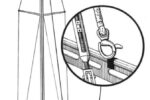
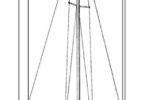
The Cal 2-27 is rigged as a masthead sloop, with a sail area of 374 square feet. Standing rigging consists of a pair of cap shrouds, single airfoil spreaders, a pair of lowers, a forestay, and a split backstay. The chainplates are inboard and securely mounted to the forward bulkhead.
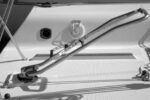
Sail controls include a pair of Barient #10 halyard winches mounted on the mast and a pair of Barient #8 two-speed primaries positioned on the cockpit coamings. The headsail sheets are led aft through cars on outboard genoa tracks. The mainsail is sheeted mid-boom and affixed to a traveler mounted on the bridge deck. Other controls include a vang and two reef points with jiffy reefing. Tiller steering was standard.
Performance
The Cal 2-27 is a fairly stiff boat and behaves well in all but the most severe conditions. It’ll heel to about 20 degrees and then settle right in. Both upwind and off-the-wind performance are above average. When the wind begins to freshen, it’s time to reef or weather helm may become a problem.
The original auxiliary was the ubiquitous Atomic 4, with the single-cylinder 12-hp Farymann diesel available as an option. Later engines included the MB10A Volvo diesel and the Universal 5411 diesel. A very few boats were even fitted with outboards — not the best option.
Miss Ruby Louise is a late-model 2-27 and is fitted with the 2-cylinder, 11-hp Universal diesel. While this power plant moves the boat along nicely under most conditions, the boat is a bit underpowered when trying to punch through rough seas. Fuel is contained in a 15-gallon tank mounted directly aft of the engine. The controls for the engine are located on the starboard side of the cockpit, low in the footwell. Access to the engine is fair.
What to look out for
While the overall design, construction, and finish of the Cal 2-27 can be considered above average, there are a few detractions. None of them appear to be major problems, however, and most can be easily corrected. They include such things as missing backing plates, leaking ports, leaking chainplates, gate valves on through-hulls, gelcoat crazing, and the lack of a convenient stowage system for an anchor rode.
Conclusion
Overall, the Cal 2-27 is well mannered and possesses sufficient room for a cruising couple or a small family. Its design, construction, and finish are above average. When contemplating the purchase of a Cal 2-27, age and condition are everything. Consider paying $9,000 to $15,000 for a nice one. By the way, when introduced, a bare Cal 2-27 listed for less than $12,000.
Gregg Nestor is a contributing editor with Good Old Boat. Having recently sold both their O’day 222 and their Pearson 28-2, Gregg and his wife, Joyce, find themselves boatless. They are currently searching for that perfect good old boat. Gregg’s third book, The Trailer Sailer Owner’s Manual: Buy-Outfit-Trail-Maintain, was released earlier this year by Paradise Cay Publications.
Thank you to Sailrite Enterprises, Inc., for providing free access to back issues of Good Old Boat through intellectual property rights. Sailrite.com