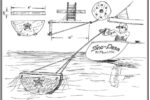
It’s a versatile and invaluable tool
Issue 87 : Nov/Dec 2012
The hand-bearing compass, or sighting compass, is a portable compass used to take a bearing or azimuth. This type of compass has been in use for hundreds of years. Early hand-bearing compasses used a dry needle, but modern versions employ the more practical liquid-damped floating card. Electronic compasses are available today that provide a digital display of the bearing.
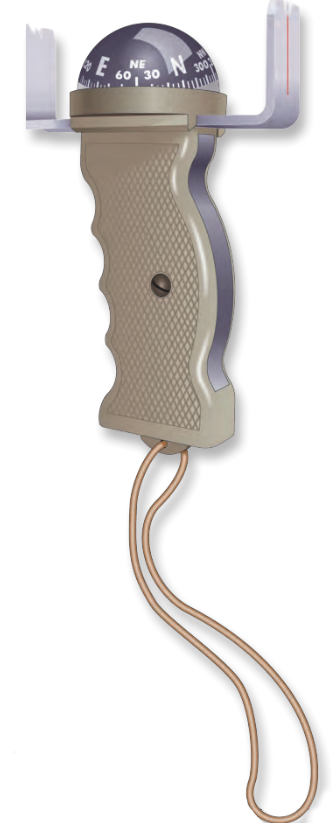
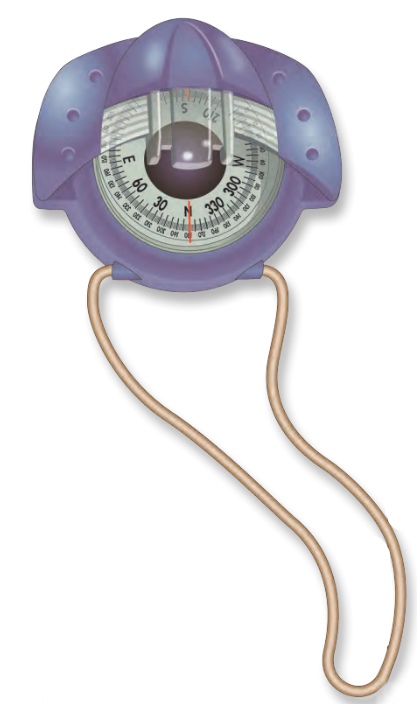
Hand-bearing compasses used on boats come in two basic forms. The gun-sight type is held at arm’s length and the target aligned using two “gun sights.” The hockey-puck type, so-named because of its shape and size, is held close to the eye. Both types usually include a light so they can be used at night. Some are made to float. There are also other types of sighting compasses used primarily by hikers.
Many binoculars have built-in compasses, and compasses are made that can be clipped onto a standard binocular’s objective lens (the large lens).
A hand-bearing compass would be useful to have in an emergency ditch bag.
When deviation correction is important
Just as your ship’s compass can be subject to errors caused by deviation, so can your hand-bearing compass. Deviation is not an issue when taking relative bearings to check for risk of collision or when using a hand-bearing compass for an anchor watch, but when determining a line of position, it’s important to know if this error exists.
When the first iron ships were built, deviation was a major problem, and methods of compensating for it were not well understood. When an accurate compass reading was needed, a sailor was sent with a compass up to the crow’s nest, where the deviation was minimal. This rule still holds true. On your boat, you’ll probably find the least deviation at the highest spot you can access. (Note: Do not assume that your standing rigging is non-magnetic. –Eds.)
If you expect to use your hand-bearing compass to determine lines of position, determine deviation at various locations on board while swinging ship. Chapman Piloting, Seamanship & Small Boat Handling gives a good explanation of this procedure.
If you’ll just be using your hand-bearing compass for an anchor watch or to determine risk of collision, it is not necessary to know the deviation.
Anchor watch
I use my hand-bearing compass to check whether my boat is dragging its anchor. Once the anchor is set and the boat is lying at the full length of the rode, I take a bearing on a distinctive object located abeam — a tree, flagpole, chimney, or clearly identifiable rock. The target should be as near as possible; a target that’s miles away is useless for this purpose. I write the bearing on a slip of paper and check it again after several minutes. If it has remained the same, I’m not dragging. If the wind picks up, I check the bearing again just to be sure. I take the bearing from the same spot on deck each time.
The actual bearing is unimportant; it’s the consistency of the bearing that I’m looking for. If, due to wind or tide, the boat swings around, I have to establish a new bearing.
Risk of collision
If another vessel appears to be on a course that will cross yours, using the hand-bearing compass will tell you if the risk of collision exists long before the situation becomes critical. If, while you maintain your heading, the bearing of the other boat doesn’t change, you are on a collision course (assuming that neither boat changes course or speed).
As when using the hand-bearing compass for an anchor watch, the actual or true bearing observed is unimportant; you are interested only in the relative bearing.
Line of position (LOP)
When determining an LOP with your hand-bearing compass, you do need to take deviation into account.
Let’s say you’re heading down the coast and your GPS has failed, so you’re back to basics and must use bearings as LOPs to determine your position. Take a bearing on a lighthouse, water tower, or other distinctive landmark shown on the chart. Take a bearing on another object at 90 degrees (or close to that) from your first target.
Lay your parallel rule across the chart’s compass rose so one edge connects the center of the rose to your first bearing on the inner, magnetic, rose that’s rotated to account for the local magnetic variation.
Walk the rule across the chart until one edge lies on your target and draw a line.
Voilà, you have a line of position.
Repeat the process with the second bearing. Where the two LOPs cross, you have your fix.
Don Launer, a Good Old Boat contributing editor, built his two-masted schooner, Delphinus, from a bare hull. He has held a USCG captain’s license for more than 38 years and has written five books. All of his 101 articles are now available for downloading as a collection from the Good Old Boat download website, www.audioseastories.com. Look under Archive eXtractions.
Thank you to Sailrite Enterprises, Inc., for providing free access to back issues of Good Old Boat through intellectual property rights. Sailrite.co