Restored to order, she’s a daysailing delight
Issue 107 : Mar/Apr 2016
“Bill, you really ought to come over to Yacht Works this morning. There’s a sleek, small boat being rigged right now and her owner is from New York,” said my friend Bob, whose beautiful Pacific Seacraft 34, Dalliance, was featured in Good Old Boat’s September 2012 issue.
That brief description was all I had when I pulled into the yard in Sister Bay. On the face of it, this is not such an unusual event, but when the sailor hails from Saugerties, New York, along the banks of the Hudson River, it’s a bit of a stretch. Why launch here on the shores of Wisconsin’s Green Bay?
The mast had just been lowered into the hull, which looked brand-new even though it was obvious the boat had been designed in another era. Moments later, I was joined on the dock by her proud owner, Joel Schuman.
“She’s an Alberg design, you know,” he said.
“I thought she was,” I replied, “but what class?”
“Well, she’s not a Pearson Commander, which is what I was looking for.”
The fairy’s tale
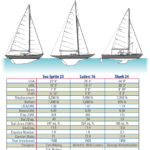
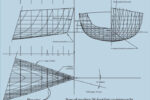
You might say the story really began in 1900, the year Carl Alberg was born in Gothenberg, Sweden. Before moving to the United States in 1925, he studied yacht design for two years. He first took a job as a rigger, and was then hired by the John Alden firm as a designer. Over the next 60 years, he designed 47 boats, including the Pearson Triton, the Alberg 30, the Ensign, and most of the Cape Dory line . . . all extremely successful designs. Among his earliest designs was the Sea Sprite 23. She was first produced by the American Boat Building Company and offered in two versions, the Daysailer and the Weekender. The hull and rig dimensions are identical.
The Daysailer has a large non-self-bailing cockpit and a small cuddy cabin with two bunks. The Weekender, the subject boat here, has a self-bailing cockpit, a larger cabin trunk, a V-berth, two quarter berths, a small galley, and a space for a head under the forward berth. Both have a built-in well for an outboard motor located to starboard of the rudder below the aft deck.
A number of small boatbuilders in the Bristol, Rhode Island, area continued to produce the Sea Sprite 23 for the next 25 years. The final builder was Clarke E. Ryder, who acquired the rights to the design in 1974 and built new molds for the boat that encapsulated a lead keel, created a new self-bailing cockpit, and introduced a
full interior liner. According to records kept by the Sea Sprite Association, C.E. Ryder built hull numbers 525 to 768, including Ms Lynne G.
A family of sailors
Joel grew up on the East Coast and learned to sail in a 14-foot wooden Aykroyd dinghy while in summer camp in Canada. He loved sailing and actively raced during his high-school and college years in the Lightning and Flying Dutchman class one-design fleets. He met and married his wife, Lynne, and they settled in Saugerties to raise their family. Business and other interests precluded boat ownership, but the family regularly spent vacations in the winter months on charter boats in the British Virgin Islands.
Lynne’s family has a summer home in Ephraim, Wisconsin, so each summer they spent time there with the children, who enrolled in summer sail-training classes at the Ephraim Yacht Club. After the kids left home, Lynne and Joel continued to go to Wisconsin, where they became involved in sailing and racing Flying Scots at the club. They purchased their own boat and sailed it actively for 10 years in Wisconsin and New York. While on the East Coast, they raced on an inland lake with a fleet of Flying Scots after first sailing their boat on the Hudson River. “Too much traffic, too much current, and not enough water,” says Joel.
On one of their summer trips, the Schumans chartered an Alberg 35 and enjoyed the traditional appearance and performance of the classic cruising boat. One of Joel’s business associates sailed a Pearson Commander, another Alberg design. Joel crewed on the Commander several times and thought it might be an ideal daysailing boat for the two of them. They decided to sell the Flying Scot and look for a Commander in good shape or one they could consider restoring.
They searched the Internet for several seasons and, failing to find a desirable Commander, Joel decided to search for boat restorers. After several phone interviews, he called Northern Yacht Restorations in Whitefield, Maine (see Good Old Boat, January 2006). Tim Lackey, the owner, answered the phone — no surprise since he works alone. Tim started the business in 2004 and works on only one boat at a time. After the initial conversation, Joel knew he had found his man.
An alternative Alberg
Tim told Joel he could probably find a Commander, but suggested he come to Maine and look at a 1975 Sea Sprite 23, also designed by Alberg. In August 2014, Joel and Lynne did just that. The Sea Sprite had been brought in for restoration earlier that year, but the owner developed health problems and couldn’t complete the project. Joel and Tim signed an agreement scheduling delivery for the spring of 2015. Two weeks later, Tim called Joel to say he had a sudden cancellation. The new completion date would be December of 2014. The project was under way.
An extremely detailed log on Tim’s website records each step in the renovation of Ms Lynne G (see “Resources” on page 19). The project began on August 21, 2014, and was completed on November 13. It involved more than 300 hours of labor. A study of Tim’s website would help anyone interested in restoring his or her own boat or hiring a professional to do so. It offers great insight into what’s involved in a complete restoration.
Simplify and beautify
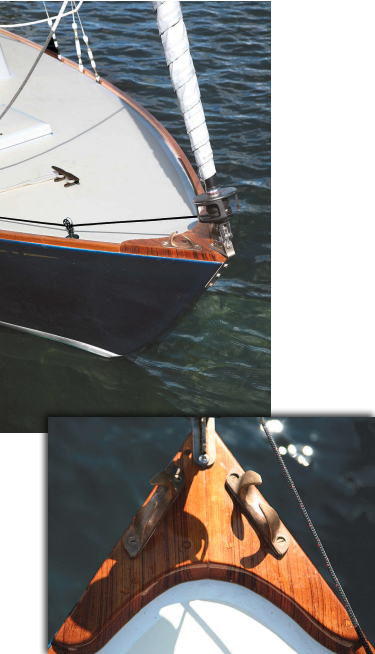
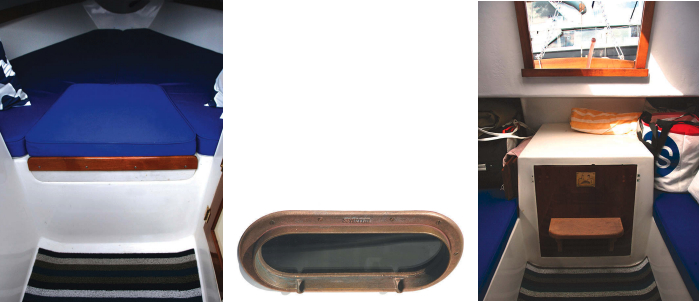
Although some preliminary cosmetic work had already been done for the boat’s prior owner, Joel and Lynne had a different vision for the finished project: they wanted the ultimate daysailer for two people with an occasional guest. Hence the decision was made to start the renovation by removing much cruising-oriented equipment, such as unnecessary instruments and cooking facilities. They concentrated on improving the overall quality of the boat, simplifying systems, replacing fittings, and redoing all the finishes.
Some of the major projects included removing all the deck hardware, a total redo of the hull-to-deck joint, a new wooden toerail, and new cockpit coamings and handrails. Tim also refinished the spars and replaced all the running and standing rigging. He removed all the plastic through-hulls and replaced them with bronze fittings. The bottom was sanded down to the gelcoat, re-faired, primed, and painted.
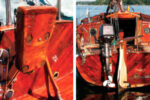
Joel did not like the original deadlights with their plastic frames, so they were replaced with new bronze opening ports from Spartan Marine. Tim constructed an entirely new motor well to house a new Torqeedo Travel 103 long-shaft electric outboard. Finally, the hull was refinished with AlexSeal Topcoat Flag Blue. Joel had a new main and jib made by Dorsal Sails, a local Wisconsin sailmaker.
Following her refit, Ms Lynne G was towed to Door County and launched in the spring of 2015. Joel and Lynne spend about four weeks each summer in Door County and keep their boat on a mooring in Eagle Harbor.
A delightful sailer
By the end of the first full sailing season, they were delighted with the sailing characteristics of their small
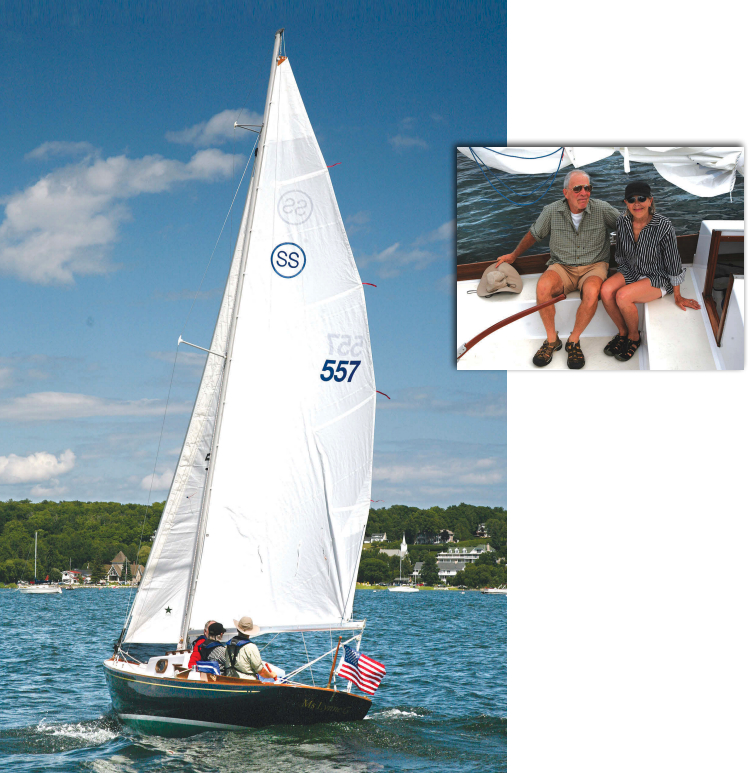
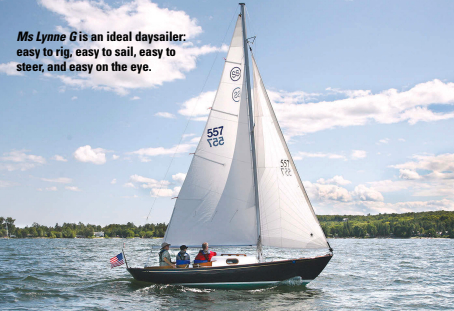
yacht. I photographed her on a clear day in a northwest wind when the bay was kicking up a lively chop. As the sails filled on a new tack, she heeled quickly to rail down, then stiffened up, cutting cleanly through the inland sea. With a crew of three sitting comfortably in the generous cockpit, there appeared to be little pressure on the helm and plenty of smiles as she sped by.
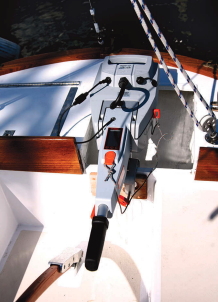
A few weeks later, Lynne and Joel sailed her back to the marina in a very stiff breeze. I had driven over to see them off and watched them as they rounded up into Sister Bay. The boat shook off the gusts and kept her hull firmly planted as they rolled the jib and doused the main. Then, powered by her Torqeedo, Ms Lynne G motored silently into the still waters of Yacht Works for a long winter’s rest.
With the obvious quality and care she has had in restoration and her planned short seasons, I predict that Ms Lynne G is destined to become a family heirloom and to lead a long and serendipitous life.
Bill Jacobs has been racing and cruising for 50 years and writing about boats for the last 10. He currently sails a Cape Dory Typhoon in Baileys Harbor, Wisconsin, and spends winters in Sarasota, Florida, sailing a 55-year-old wooden Luzier 27.
Thank you to Sailrite Enterprises, Inc., for providing free access to back issues of Good Old Boat through intellectual property rights. Sailrite.com