Surface mounts step in where holes are not welcome
Issue 107 : Mar/Apr 2016
The gold standard for secure mountings on boats has always been to use through-bolts, with a backing plate if the loads justified it or the skins were thin. But what if the opposite side is not accessible, if it means drilling through the topsides, or if you would simply rather not expose a cored structure to the risk of moisture absorption? The answer can be an engineered glue-on surface mount.
Case 1 – Solar panel mounting
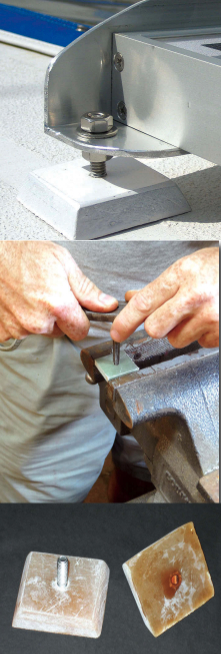
We wanted to mount solar panels on the hard top on our catamaran. The mounting system needed to accommodate the compound curve of the hard top, allow for the panels’ easy removal, and provide ventilation beneath the panels. Because the hard top is cored, we really wanted to avoid drilling holes. Our solution was to build four mounting “feet” from precast fiberglass (FRP) sheet and stainless-steel bolts. We also like knowing that, should we ever change panel sizes, we can grind the feet off without leaving holes.
Procedure
Before working with it, scrub the precast FRP with TSP (trisodium phosphate) to remove any amine blush or mold release. Scrub the stud material (bolts or threaded rod) to remove any lubricant. Laminate the FRP to 1⁄2-inch thickness, about 2 x 2 inches square, and allow it to cure. We used two layers of 1⁄4-inch plate, since it was what we had. Testing has shown that a 1⁄4-inch bolt will break before stripping the threads in 1⁄4-inch FRP.
Tap the FRP squares for 1⁄4 x 20 bolts. Epoxy the bolts (heads removed) and thread them into the holes until about 1⁄8 inch protrudes from the bottom side. Carefully wipe any epoxy from the upper end.
When the epoxy has set, grind the edges of the feet smooth and bevel them to suit your eye. Grind the bolt flush where it protrudes from the bottom. Scrub the feet to remove amine blush, and apply your preferred finish to the surfaces that will be visible.
Attach the mounting feet to the panel frame using double nuts so you can adjust the height. We made a strong, simple frame with two lengths of 2 x 2 x 1⁄8-inch aluminum angle.
Dry fit the frame with the feet attached, mark and sand the mating areas, then bond the feet in place with thickened epoxy. (We used fumed silica.) The weight of the solar panel provides sufficient clamping pressure but the panel might try to slide off a sloping or curved roof, so use spacers or ropes to prevent that.
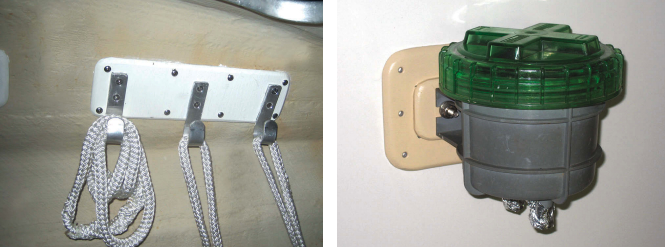
Case 2 – Rope hooks
We needed hooks in our sail locker to tidy up a mess of sailbags, docklines, and bridles. However, we couldn’t drill holes for hooks since there was no reachable bulkhead and we did not want ugly through-bolts in the hull. The hooks needed to be strong enough to hold a sailor, since we sometimes jump into the locker and it’s easy to get a foot inside a coil. Again, the solution was a glued-on surface mount.
Procedure
Cut a precast FRP mounting plate to shape, beveling the edges as appropriate, and apply your chosen finish to the visible surfaces. Fabricate hooks from 1⁄8 x 3⁄4-inch aluminum strip. We bent these around a mandrel formed by two pieces of 1⁄2-inch rod clamped in a vise. Bend and radius the edges so ropes can be held securely but sailbags will not catch easily.
Mount the hooks to the plate with screws or through-bolts. We used sheet metal screws and ground the protruding points flush. Drill and countersink holes around the perimeter of the plate. Our hull is thick enough we could use very short screws purely to provide clamping pressure while the epoxy cured — they provided little structural strength. We could have held the plate in place with tape or other clamping means, but short screws made for a neat job that was finished when the last screw went in.
Sand the mating surface and mount the plate with thickened epoxy. If you believe you may remove it someday, use 3M 4200 or Loctite PL S40 polyurethane. Finish as desired.
Case 3 – Filter mounting
This was much like the hook mounting, except we used flat head bolts threaded in from the back side and epoxied in place. We’ve mounted four filters this way: carbon holding-tank vent, silica gel gasoline-tank vent, AC raw-water intake, and head raw-water intake.
Permanent or temporary
This no-through-bolt technique has countless applications, and most of the fabrication can be done in the shop, which is always an advantage. The keys are to provide sufficient bonding area for the reinforcement plate and for the precast FRP to be thick enough to hold the fasteners. Without making a new hole in your boat, you have added a strong point that will last as long as the boat but can be ground or pried off when it’s no longer needed.
Drew Frye cruises Chesapeake Bay and the mid-Atlantic coast aboard his 34-foot catamaran Shoal Survivor, searching for out-of-the-way corners known only by locals. A chemical engineer by training, 40-year climber and 30-year sailor by inclination, he brings a mix of experiences to solving boating problems and writing about his solutions.
Thank you to Sailrite Enterprises, Inc., for providing free access to back issues of Good Old Boat through intellectual property rights. Sailrite.com