An unusual “powersailer” that will get you home in a hurry
Issue 108: May/June 2016
Richard “Dick” Valdes, founder and former chief executive officer of Columbia Yachts, established Lancer Yachts of Irvine, California, in 1974. In the dozen or so years that Lancer was in business, its product line totaled 20 models ranging in size from 25 to 65 feet and included both sailboats and high-speed motorsailers.
Dick contracted the design team from C&C Yachts to draw the lines for the bulk of Lancer’s sailing yachts and commissioned W. Shad Turner to design the company’s trailerable sailboats. With the majority of the company’s product line in good hands, Dick perceived that he could market a motorsailer that could be sailed or powered. He teamed with German-born Herb David, one of the few boat designers around with a master’s degree in naval architecture (from the University of Hamburg) and a taste for Italian styling. The results of this union performed tolerably well under sail but their high-horsepower engines helped them achieve speeds in excess of 15 knots when under power. They called them “powersailers.”
In 1983, Lancer Yachts was sold to Bally Manufacturing Corporation of Chicago, which held the company for only two years. In October 1985, Lancer’s then president, Saul Padeck, and partner Bill Mead reached a verbal agreement to purchase the company from Bally. Saul stated that the company would shift its emphasis from mass-produced sailboats to special-order custom motorsailers. “The sailboat industry has almost disappeared, so you have to find yourself a niche in the market,” he said. “The guy who used to buy a boat for $25,000 is done because his discretionary income has decreased. We want customers who are buying million-dollar boats.”
No Lancers were built after 1986.
Design
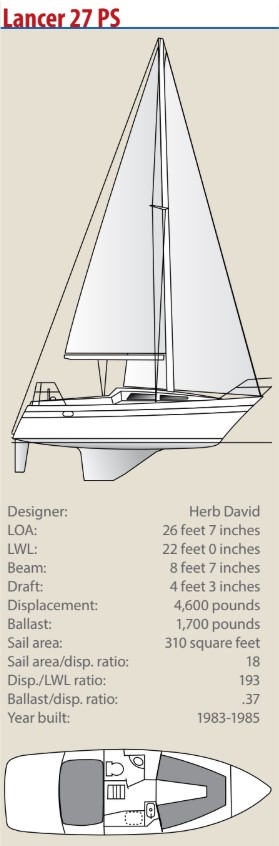
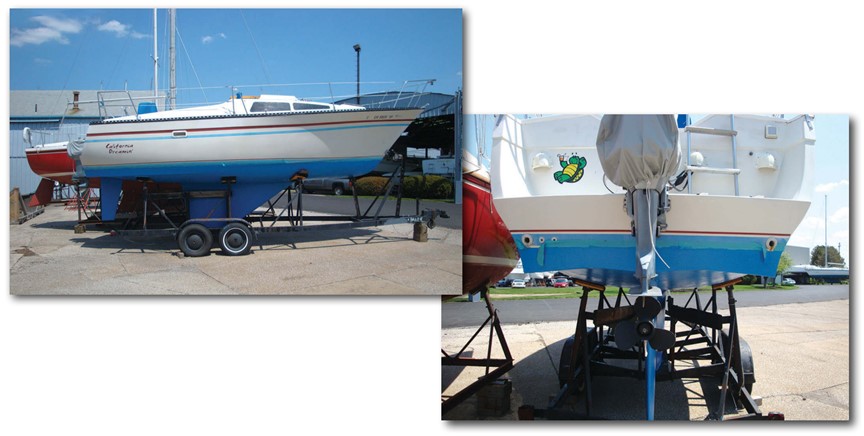
Herb David adapted computer-aided technology used in aircraft design to develop the hulls, keels, and rudders of the Lancer powersailers. His efforts resulted in a unique underwater design that employs two molded lift strakes running from aft of amidships to the stern. Lancer called these little wedges “finite ventilating surface-piercing foils.” Although small, at high speeds they are quite effective in preventing the hull from squatting, and appear to generate enough dynamic lift to raise the boat’s displacement hull onto a plane. They do add a modest amount of wetted surface.
The hull of the Lancer 27 PS is a novel blend of both sail and power. Since a more conventional bow caused the bow wave to rise up to deck level when under power, the bow on the 27 PS is flared. The sheerline is straight, the topsides are high, and the maximum beam is carried all the way aft. Underwater, the forward portion of the hull is all sailboat, including a ballasted fin keel. Starting just aft of amidships, the bottom begins to flatten out much like a powerboat’s and the two foils create a hard chine toward the stern. Completing the picture is a spade rudder and, aft of it, a combination engine well and swim platform that extends the boat’s waterline.
Construction
While the design of the Lancer 27 PS is unconventional, its construction is quite typical for the era. The hull is constructed of solid hand-laid fiberglass-reinforced plastic (FRP) using layers of fiberglass mat and woven roving. It is not cored, and the thickness of the hull ranges from 0.3 inch in the topsides to 0.43 inches at the bilges.
The deck is also hand-laid but with the addition of a core of end-grain balsa to reduce weight while increasing stiffness. Fir plywood is substituted for the balsa in those areas where greater compression loading is anticipated, such as beneath hardware. The deck thickness is in the neighborhood of 0.6 inch.
The deck is epoxy-bonded to an inward-facing flange on the hull. The joint is capped with a black-anodized aluminum slotted toerail that’s secured with polysulfide sealing tape, then mechanically fastened, through the top and the side, on 6-inch centers.
The Lancer 27 PS utilizes a one-piece molded hull liner that’s a combination of solid laminate and cored areas where additional stiffness is required. Bulkheads are bonded to the liner, which functions as an integral structural member, providing transverse and longitudinal stiffening.
Because the fin keel is an integral part of the hull, there are no keel bolts to deal with, as the 1,700 pounds of lead ballast is glassed into the bottom of the hollow keel. The spade rudder is foam-cored FRP.
Deck features
With the exception of the stemhead fitting with its light-duty anchor roller, the anchor locker’s hasp, and a pair of open-throat cleats, the foredeck is relatively clutter-free. A stainless-steel bow pulpit, double lifelines, and light gray non-skid make the area a fairly secure base on which crew can make sail changes and perform mooring and anchoring tasks.
As the deck rises to form the wedge-shaped cabintop, there is a 2-foot-square, smoke-gray translucent hatch. Farther aft, the companionway hatch is fitted with a seahood. Smoke-gray deadlights, two on each side of the cabin trunk, are styled to mimic the forward slope of the cabin. The sidedecks are relatively free of hardware and are comfortably wide — 16 inches at the beginning of the cockpit and becoming wider going forward.
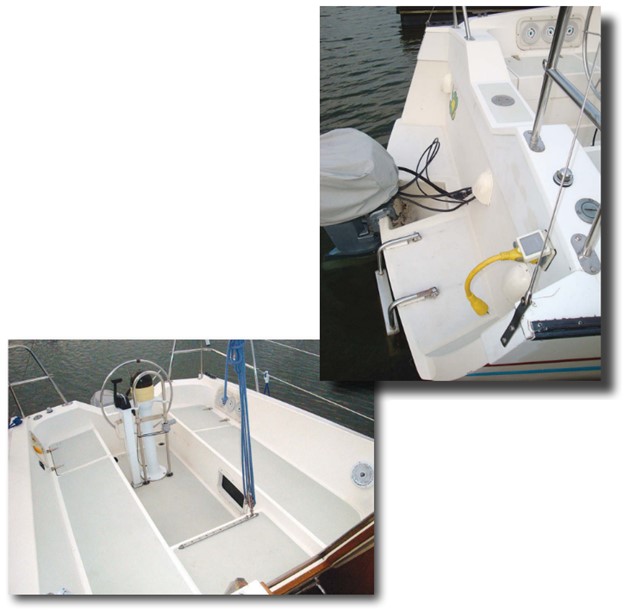
One of the most striking features of the Lancer 27 PS is the cockpit. It is 8 feet long, with seats 20 inches deep. The coamings are properly sloped and quite high — 11 1⁄2 inches at the lowest and rising to 17 1⁄2 inches. The footwell is 28 inches wide and 15 inches deep. Forward, there’s a 26-inch-deep bridge deck and aft, a pair of 2-inch drains.
Cockpit seat hatches on either side of the binnacle provide access to the cavernous area between the aft cabin and the transom. Even though this area houses the 46-gallon aluminum fuel tank, two batteries, and the battery charger, there’s still plenty of room for additional loose gear, as well as fixed equipment such as a water heater, air conditioner, and/or a generator.
Speed, depth, and wind gauges are located in the coaming on the port side above the cockpit seat hatches. A rudimentary engine panel is opposite to starboard.
Aft of the transom is a short sugar-scoop swim platform. Port and starboard stainless-steel rails and a pair of open-throat mooring cleats flank the transom, which is cut down in the center to ease access to the swim platform and also to function as a helmsman’s seat. The swim platform is fitted with a swim ladder and an outboard motor bracket.
Belowdecks
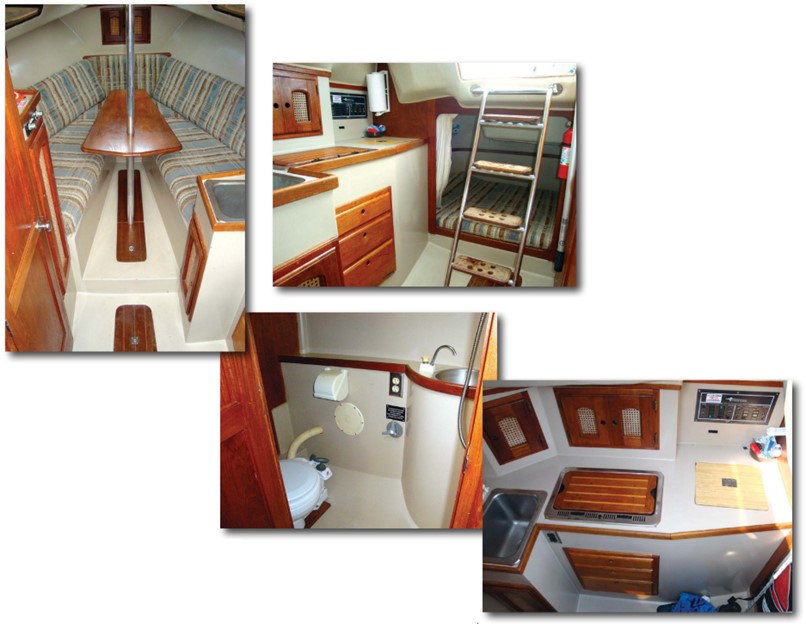
A stainless-steel ladder fitted with four teak rungs leads down into the main cabin. The layout below is simple, bright, and open.
Forward, instead of a V-berth, there are opposing settees that form a U shape and easily provide seating for five. Between the settees, and built around the compression post under the mast, is a centerline teak table. This table can be lowered, covered with cushions, and converted into a king-size berth measuring 74 inches long and 72 inches wide.
Aft and to starboard of the U-shaped seating area is the galley, which consists of a stainless-steel sink with pressurized cold water, an Origo 4000 alcohol cooktop, and a 2.5-cubic-foot icebox. For stowage, there are four cabinets and three drawers. Immediately above the icebox is the electrical panel. Our review boat was fitted with the optional AC panel.
To port, directly opposite the galley, is a narrow hanging locker with a bureau top and the head compartment, which measures a generous 48 x 32 inches and has a forward-facing head, a stainless-steel sink with a hand pump, and a pressurized “telephone” shower. The marine toilet and sink were optional equipment.
Behind the companionway ladder and beneath the cockpit is the aft cabin that, in its entirety, is an athwartships, queen-size berth measuring 54 x 78 inches. It can be separated from the main cabin by a privacy curtain. A pair of portlights in the cockpit footwell as well as port and starboard portlights in the hull sides provide ventilation and light. A shelf surrounds the berth on three sides. This compartment adds two more berths and brings the total to four.
In addition to the galley stowage, there is a locker in the bow above the U-shaped settee and stowage behind the settee backs and beneath the aft end of each settee. Also beneath the settees is the U-shaped 60-gallon aluminum water tank.
The boat’s interior is predominately off-white gelcoat trimmed in oiled teak. The drawers are solid teak, and the locker doors are teak with cane inserts that ventilate the lockers and add a touch of class. The sole is mostly off-white gelcoat with teak-and-holly inserts. Overhead, the insulated vinyl liner is fitted with zippers where access is needed to deck fittings. Headroom is 6 feet 2 inches.
A hatch immediately forward of the aft berth provides access to the bilge and bilge pump. The optional 20-gallon aluminum holding tank is in the keel cavity above the lead ballast.
The rig
The Lancer 27 PS is a sloop with a 7/8 fractional rig. The mast, which is stepped in a tabernacle that includes a stainless-steel block organizer, is supported by a forestay, a split backstay, a pair of cap shrouds running through a single airfoil spreader, and a pair of lower shrouds. The chainplates are inboard 18 inches and allow for a sheeting angle of approximately 12 degrees for the jib. Both halyards are sheaved internally and there are provisions for additional internal halyards.
The 36-inch headsail tracks are inboard and just aft of the chainplates. On the aft end of the cabin, one each side of the companionway, is a pair of Lewmar #16 self-tailing winches, used not only to hoist the halyards, but also to control the headsail sheets. Two cam cleats just forward of the winches are used to secure the halyards when sailing. There are no winches on the coamings. This basic equipment package makes singlehanding a bit awkward. An optional equipment package was available that would have made sail handling much easier. It included additional headsail tracks and winches installed on the coamings near the helm.
The mainsail is sheeted to a very basic traveler mounted on the bridge deck. A vang, topping lift, and slab reefing with two points make up the rest of the sail controls.
Under way
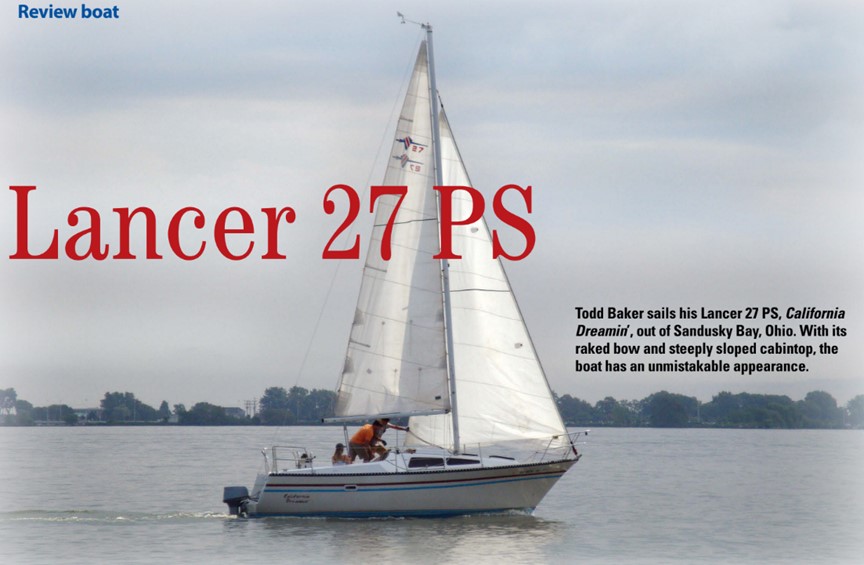
Our test boat, California Dreamin’, is owned by Todd Baker, who sails out of Sandusky Bay, Ohio. Though Todd was a sailor in the U.S. Navy, he’d never owned a sailboat before coming across this Lancer 27 PS with a “for sale” sign. He took the plunge, made friends with the seller, and learned to sail.
On the day of our scheduled sea trial on western Lake Erie, the winds were light and variable, which made assessing the Lancer 27 PS’s capabilities something of a challenge. I did confirm that the boat is not a light-air performer and doesn’t like to point all that high, maybe 45 degrees. Its best points of sail are on a run and broad reach.
A displacement boat with a waterline of 22 feet has a theoretical maximum hull speed of 6 mph (5.2 knots). But the Lancer 27 PS is not normal. Fitted with a 200-horsepower outboard, the boat has achieved a recorded speed of 20 mph! California Dreamin’ was equipped with a 40-horsepower outboard and, with the throttle fully opened, the speedometer read 10 mph. (This is a powerboat in many ways, remember, and powerboaters record speeds in mph.)
While under sail, the boat is quiet and smooth, as one would expect of a sailboat. Under power it’s a different story. The outboard is noisier than an inboard and the ride is not all that smooth — a bit wobbly in fact. Turning under power, especially at speed, is quite uncomfortable. It’s best to reduce power when maneuvering.
Things to check out
The majority of the sail-handling hardware is minimal, basic, and low-end. This includes the headsail furler, headsail tracks, and traveler. If they haven’t been updated, they’re prime candidates for replacement. The electrical panel is basic and may require the addition of a sub panel to accommodate modern instrumentation.
As is the case with most 30-year-old boats, there will be the typical issues related to age, including water incursion around stanchions and other deck hardware, craze cracking of the gelcoat, and head odors from saturated holding-tank hoses. There have been reports of internal corrosion of the water tank and subsequent leaks, external corrosion of the fuel tank, and internal failures of the optional aluminum holding tank.
Todd told me that the mounting screws around the deadlights on California Dreamin’ work loose every season. This, and aging sealant, causes significant leaks. Renewing the sealant and through-bolting the deadlights should cure the problem.
Conclusion
The Lancer 27 PS has aged well and is an attractive-looking boat . . . except, perhaps when viewed from astern. The interior is laid out well, is user-friendly, and gains significant volume from the space that would have normally been filled by an inboard engine. It has one of the largest head compartments I’ve seen as well as a generous aft berth.
Compared to other manufacturers’ powersailers, the Lancer 27 PS performs better under sail. Under power it can be both fast and a bit awkward. Overall, its performance is acceptable for what it is.
The demand for powersailers is not that strong. Expect to pay $6,000-$10,000 for a boat in good condition.
Gregg Nestor is a contributing editor with Good Old Boat. He has authored three books on sailing, including Twenty Affordable Sailboats to Take You Anywhere, The Trailer Sailer Owner’s Manual, and All Hands on Deck. He has been preparing his boat for a trip down the Intracoastal Waterway.
Thank you to Sailrite Enterprises, Inc., for providing free access to back issues of Good Old Boat through intellectual property rights. Sailrite.com