Fashion and formulas reshape the forefoot
Issue 95 : Mar/Apr 2014
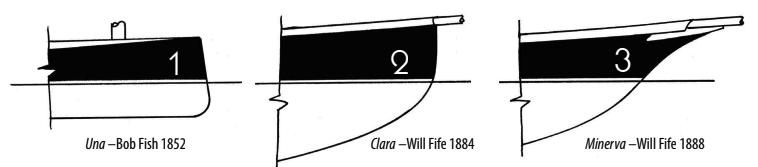
Nothing looks quite as “yachtie” or traditional as a clipper bow with a long bowsprit pointing the way ahead. Some of the most classic designs through the history of sailing have sported clipper bows, from the little Friendship sloop to the magnificent designs of L. Francis Herreshoff and Bill Garden. Clipper bows don’t have to have bowsprits (that configuration is known as a “bald” clipper), but the bowsprit does seem like the logical extension of the line of the bow arching compellingly forward. However, we must remember that yacht design — like architecture, art, music, fashion, and automotive design — does evolve over time and go through “periods,” so trying to define what exactly constitutes “good” design in any of these various disciplines can be a moving target. Every time I visit the Museum of Modern Art in New York City, I’m bowled over by the large Jackson Pollocks, but even he once asked himself, “Is this art?” Tastes change and, as we will see here, in the case of yachts they often change and evolve in line with shapes defined originally for racing. This evolution does not always move in a straight line but, in some cases, in what looks like a circle.
The clipper bow is named for the great clipper ships of the mid-19th century that bore it, but the concept was quickly adopted on pilot schooners and some large schooner yachts. The clipper bow soon became associated with “speed under sail.”
In those various applications the advantages were the same. By stretching the bow forward, increased flare can be introduced in the forward sections, adding more buoyancy against burying the bow at speed in rough conditions, as well as keeping the foredeck drier and increasing the amount of working space for handling headsails. The extended bow also shortens the unsupported length of the bowsprit, and this has both structural and safety benefits. It’s no coincidence that the long bowsprits in the offshore fishing fleets were known as “widow makers.” There are also other practical advantages, such as being able to locate the hawsepipe farther forward so the anchor more easily clears the hull when it’s being raised.
The influence of rules
Several past articles in Good Old Boat have discussed the important influence rating rules have had on the design of yachts, and this is as obvious in the profile shape of bows as any other aspect of design. What becomes popular and acceptable in racing yachts invariably influences the shape and perception of cruising boats.
Keeping that in mind, the “Golden Age” of the clipper bow on racing yachts on both sides of the Atlantic was immediately after the introduction of the Seawanhaka Rule in North America in 1883 and the similar Sail
Area/Waterline Rule in England at the same time. Both of these new rules replaced older rules that penalized bow overhangs by measuring length as the “length between perpendiculars,” that is, from the stern post to the farthest extent of the stem. Such a rule strongly encourages plumb stems — or even stems with reverse rake.
With the new Seawanhaka Rule, the length used in the rating formula was the waterline length, not the overall length. Since the amount of bow overhang made no difference to the rating, British and American designers of the era, most notably Edward Burgess, A. Cary Smith, and William Gardner in the U.S., and George Lennox Watson and William Fife III in Great Britain, started to extend the bow beyond the LWL. They did this tentatively to begin with, since the dictums of the old rule were well ingrained in all of these designers, and the introduction of the clipper bow was their first attempt to inch the bow forward, free of the constraints of the old rule. The clipper bow was still popular on the larger schooners, so its adaptation to the smaller sloops followed an accepted precedent. This is seen most notably in the work of Edward Burgess in the U.S. and G.L. Watson in the U.K. The yachts in this period were some of the most strikingly beautiful boats ever built, although to us they are still obviously from another era.
Rule changes always bring new designers to the fore, since everyone has to start at the same point on the new playing field. Past experience with the old rule is of little value, and is often a detriment. It wasn’t long before the new rule attracted new designers and new thinking.
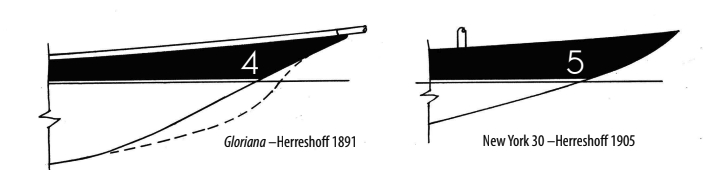
In the U.S., Nathaniel Green Herreshoff introduced that new thinking when he designed Gloriana. With Gloriana’s bow, Herreshoff changed the look of yacht design overnight, making obsolete everything that had gone before.
The advent of the overhang
Ever since America in 1851, and certainly with the Wave-Line Theory (see “Scientific Yacht Design,” January 2014), a long fine bow with a hollow entry was considered essential for speed. However, under the new Seawanhaka Rule, which measured waterline length only, a long bow increased the rated length of the boat but did not create a speed advantage to make up for it. Herreshoff demonstrated that trimming away a good chunk of the deadwood at the forward end of the load waterline created a fuller entry but substantially shortened the measured waterline length. This lowered the boat’s rating and did not cause enough of a reduction in speed to negate this rating advantage. The approach taken in Gloriana was not so much to lengthen the forward overhang but more to shorten the waterline forward, which had the visual effect of lengthening the overhang. However, even Gloriana maintained a slight reverse curve as emblematic of the clipper bow.
This soon changed, even in Wasp, Herreshoff’s successor to Gloriana. The American and British designers of the 1890s developed what was called at the time the “Viking” bow, which we now know as the “spoon” bow. Like many innovations, this change in bow shape was not greeted with universal approval, and at the time was considered ugly and even an abomination.
Later on, the Seawanhaka Rule did produce some of the most magnificent yachts ever built, and certainly the first of the “modern” yachts, with Watson’s Britannia being a crowning example. However, only measuring one aspect of hull design (LWL) did produce problems as designers sought to exploit the rule. Boats designed to this rule soon approached scow-like proportions, with very short waterlines, very long overhangs, shoal draft, and wide beam carried well forward and aft. In extreme cases, and there were many, overall length approached twice the waterline length, with all sorts of structural challenges that long overhangs entail. The most notable example of this successful exploitation of the rule was the Herrick Duggan-designed Dominion, which for all intents and purposes was a catamaran. However, the magnificent 1903 Herreshoff-designed 140-foot America’s Cup defender, Reliance, was another remarkable exploitation of the obvious weaknesses of the rule.
Reeling in design excesses
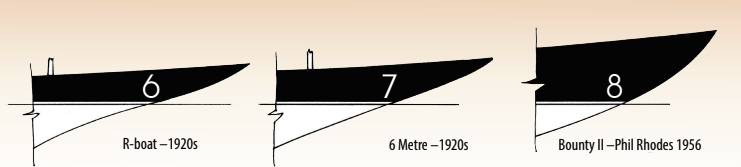
The excesses that arose from the simplicity of the Seawanhaka Rule caused a response on both sides of the Atlantic that resulted in the adoption in 1906 of Herreshoff’s Universal Rule in North America and, in Europe, the International Rule. Each of these had slightly different methods of defining length, with the Universal Rule taking a length measurement at the quarter-beam line, to penalize scows, and the International Rule introducing girth measurements (that would reappear much later in the IOR).
Both rules influenced the bow profile but produced very similar bow overhangs, with the spoon bow becoming even more established. Granted, large yachts built with clipper bows still did well on the racecourse, with L. Francis Herreshoff’s Tioga II (better known today as Ticonderoga) and, sometime later, Philip Rhodes’ Thunderhead being excellent examples. Herreshoff was the more traditional in this respect, almost always employing bowsprits and trailboards, but Thunderhead had a “bald-headed” clipper bow with no bowsprit or trailboards. By contrast, Olin Stephens started his career designing International Rule 6 Metres, and that influence can certainly be seen in the bow of Dorade, his first offshore success.
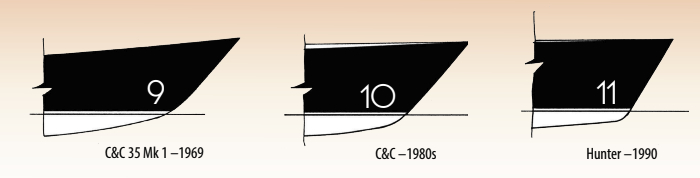
In 1933, the Cruising Club of America established the CCA Rule. It was not a design rule, as such, but was based on an idealized hull form and applied penalties and benefits for departures from those base proportions. Since the CCA hull form drew from “healthy” examples produced by its predecessors, the bow shape did not change dramatically, although it became somewhat shorter than under the Universal and International rules. Since the measured length was calculated from LWL and a waterline above the LWL, the CCA stem profile had an interesting flatness at its lower end.
The IOR superseded the CCA rule in the early 1970s, and the influence of girth measurements, originally established in the International Rule and the Royal Offshore Racing Club (RORC) Rule, produced boats with raked but almost straight-line stems. It is amazing how consistent this rake was across the IOR fleet. It was steeper than the spoon bows of the CCA Rule that preceded it.
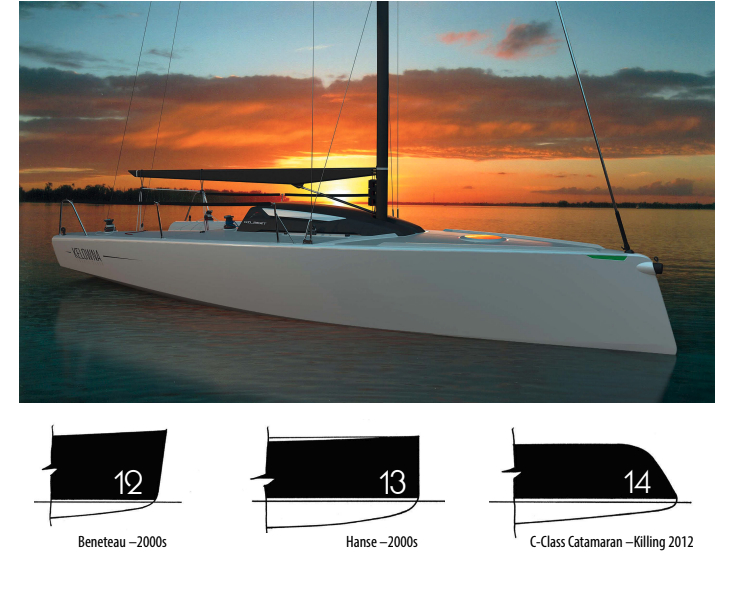
Swinging back to plumb
After the IOR faded away, a number of offshore one-design classes prospered. A good few of these — the Mumms and the Farrs are examples — returned to almost plumb stems. This design trend has also been picked up by many builders of production cruiser/racers and cruising boats. However, even when I was designing for Hunter back in the early 1990s, stems were becoming more vertical, irrespective of any rating rule. Reducing the rake of the stem leads to an increase in the waterline length, which in turn leads to more usable accommodation in the forward part of the boat.
Recently, of course, multihull racing, as seen in the latest America’s Cup, has been well publicized, so we again see a change in bow fashion with a return to the “reverse” bow of Una of more than 150 years ago. This bow, too, may well become the norm and accepted by cruising purists as a thing of beauty and a joy forever.
It’s well understood that beauty is in the eye of the beholder, and tastes change on a generational basis based on the types of boats people grew up with. Indeed, Gerry Douglas, chief designer and vice president of Catalina Yachts, maintains that a person’s tastes in yacht design are established at the age of 14 by the boats then in vogue. So in 150 years of yacht design, from a “styling” point of view, have we really come that far? It really does look as though we have come full circle.
Rob Mazza is a Good Old Boat contributing editor. A lifelong sailor, he writes about good old boats from the vantage point of having been involved in the design of a good many of them.
Thank you to Sailrite Enterprises, Inc., for providing free access to back issues of Good Old Boat through intellectual property rights. Sailrite.com