See, be seen, and talk about it
Issue 103 : Jul/Aug 2015
“This is sailing vessel Entr’acte WYR 3025 — at latitude 24 degrees 16 minutes north, longitude 97 degrees 14 minutes west — calling the cargo vessel astern. Do you see us? Over.”
Silence.
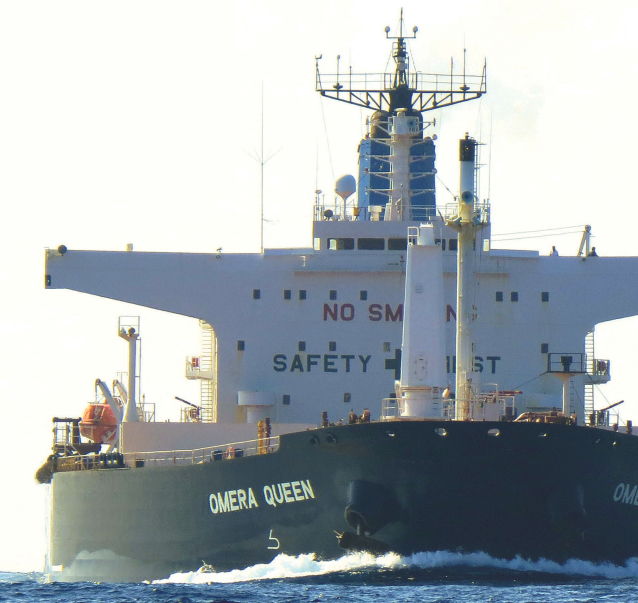
The sun has just set. Entr’acte is running dead downwind in a moderate sea making 6 knots, genoa poled out to port, main to starboard, boom vang set, and preventers in place. Rolling along without a care, we now have a “situation.” A large container ship has just appeared among the waves some distance astern and to port. Her lights indicate an almost parallel course, overtaking and possibly converging. Continuous bearings appear to remain constant but there’s so much motion, it’s hard to be certain. She might pass well to port and safely ahead but we just . . . don’t . . . know!
With the radio silent, we have no idea what he’s thinking or if he even knows we are here, so it’s up to us to remain clear . . . but how? Crossing her bow is out of the question. It’s dark and any other move will involve a lot of foredeck work and lost time.
We call again: “This is sailing vessel Entr’acte . . . blah, blah, blah.”
More silence. The only safe decision is to jibe the main, lower the pole, come onto the wind and sail off on a course perpendicular to the ship’s track.
Two hours later, sails re-set, we are safely back on our course, but Ellen’s off-watch rest has been destroyed. With a little more information, our actions might not have been necessary.
These days, thanks to the Automatic Identification System (AIS), such scenarios are becoming less common. AIS is an anti-collision tracking system that locates vessels electronically and exchanges navigational information between vessels. A simple, continuously transmitted VHF radio message shares critical navigational info about each transmitting vessel.
Be seen or see only
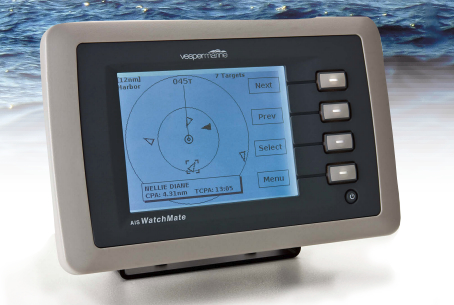
Class A and Class B transponder units, which send and receive information, and receive-only units with no class designation. AIS receivers display contacts (called targets) on a screen with your boat in the center, much like a radar display. Thus it is sometimes referred to as AIS radar.
Class A is for commercial vessels. Since 2002, all commercial international vessels exceeding 300 gross tons, non-international vessels exceeding 500 tons, and all vessels carrying passengers for hire regardless of size, must be fitted with Class A transponders. Class A is the most expensive because it transmits at a higher power and more frequently (every 2 to 10 seconds when under way depending on speed and every 3 minutes at anchor). It has all of the functionality the law requires of commercial vessels and requires operator intervention during use.
Class B is for the average boater who does not carry passengers for hire. Introduced in 2006, Class B transponders are fully functional but less complicated, far less expensive, and within reach of the average pleasure boater. Class B units transmit at lower power and do not require or allow user intervention. Once initially programmed, they’re fully automatic, broadcasting every 3 minutes when the boat’s speed is less than 2 knots and every 30 seconds at greater speeds. Class B is not inferior or lacking functionality in any way. Many transponders now include WiFi to connect with computers, tablets, and other iOS devices.
Receive-only units, the simplest and least expensive, are available as stand-alone units with screens or as “little black boxes” minus screens that fit almost anywhere and connect to your chart plotter or computer charting program through NMEA 183 or NMEA Some VHF radios now include an AIS receiver. Older single-channel units see only Class A targets. Newer multi-channel units process both Class A and B vessels plus a wide selection of other available targets. Since you want to see everyone who is transmitting, regardless of class, check specifications carefully before you buy, especially if buying a secondhand unit!
Using AIS
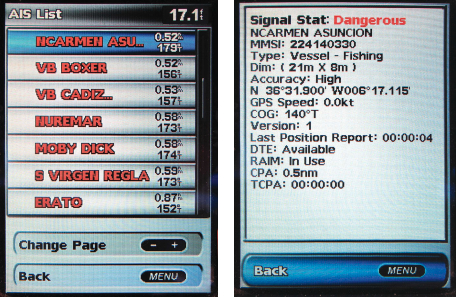
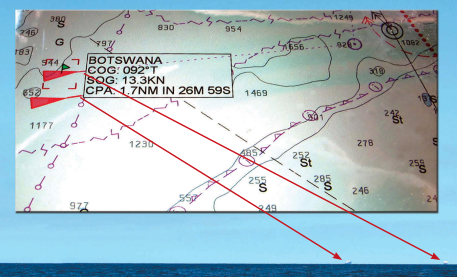
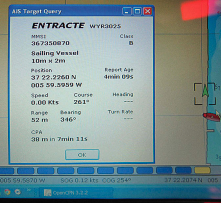
AIS targets appear as icons on the display. When you place a cursor on a target, a text box shows the vessel’s name, MMSI number (an ID number unique to that vessel), type (pleasure, sail, or cargo), course, speed, destination, and the two important figures: closest point of approach (CPA) and time to closest point of approach (TCPA). Press a button to see a target list of every vessel within range, usually ranked according to proximity.
If AIS does nothing more, it gives you a vessel’s name to hail. This eliminates the need to transmit coordinates, which can be confusing. English may be the international language for navigation, but it is usually the second or even third language spoken on board. Those on the ship’s bridge can communicate in English “face to face,” but over the radio the more words spoken the greater the chance of confusion and of being ignored, so come right to the point: “Da Vinci, Da Vinci, this is sailing vessel Entr’acte. Over.” We have never hailed a ship by name and not received a response.
If your VHF has Digital Selective Calling (DSC) capability (in the U.S., that’s any non-handheld VHF radio sold since 2000), you can send a DSC priority call directly to the vessel’s MMSI number. You will get a response . . . and fast!
With AIS, however, if the ship appears on your screen at a range of 15 miles, you have plenty of time to adjust your course and probably won’t need the radio at all. Many times, the less said the better.
AIS is not just for world-cruising yachts. A click on www.vesselfinder.com shows that just about every body of water in the world is covered with AIS targets. Zoom in and the number of targets multiplies. If your boating activities put you into contact with large ships, ferries, or day-charter boats — basically any large commercial vessels — your life will be easier and safer if you can at least receive AIS.
In the opening scenario, even if we’d had receive-only capability and nothing more, we would have seen the ship on screen an hour before visual observation and would have been relieved to know the CPA would occur 10 minutes after he had overtaken and safely passed us one mile to port and a mile ahead of us. We could have maintained course and speed or changed course slightly to open CPA even more while watching the CPA closely and planning well in advance of problems.
Whenever you’re dealing with multiple vessels, this information will reduce tension. You immediately know which targets are dangerous and which are not. The dangerous target is not always the closest one. You no longer have to spend tedious hours trying to dodge a ship that poses no threat at all.
On rivers, you won’t be surprised by a tug towing six barges rocketing suddenly from behind a headland down-current toward you. Your proximity alarm will warn you well in advance of a visual so you can position your vessel to remain clear.
AIS aids navigation
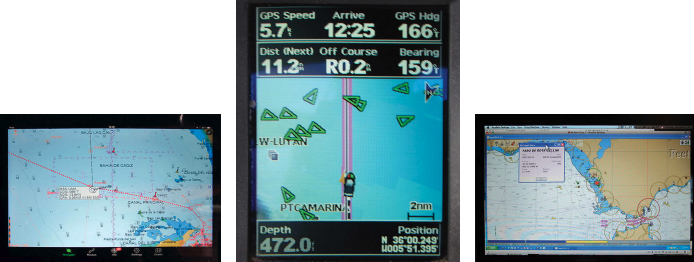
In addition to ships, AIS also receives signals from Aid to Navigation beacons. AtoN beacons broadcast AIS signals showing their position on a chart. AtoNs can be real and fixed (lighthouse), floating (buoys and fishing nets), or virtual (transmitted from a shore station). They can indicate temporary emergency channels, alternative passages, danger zones, fishing areas, racecourses . . . almost anything.
Even if you can’t see that lighthouse due to fog or a malfunctioning light, you will see it as a magenta diamond on your electronic chart and a target contact on your plotter screen and target list. You’ll also have its range, bearing, CPA, and TCPA. We receive AtoNs at 200 miles. Pretty cool! Now we have a fighting chance to avoid those large fishnet areas.
AIS and MOB
AIS can serve as a man-overboard locating device. Several manufacturers, such as McMurdo, offer personal strobe/locators that attach to a life-jacket or safety harness and transmit AIS. In the event a wearer goes overboard, the strobe will flash and the unit will transmit an AIS signal. The person in the water will appear on screen as an actual AIS ship target, visible on any vessel with an AIS receiver.
The nuts and bolts
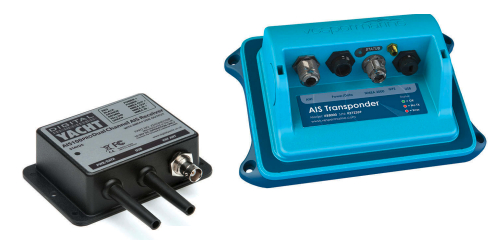
Costs – AIS is affordable. The technology changes almost daily resulting in more units with more features at lower prices than ever before. Our original black box receiver and antenna splitter cost less than $300. Our new transponder/splitter with built-in WiFi network for iPad connectivity cost less than $900.
Antenna splitter – AIS is a VHF signal just like that from your ship’s radio. The effective range is determined by the quality of your antenna and its height above the water. Since two masthead antennas will interfere with each other, the antenna splitter was developed. This small box allows your VHF radio and AIS unit to share one masthead antenna. It works seamlessly in the background and automatically connects the proper device as needed.
It’s important to be aware that a particular antenna splitter might not be universally compatible with all devices. A splitter that works with a receiver may not work with a transponder. Do your research.
Licensing – For a recreational vessel in U.S. waters, no FCC license is required to install or use a VHF radio or AIS receiver. However, if you wish to install a transponder and do not require a license, you still must obtain an MMSI number. Without formally applying for an FCC radio license you can obtain this all-important number through the BoatU.S. website (see “Resources” on page 43). An MMSI obtained through BoatU.S., however, is not valid for use outside U.S. waters.
For international travel, including to Canada, Mexico, or the Bahamas, you must have a station license for your boat. This license assigns to your vessel (not to an individual) a call sign and MMSI number that cover your VHF, EPIRB, SSB, and AIS transponder should you choose one that transmits. There is no exam. Complete the paperwork, pay the fee ($155 for a 10-year license), and you’re done.
Programming – Transponders must be programmed with your vessel’s length, beam, and MMSI number. In the United States, it is illegal for end-users to program AIS transponders. Before buying our Class B transponder, we had to complete a form listing all our vessel’s particulars and provide documentation of our MMSI. Our new Vesper XB-8000 transponder arrived pre-programmed, tested, and ready to use. If you purchase a used unit, it will be programmed with the former vessel’s MMSI. Before installation, you must have the unit reprogrammed with your vessel’s number. Check with the manufacturer to determine how this can be done and at what cost.
If you live outside the U.S. and purchase an unprogrammed transponder and program it yourself, beware! You get only one chance to input the MMSI. If you err, you must, in most cases, return the unit to the manufacturer, not the dealer, to have it corrected.
Transmit or receive-only?
Does a small yacht need an AIS transponder or is receive-only good enough? Our encounter with Argos, a 130-foot superyacht, got us thinking about this.
We were 8 miles from an entrance buoy to a reef passage in 25 knots with large seas. Our receive-only AIS alarm alerted us to “a dangerous target” barely visible among the waves. Argos was making 14 knots and our CPA and TCPA indicated that we would arrive at the buoy simultaneously.
“Argos, Argos, this is Entr’acte.”
Despite our two radar reflectors, Argos had not seen us visually or on radar. Even before we signed off, however, our readout showed that she had slowed to 12 knots, enough to increase CPA and allow us both to enter in safety. Had Entr’acte been transmitting AIS, Argos would have received a solid contact, seen our destination, and reduced speed.
As passengers on a recent trans-atlantic crossing aboard the 1,000-foot container ship, Matisse, we each stood two proper 4-hour watches for 12 days and had ample opportunity to observe the crew and study the ins and outs of AIS reception. We saw firsthand how our boats appear to these big boys. It was not encouraging, except for those yachts that transmitted AIS.
While radar contacts vary with the size of the vessel and sea conditions, AIS target icons are identical regardless of the size of the vessel. The contact icons for a 5-foot rowboat, the 27-foot Entr’acte, and a 1,000-foot container ship are all the same size, a comforting thought! AIS greatly enhances your “electronic footprint.”
AIS feeds the contact to your chart plotter. A “dangerous target” triggers an alarm followed by a target query. CPA and TCPA determine the action required.
Unfortunately, the maximum AIS threat alarm zone for chart plotters and charting programs varies considerably. On open CPN, the threat alarm zone can be set at 20 miles or more, but my Garmin plotter’s maximum threat zone is only 2 miles. In low visibility with only a 2-mile warning, you will never get out of the way in time.
For the singlehander, an AIS transponder can save a life . . . mine! We were almost run down by a singlehander who was sleeping. An AIS transponder is like having an extra crewmember constantly announcing your presence.
As of this writing, several countries (such as Singapore) are beginning to mandate that all vessels transmit AIS. The UK is also making noises along these lines.
The bottom line
The latest receive-only units will receive signals from both Class A and Class B transponders.
If you install a Class B transponder, your signal and information will show up on both Class A and Class B receivers. In short, you will both see and be seen by the big boys.
The catch
There is one snag: the lag between the rapidly evolving AIS technology and the capability of existing GPS units. Ship transmissions are slightly different from AtoN transmissions, and even though AtoNs are received by your AIS unit and relayed both over WiFi and NMEA, your chart plotter might not process them. There are 26 different types of AIS sentences (signals), each one slightly different and each serving a specific purpose (ship, AtoN, MOB, and so on). While the latest AIS units will process most of them, your chart plotter may not. For example, our Vesper transponder receives and processes ship, AtoN, and MOB sentences. We read them easily on Open CPN and on the iPad, but our Garmin chart plotter will only display Class A and B ship targets. If you plan to use AtoNs, you may want a WiFi-capable unit connected to a computer or iPad. According to McMurdo, their MOB device will show on a plotter, but as a ship contact rather than an MOB. To be certain, check with the manufacturer of your particular device.
AIS is not perfect
We should never rely on just one navigational device. Do not blindly assume that because you are transmitting and receiving AIS, you no longer have to keep a good watch. That would be a tragic mistake. Nothing replaces a good pair of eyes and sound judgment. Never assume the “other guy” is alert and conforming to the law. We are the little guys and, “right of way” notwithstanding, our survival dictates that we keep out of their way.
Throughout this season we have been continually impressed by, and have found new ways to employ, this great new technology. With AIS, good sense, and reasonable care, your navigation and encounters with the big boys will be far less tense. Forewarned is forearmed.
Ed Zacko is a Good Old Boat contributing editor. He and Ellen met while playing in the orchestra of a Broadway musical. They built their Nor’Sea 27, Entr’acte, from a bare hull and since 1980 have made four transatlantic crossings and one across the Pacific. Entr’acte is now based in Seville, Spain, where Ellen and Ed are happily sailing in and around the Mediterranean and playing in the jazz clubs of Spain, France, and Morocco. Follow them on www.enezacko.com.
Thank you to Sailrite Enterprises, Inc., for providing free access to back issues of Good Old Boat through intellectual property rights. Sailrite.com