A handsome and seasoned trailer-sailer
Issue 95 : Mar/Apr 2014
Lenny and Carla Corin sailed Sunfish and Sailfish on the East Coast when they were teenagers. Then, as Carla puts it, “life and children” intervened. Lenny spent 30 years with the U.S. Fish and Wildlife Service, while Carla worked as a biologist and editor. Their boating activities were limited to family canoe and kayak trips, plus work-related diving from larger vessels. They spent several years working in Alaska before moving south in 2008 for an active retirement on Whidbey Island in Washington state.
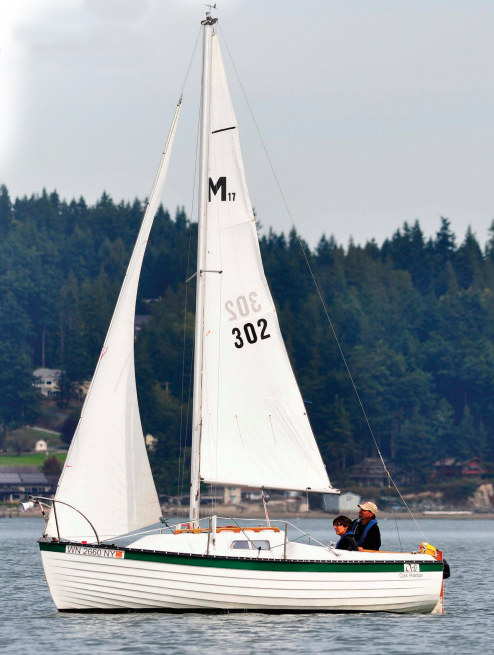
Lenny had expressed interest in a 32-foot sailboat an acquaintance was selling when Carla asked, “But do we know how to sail?” Both wisely enrolled in a sailing course in the spring of 2013 and, as Carla puts it, “Luckily, that 32-footer was sold by the time we graduated.” It seemed more prudent to restart their sailing adventures with a more modest craft, so after a brief flirtation with a new Montgomery-designed Sage 17 (see November 2012), they purchased a used 1979 Montgomery 17 in nearby Anacortes.
Lenny is clearly enthused and anxious to begin taking weekend cruises. Carla is a bit more circumspect, but both express appreciation for having found such a sturdy, safe, and manageable craft for their first sailboat and are exploring the subtleties of small-boat sailing in an area of unpredictable winds and weather.
In addition to photographing and sailing the Corins’ boat, we contacted a number of other M17 owners through the Montgomery Sailboat Owners Group. We asked about their experiences with the boat and have used their observations to flesh out our review.
Background and history
Lyle Hess designed the Montgomery 17 in 1973 with and for his friend Jerry Montgomery, who was already highly regarded as a designer and builder of small, fast, high-quality fiberglass daysailers, including a 12-foot Lyle Hess design. The very first examples of this compact coastal cruiser had bolted-on cast-iron fixed keels, but the more easily trailerable keel-centerboard version was better received and soon dominated production and sales. A few boats were built with flush decks and tall rigs, but the majority are the familiar trunk-cabin, keel-centerboard model we tested.
Many refinements were made during the boat’s long production history. Montgomery Marine built nearly 500 M17s before delivering the last Jerry Montgomery-built boat in 1994. After that, the molds were sold. A difficult and unsettled period of several years followed, but Bob Eeg of Nor’Sea Yachts eventually stepped in and currently produces both models under the mark of Montgomery Boats.
Design
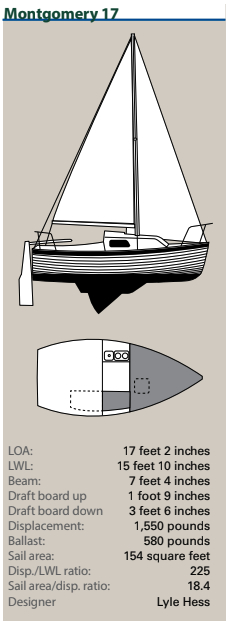
The Lyle Hess pedigree is evident in the design. Better described as “purposeful” rather than “graceful,” its short overhangs, spoon bow, fine entry, simulated lapstrake topsides, and balanced proportions reflect the beautifully functional aesthetic so typical of Hess designs. Although clearly a descendent of those British working craft its designer so admired, It is not just a scaled-down version of a larger boat but a unique design, derived from and for its own purpose. Length overall is 17 feet 1 inch on a 15 feet 10 inch waterline length. The beam is 7 feet 2 inches, and the displacement of 1,550 pounds gives a moderate displacement/LWL ratio of 225.
End-grain balsa core was specified to lighten the cabin and deck, while the solid fiberglass hull is stiffened by the difficult-to-mold strakes, which also act as miniature spray rails and are essential to the strikingly distinctive character of the boat.
A keel-centerboard design with a keel-contained pendant and full-length bearing for the board was selected as the best compromise for shoal draft, structural integrity, stiffness, and sailing ability. The centerboard in early boats was a heavy iron casting, and additional iron or steel ballast was encapsulated within the shallow keel. A slightly smaller and lighter fiberglass centerboard with a lead core replaced the ferrous version in 1987. Encapsulated lead ballast was substituted for the iron ballast, and the total ballast was increased from 550 pounds to 600 pounds at the same time. Both versions of the centerboard were shaped for maximum lift, as is the deep but slender, vertically retractable wooden rudder. The heavy cast-iron centerboard on early models is raised by a winch mounted inside the cabin directly below the companionway. The draft is 42 inches with the board down and 21 inches with it up.
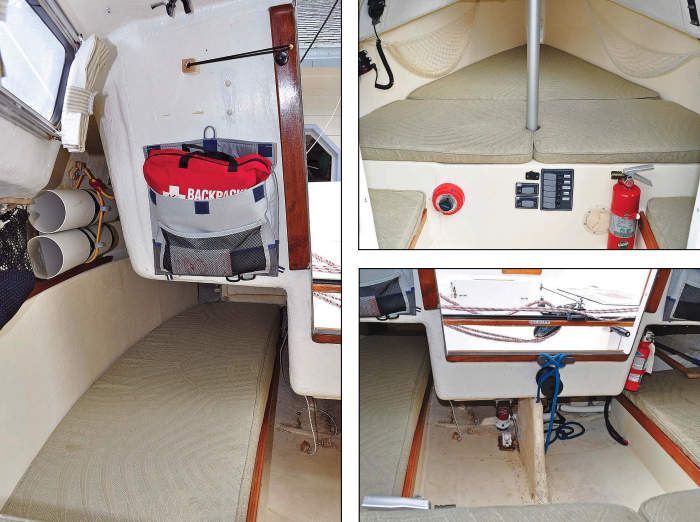
The original cabin layout included a V-berth with the head located under the starboard section, a very narrow quarter berth to starboard, and a tiny galley to port. A new interior with a full-length port-side quarter berth/settee replacing the galley was introduced in 1978, and a final version, in 1987, shortened the port quarter berth to 5 feet to make room for a larger cockpit locker.
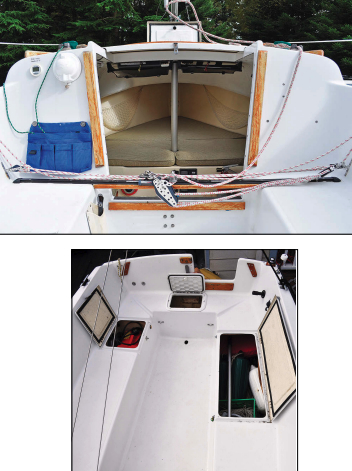
The self-bailing cockpit is deep with high backrests and two cockpit seat hatches opening to stowage lockers. One hatch accesses a small locker at the after end of the starboard seat and a larger hatch opens to a deep locker to port. Both hatches are well drained and can be secured for sea. A wet locker incorporating improved cockpit drainage was added to the aft end of the cockpit in 1981 and, in 1984, the perforated-aluminum toerails were replaced with teak.
The masthead Marconi sloop rig is supported by six shrouds, a headstay, and a backstay and carries a total sail area of 154 square feet (100% foretriangle), for a sail area/displacement ratio of 18.4. The standard rig (a few boats were built with a 21-inch taller mast) will clear a bridge at 25 feet 6 inches.
Construction
In spite of her 34 years, Orli, the test boat, displayed excellent glasswork with only a few spots of minor gelcoat crazing at corners or around heavily stressed fittings. All owners reported their boats were solidly built with no oil-canning or delamination and praised the quality of construction. Most mentioned the sturdy hardware, mast, and rigging. Sails and the standing and running rigging had, of course, been replaced on most of the older boats. A few owners reported the usual portlight leaks, balsa core saturation, and gelcoat fading typical of vintage fiberglass boats.
More common and more serious were issues with rusting of the cast-iron centerboards of the older boats and consequent binding inside the keel. Most affected owners have removed the boards, sandblasted and faired them, and coated them with epoxy. Rusting and subsequent expansion of the encapsulated ferrous ballast in the keel is even more serious, as the keel swells and seizes the centerboard. Extensive fiberglass surgery is required to remove the iron or steel ballast and replace it with lead, and reshape and re-glass the keel. It is a testament to the perceived value of these boats that many owners have been willing to go through with such extensive repairs. Boats that have been consistently and carefully maintained seem to have avoided most of these problems, even though some are nearly 40 years old.
Accommodations
The Corins have not used Orli for cruising yet, but many owners have. Despite one comment of, “The cabin of the M17 is not the place for a big 6-foot 6-inch guy,” several said cruising was comfortable for one and possibly for two very intimate friends. No one admitted to having slept in the quarter berths. The V-berth as split by the mast support post but is 6 feet 7 inches long on centerline, 5 feet 11 inches wide at the head, 6 inches wide at the foot, and has 29 inches of headroom under the cabin trunk. A 6-foot 6-inch settee berth in the starboard quarter tapers in width from 15 inches under the cockpit seat to a maximum of 19 inches, with 10 inches from the cushion to cabin sole and 36 inches of headroom above. Under the cockpit seat, the clearance is 12 inches, and it’s a little more under the gunwale — it’s a good seat, but a very narrow berth. Other than being shorter, the matching settee berth to port is identical.
The portable head is stowed (and intended to be used) in a dedicated recess molded immediately forward of the athwartships bulkhead of the V-berth. It’s covered by a removable portion of the starboard berth cushion. Use and operation in place are possible but extremely awkward and uncomfortable. Many owners either move the head out onto the cabin sole or use alternative systems.
From sole to overhead, the cabin headroom is 4 feet 3 1⁄2 inches. The sliding companionway hatch is a generous 32 inches wide but slides forward only 10 inches before it hits the mast step. The hinged forward hatch, located over the V-berth, is 17 1⁄2 inches wide and 14 inches fore-and-aft.
In boats that have galleys, owners tend to use them for stowage rather than food preparation. Most cruisers responding to our survey use camping gear for simple meal preparation.
The deep and secure cockpit is 5 feet 3 inches wide at the forward end and 4 feet 1 inch wide aft. The seats are 6 feet 7 inches long, 15 to 17 inches wide, and 12 1⁄2 inches above the cockpit sole, and they are spaced apart 30 inches forward and 24 inches aft. The backrest/coaming is a reassuring and comfortable 15 inches high.
Some owners have slept in the cockpit during good weather and all confirmed our observation that the cockpit was quite sumptuous for three when sailing and adequate but snug for four. A number of owners rig cockpit tents when at anchor and at least one has a Bimini.
Under way
The weather for the test sail was overcast and quite still. Orli handled well under power, even when backing away from the ramp. The centerboard was lowered at launch, and the deep rudder, although a bit awkward to rig, was very effective. We hoisted the rather tired mainsail and the working jib and slowly but deliberately sailed out into the swirling currents just east of Deception Pass. In less than 5 knots of wind, it was impossible to test the vaunted sailing ability and heavy-weather prowess of the little Montgomery, but considering the extremely light fluky air and unsettled currents, the boat was responsive and well-mannered. Eventually, we gave up and returned to the ramp. During the subsequent photo shoot with only the owners aboard, the breeze picked up a bit and the Montgomery began to show her pedigree, pointing well and tacking smartly.
Owners we contacted were unanimously enthusiastic about the boat’s sailing characteristics. The M17 was consistently described as solid, stiff, stable, predictable, and fast, especially as the wind picked up. Most noted that the boat, like most masthead sloops, needs the right headsail to make good progress to weather, but with decent sails it points well for a shoal-draft mini-cruiser. Weather helm was not considered excessive, and the boat was said to “shoulder in” until overpowered, and then round up safely. All commented that the boat was easy to heave-to and to reef. Most tied in the first reef when the wind speed was about 15 knots and a few had sailed in winds of 30 knots. Many felt the boat could take a lot more weather than the crew and all said it was exceptionally seaworthy, especially for its size and displacement.
It should be noted that, despite having made successful ocean passages, the M17 was not designed for serious offshore sailing. It is, after all, a light-displacement trailerable sailboat.
Our sample of owners was a mix of cruisers and racers. Some did both, and several have cruised in far-flung places, taking full advantage of the boat’s trailerability. The racers seem pleased with overall performance (the average PHRF is 294), and several suggested that it is the fastest cruising boat of its size except for the much newer Montgomery-designed Sage 17.
Although a few owners use an electric or lightweight 2-horsepower gas motor, most use a long-shaft 4- or 5-horsepower four-stroke outboard that will push the boat at hull speed (5.3 knots) under most conditions. Orli’s 5-horsepower outboard was mounted on a lifting bracket, rather than in the transom cutout molded into the port side of pre-1981 cockpits. Some owners maintain that fore-and-aft weight distribution is better with the motor in the cutout, rather than cantilevered behind the transom, but others suggest this is offset by lower-unit drag when the boat is heeled to port. Later boats were fitted with a retractable mount. Owners reported no bad habits when powering, but some suggested turning the motor as well as the rudder to steer in reverse.
Trailering and launching
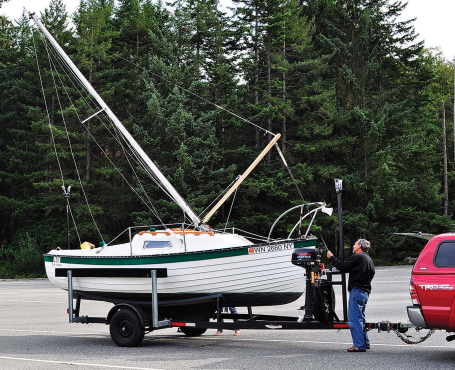
The Corins rigged and launched at the excellent Cornet Bay ramp without a hitch . . . other than the extending trailer tongue, that is. The original steel trailer was painted rather than galvanized, and rust between the telescoping tubes made it extremely difficult to align the holes for the clevis pins. On the other hand, the clever mast-raising rig Lenny fabricated made the hour-long rigging process look almost easy, even though it was only their fourth time out. Hauling and unrigging was uneventful as well.
Owners we contacted for the most part described the boat as relatively easy to trailer, rig, and launch, with the usual grumblings about the depth of the fixed keel and the extending trailer tongue (or lack thereof). An hour or slightly less seems to be the average rigging time. One noted that a stepladder was a big help when setting up the rig as the boat sits high due to the keel and the healthy freeboard.
Tow vehicles ranged from a turbo Subaru Forester to a Hummer H-3, with most being four-wheel-drive pickups. The smaller vehicles all towed trailers with brakes and the typical mileage penalty when towing was 2 to 4 mpg. All said towing was a breeze.
The test boat and trailer measured 22 feet 6 inches overall. The stowed mast was 8 feet 6 inches above the road at the bow pulpit and 9 feet 8 inches above the road at the stern when supported on the factory-supplied carrier that fits into the rudder gudgeons.
Conclusions
The Montgomery 17 is an affordable classic — a well-built, nimble, seaworthy, trailerable mini-cruiser — with a great pedigree and a loyal and experienced following. Its distinctive salty appearance and superior sailing characteristics combine with the Hess/Montgomery mystique in a well-built, seaworthy quart-in-a-pint-pot. Current Internet prices range from a low of less than $4,000 for a late 1970s boat to $17,000 for a five- to seven-year-old model, depending on equipment and condition. The boat is still in production. Jerry and an active owners’ group are happy to provide advice on nearly any aspect of the boat.
Ferd Johns and his wife, Beth, live on Whidbey Island and cruise the Pacific Northwest, Chesapeake Bay, and Florida Keys. Ferd, an architect, cannot count how many old fiberglass cruising boats he has owned (Beth, also an architect, can!), but the fleet is currently down to two trailerable sailboats and one mini trawler.
Thank you to Sailrite Enterprises, Inc., for providing free access to back issues of Good Old Boat through intellectual property rights. Sailrite.com