A bound-up bilge pump yields to friendly persuasion
Issue 69 : Nov/Dec 2009
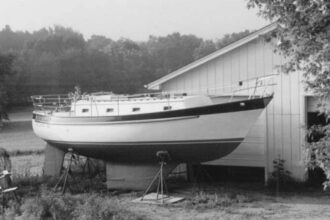
The thing about a 30-year-old boat is that some of its gear is apt to be 30 years old and, unlike that good old hull, not all of it works quite as it used to. I’d been preoccupied with getting a succession of electric bilge pumps and their floating switches to work. In the process, I cleaned out the deep bilge sump — no easy job but finally immensely satisfying — and discovered three decades’ worth of stray bolts and nuts, washers, and electrical wiring snippets. There was an old cigarette lighter down there, a few peach pits, and a lot of watermelon seeds, along with several clots of an unidentifiable substance. Everything lay just beyond arm’s reach in a bed of oil and mud — all part of Kuma’s mysterious former life.
I put in a new pump, but that didn’t work. My friend Jerry brought in his test meter and found that the problem was in a faulty three-way panel switch as well as in the pump. When I got it all back together, it worked . . . and then it didn’t. Jerry’s nose for trouble led to some frayed wiring. It’s working now, happily chucking out water from stuffing box and icebox with impressive regularity, but my confidence in submersible electric bilge pumps and their sometimes fickle nature has been shaken.
The manual alternative
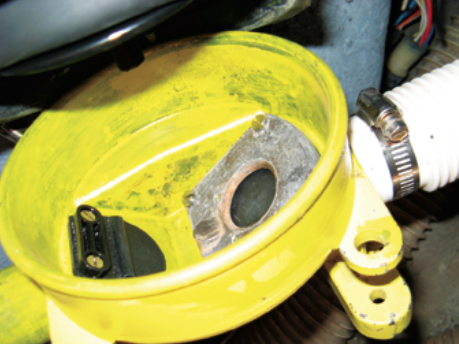
Kuma came to me equipped, like many good old boats, with a Whale Gusher 10 manual pump. It looked good but didn’t lift a drop of water. It’s been on the spring-outfitting job list for years. This year I finally got to it.
Once I got the neoprene diaphragm off, all came clear: the Gusher’s inlet and outlet valves were stiff and mired in corrosion; they’d have to be replaced. The solution seemed pretty simple: I’d get a service kit from West Marine. But, as I was unable to get at the machine screws holding the valves in place, I first had to very carefully extract the pump and all its bits and pieces from the boat.
I took it all home and shot WD-40 around the bases of the machine screw heads, gave it a few taps with a hammer, and let it soak overnight. In the morning, I tried loosening the screws, but nothing doing. I emailed Jerry, who suggested heat. I went back into the shop and fired up the propane torch. Still nothing doing. Another email. Jerry said it needed more heat, real heat, and a lot of it.
“Bring it over,” he said. “It could be brutal; are you prepared for failure?”
On the way over to Jerry’s shop, I thought about a new $300 Gusher. I also thought about a $40 plastic job, which is not as fitting for a small yacht but was a compromise that wouldn’t deplete my two-speed-winch-and-new-headsail kitty by much.
We placed the pump’s aluminum body in a bench vice and, as I held the tip of a blue acetylene flame at the base of a screw head, Jerry addressed it with a properly sized screwdriver, a hammer tapping, and two strong hands. We poured on more heat and Jerry squirted in a little penetrating oil. The valves bubbled when the oil caught fire, and I expected a slurry of melted metal on the bench at any moment.

Torquing and twisting
But Jerry knew better. He leaned into that screw head with his whole weight, grunting like a Wimbledon champion and muttering something I couldn’t quite make out over the roar of the torch. He torqued some more with a steadily increasing back and forth twisting motion, all the while adding penetrating oil to avoid snapping off the screw head. Just when I knew the head must come off, there was a very slight movement, and then a little more.
Jerry made a quick clockwise jerk, one final mighty twist to the right, and it was over. The old pump gave up its treasure. The rest of the fasteners almost seemed to unscrew themselves. It had been brutal but it was done. Later, flushed with success, with everything along with a can of magnesium-chromate paint in a cardboard box in the back of the pickup, we celebrated with coffee and some good talk about bilge pumps and boats.
Sometimes it takes a lot of work to set things right. And sometimes a little more than that. It takes a clear sense of one’s own limitations, knowing what we can do and what we probably can’t. Despite all our efforts, we sail imperfect boats or we don’t sail. Looking back on it, I doubt I would have been able to repair that pump without Jerry’s help. Left to my own devices, I would probably have put it off for another year or I’d have struggled until I left a headless screw in the casting and bought a new pump (and put off my new genoa for another year). What made it all come together right was a little help from my friend.
Richard Smith is a contributing editor with Good Old Boat. He has built, restored, and maintained a wide variety of boats and sailed them on Michigan lakes and Oregon reservoirs and from harbors and mud berths in the Irish sea. He sails Kuma, an Ericson Cruising 31, with his wife, Beth.
Thank you to Sailrite Enterprises, Inc., for providing free access to back issues of Good Old Boat through intellectual property rights. Sailrite.com