Antique technology that still finds favor
Issue 86: Sept/Oct 2012
The gaff rig was the rig of choice for more than 250 years until the Marconi rig (also called the Bermudan rig) came along. The gaff-rigged sail is a quadrilateral fore-and-aft sail with the top attached to, and supported by, a spar — the gaff. The foot of the sail may be fastened to a boom or loose-footed.
There is no question that the Marconi rig performs better to windward than the gaff rig, and soon after its introduction it became predominant. Today, since nearly all modern sailboats are designed with Marconi rigs, very few sailors have ever sailed with a gaff sail. The fores’l of our schooner (the sail between the foremast and the mainmast) is gaff-rigged, and I’ve found that even experienced sailors who come aboard have no idea how to raise and set the fores’l. What follows is a primer on the gaff-rigged sail.
Hoisting and lowering sail
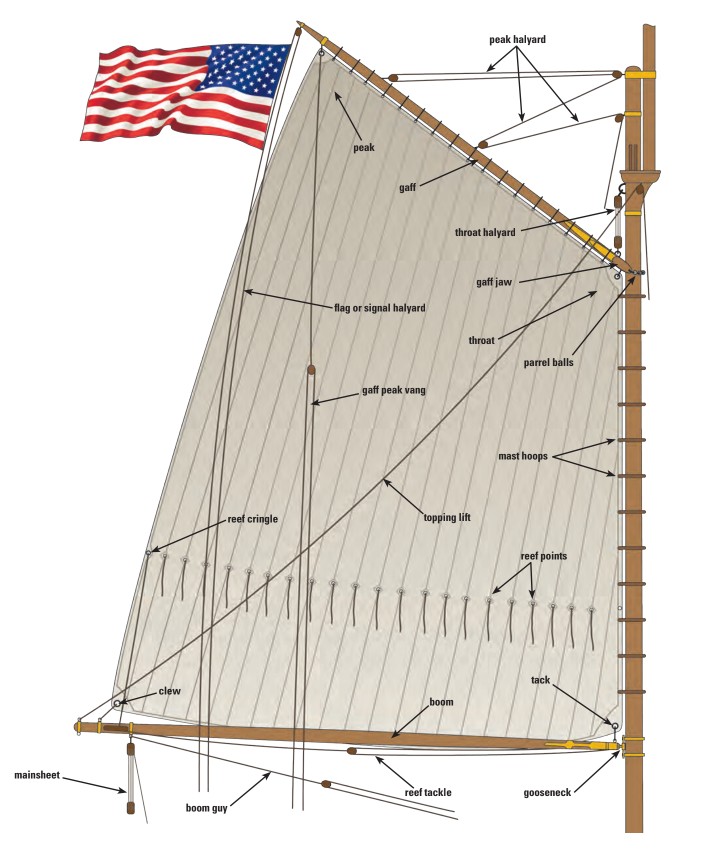
Usually, the gaff sail is raised with two halyards, the throat halyard and the peak halyard. The throat halyard is attached to the forward end of the gaff, close to the mast. This halyard can be a single line or, on larger boats, a multiple-part block and tackle. A winch adds mechanical advantage.
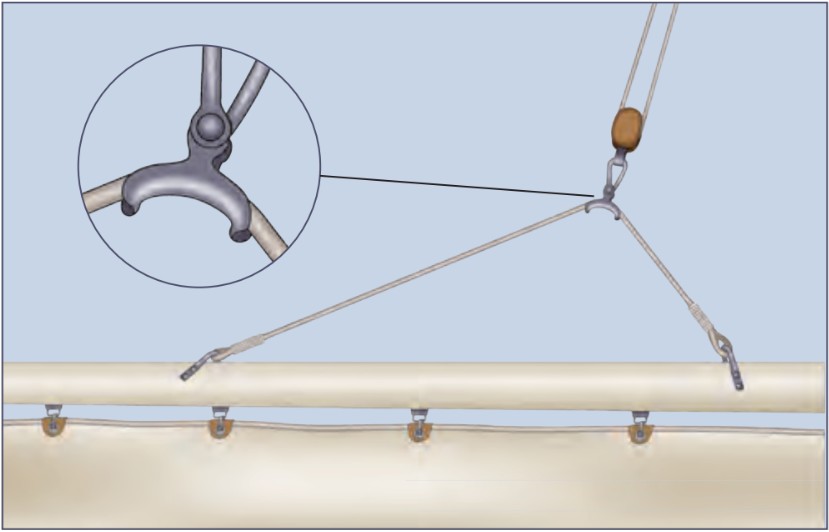
The peak halyard raises the peak, or aft end, of the gaff. This halyard is attached to the gaff with either a gaff bridle or one or more blocks attached to the gaff. When a bridle is used, the peak halyard slides along the bridle as the angle of the gaff changes. This is accomplished with either a small block or a saddle on the bridle. On larger boats with longer and heavier gaffs, there are sometimes several bridles along the gaff.
If multiple-part block and tackles are used to hoist the sail, the throat halyard and the peak halyard must have the same ratio. That is, if the throat halyard is a 2:1 block and tackle, then the peak halyard should also be a 2:1 block and tackle. When the sail is hoisted, the crew work the halyards together as if they were a single halyard.
As the sail is hoisted, the gaff is horizontal. Eventually, the throat halyard comes to a stop as the luff of the sail becomes taut. At that point, the throat halyard is tensioned and cleated off. The gaff is then raised up from horizontal to a more vertical position with the peak halyard until the leech is tight. The peak halyard is then also tensioned and cleated off.
When lowering the sail, the procedure is reversed. After the gaff is lowered to the horizontal position with the peak halyard, the two halyards are used as one to lower the sail the rest of the way.
Lazy-jacks are particularly useful with the gaff sail. They act as a topping lift to support the boom and contain the sail and the gaff, preventing both from dropping on deck.
Trimming sail
Once hoisted, the gaff sail is trimmed the same way as a Marconi sail, using the sheet, traveler, outhaul, Cunningham, and boom vang. One additional piece of running rigging used for trimming is unique to the gaff sail, and that is the gaff vang, or gaff peak vang. The gaff vang attaches to the peak of the gaff, either directly or with a block, and is led down to the windward rail. On a schooner, where there is a mast just aft of the gaff sail, the gaff vang is led back to the mast and then down to deck level. This gaff vang allows the gaff to be adjusted to eliminate sail twist, vastly improving the performance and windward ability of the gaff sail.
One associated sail-trimming maneuver and term is unknown to today’s Marconi-rig sailors: scandalizing. When the peak halyard is released, the peak of the gaff drops down and the sail is almost completely and instantly de-powered. Scandalizing the sail in this way is a very useful tactic when the boat is hit by a sudden squall.
Attaching the sail to the spars
In early gaff rigs, the gaff, and sometimes the boom, rode up and down the mast with “jaws” loosely holding it in place. The luff of the gaff sail was often held in place with wooden hoops that encircled the mast. Usually, the head of the sail was lashed to the gaff and the foot was lashed to the boom.
Some gaff rigs today have replaced these ancient methods with the same technology used in Marconi rigs. The gaff, and sometimes the boom, has a gooseneck fitting that rides up a sail track on the mast. The gaff and boom spars are fitted with sail tracks that take either the sail’s bolt rope or track slides, bringing the rig into the 21st century.
So now, when you’re crewing aboard our schooner and I ask you to raise the gaff fores’l, you’ll know exactly what to do.
Don Launer, a Good Old Boat contributing editor, built his two-masted schooner, Delphinus, from a bare hull. He has held a USCG captain’s license for more than 38 years and has written five books. All of his 101 articles are now available for downloading as a collection from the Good Old Boat download website, www.audioseastories.com. Look under Archive eXtractions.
Thank you to Sailrite Enterprises, Inc., for providing free access to back issues of Good Old Boat through intellectual property rights. Sailrite.com