Beautifully restored daysailer takes to salt water
Issue 43 : Jul/Aug 2005
The drive from my home in Wales across old Somerset and Dorset had taken me through an England as one imagines it: my trusty roadster with running boards and British Racing Green coachwork entirely in keeping with a picture-postcard countryside of thatched cottages and narrow lanes. The next morning would herald an appointment with a boat, her owner, the man who had restored her, and a very restless sea.
We were to meet for the first time at Hythe, a center for yachting on an inlet off the Solent, which serves the port of Southampton. Arriving early, I took a look around. In the distance was the aging skyline of a history of maritime industry across a roadstead still busy with shipping and glistening harshly when the low sun emerged between fast-scudding clouds. The sky looked as if it might clear but the autumn wind was keen, so I waited in my car near the public boat launch where the keel of the restored Drascombe Lugger, Guillemot, was to take her first-ever taste of salt water.
For a small boat, conditions were somewhat daunting. The wind was strong, verging on too strong for sailing, in my opinion, a view evidently shared by several skippers who were working aboard their boats or wrapping fingers around steaming mugs at moorings they had no intention of leaving that day. Two brave souls attempted a sail but found themselves on their beam ends. One soon returned chastened. A magnificent old ketch, all 100 or more feet of her, thundered by under full plain sail, the roar of her passing carrying across the gray and forbidding Southampton water, but even her lee rail was awash.
Current builders
When Guillemot arrived, newly painted and jaunty, the wind had scrubbed the clouds from an ice-blue sky. Stewart Brown appeared first. Stewart is director of Churchouse Boats Ltd., the current Drascombe builders. He introduced Joan Swindells as Guillemot’s owner. I asked how they felt about the sailing conditions. Stewart lifted his nose to the near gale, pronounced it a nice breeze and weren’t we lucky the sun was shining? He then began to dress the Lugger in her working rig. I was to see that his confidence was entirely justified.
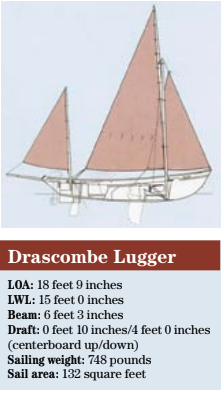
The Drascombe Lugger might be a contender for best known among the traditional open daysailers designed in modern times in the United Kingdom from lines that arrived from the north with the Vikings; she has a reputation for ease of handling and sea-kindliness beyond her modest size. Her provenance also lies in another part of England rich in maritime history and a tradition of seaworthy craft: the fiercely competitive counties of Devon and Cornwall pointing westward to the turbulent Atlantic approaches off Land’s End.
The Drascombe Lugger we know today is the evolved product of a team of individuals drawing upon solid practical experience, much of it military. She was designed by John Watkinson, a veteran of naval service in World War II, who completed a distinguished military career and left the Royal Navy in 1958. He had married Kate, a Signals Wren, in 1954.
The two set up a boat-building yard, Kelly and Hall, in Devon, but sold the yard in 1964 to sail a 13-ton ketch to the Mediterranean. This was evidently not their most enjoyable adventure; they returned to England with firm thoughts of daysailers.
Seventh-century home
They rented an ancient Devon Long House, so called from days when people and livestock lived in the same building, each warmed by the same fire in the common wall. The place was called Drascombe Barton, a place of habitation with records to the seventh century.
It was here that John designed his famous daysailer. She would be beachable, seaworthy, safe, and pleasant to be aboard with the noise and smell of the auxiliary engine confined to a well. She would be inexpensive to own in a climate of increasing berthing and yard fees. The prototype was built and named Katherine Mary, after Kate. Thus began what would expand to form a theme of successful designs, crossing continents and oceans, but ever faithful to the original Drascombe concept.
The demand for Drascombe Luggers, ultimately around 2,000, would not be met by individually built timber boats. Construction in fiberglass became a natural stage of the Drascombe evolution, taken up by Honnor Marine, a respected name in British fiberglass boatbuilding.
Drascombes appeared in the United States after Harold Wilson’s government levied a 25-percent tax on boats sold in the United Kingdom. This tax caused the British boatbuilding industry to look to export as an attractive avenue for sales, if not survival. Drascombe Boats Inc. was formed in Camden, Maine, later merging with the Lincoln Canoe Company to form Maine Marine Corporation. They were to build the Drascombe Lugger, Longboat, and the smaller Scaffie.
A large family
Through the 1970s to the present, there have been other interesting Drascombe designs ranging from 16- to mid-20-feet in length. The whole Drascombe family, of which some 5,000 boats have been built, reflects a steady theme of sensible, practical, seakindly craft of traditional lines and pleasing sheer. That theme has proved to be a consistently marketable concept, which surely reflects on the merits of paying attention to what a relatively modest, but by no means insignificant, number of discerning sailing folk actually want.
Today there is a healthy market in used Drascombes with the Lugger ever the most popular. Any used boat should be approached with caution, of course. I have examined several older fiberglass boats and noticed stress damage in the members supporting the centerboard case. Hull-centerboard case joints may give seal problems (newer models now have an integral molded centerboard case). Trailer damage is another thing to watch out for. Daysailers gather rainwater if they’re not covered well and if their drain plugs are not removed or the drains are blocked. Water is heavy; check trailer chocks or other localized stress points. It freezes in winter and expands; check the hull for fairness or delamination where ice expansion has pushed the hull away from rigid members.
Water, particularly fresh water, in the bilges for long periods can cause penetration to the laminate. Older boats should be thoroughly cleaned, dried, and painted with good quality bilge paint to protect them from internal moisture ingress.
There is a vulnerability with chine forms in fiberglass in that the chine can harbor a problem derived from air trapped in the laminate during original layup. I have seen this on many craft but never yet on a Drascombe. Nonetheless, it makes sense to examine the chines for crazing or cavities.
If there are any areas of visible wear, check for excessive stress in surrounding areas that abut nonflexing members. Check for stress at deck fittings, such as cleats. One specific Lugger problem seems to be water damage to the foot of the mizzenmast; the older models were not self-draining.
When Honnor Marine ceased producing these boats, Drascombes were subsequently built by McNulty in northeast England before Stewart Brown, who had joined forces with Churchouse, a company in Wales restoring and modifying Drascombes under warranty, took over from each company the building of new Drascombes and refitting of used boats. His company, called Churchouse Boats, is located at Whitchurch in Hampshire, England.
Fine craftsmanship
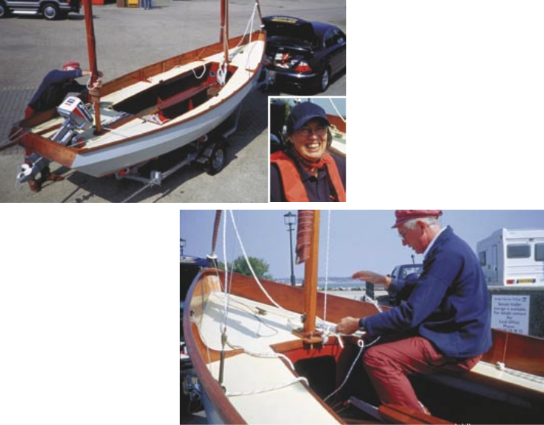
The lovely condition of Guillemot is a credit to Stewart and Churchouse Boats for her restoration and to her American builders for her original fine craftsmanship. Her gleaming bronze builder’s plate shows that she was built in 1981-82, by East/West Boats Inc., Kittery Point, Maine. Now also Echo Rowing, the company still flourishes, building specialized rowing craft.
David and Joan Swindells, a British couple who had moved to America in the 1970s when David worked for Corning Glass in New York, found themselves living in an area of beautiful lakes. This was an opportunity to return to an interest in sailing that young children and work moves had inhibited. Although a fiberglass version was also available in America, David was keen on wooden Drascombes and found that Ted Perry, of East/West Boats, was building them under license at the time. Ted says they built eight Luggers and remembers Guillemot and her British owners with whom he subsequently became friends.
Forgiving boat
The Swindells’ new craft was to be sailed on Lake Cayuga, one of the Finger Lakes. The comings and goings of the English couple as they learned to master their new craft may have occasioned a few smiles. The boat was forgiving, an ideal craft to learn on and no slouch in a good breeze. In the hot summers she was a delightful platform for picturebook picnics or swimming in the warm water. Not so idyllic, reminisces Joan, was when the wind got up one time and Guillemot dragged her anchor with Joan aboard waving farewell to the swimmers.
When David retired from Corning, the couple returned to England and moved Guillemot with them to her new home and what was to be a time of desolate sadness for Joan. Shortly after their return, in a dark and cruel event while traveling abroad, David Swindells was to lose his life. For the next eight years Guillemot sat on blocks in the garden of the Swindells’ Oxfordshire home, until Joan resolutely determined that the boat should be restored to the craft they had once known. Stewart Brown agreed to undertake the refit.
One reason it was possible to do this was the high standard to which Guillemot had been built and the uncompromising quality of the materials used. Her scantling specification included mahogany marine plywood for planking, deck, and bulkheads, teak floorboards, iroko keel and bilge rubbers, galvanized steel centerboard and rudder, and Sitka spruce spars. That list reveals care in selection dictated by function.
Good workmanship
When I saw her, her perfect plate and rudder still evidenced good original workmanship, and her planking was sound. This did not surprise me. The ply used throughout was Bruynzeel. This superb material was, I believe, the only ply warranted by Lloyd’s at the time. Ted Perry recounted how he had kept an untreated piece of Bruynzeel tethered in the tide for a year. The sample discolored but showed not the smallest sign of rot or delamination. This account revealed to me how it was that a boat from a builder of his standards would endure.
Those standards were still there to see when I met Guillemot. There is no doubt that the restoration work was of a quality fit to honor her original build, although Stewart, in deference to Ted’s work, insisted that the restoration was only partial, none of the work required being due to deterioration of original structure but simply the natural entropy attributable to time and neglect. My guess would be that, notwithstanding their differing accents and the ocean that separates them, those two are of the same ilk.
Joan had given me some photographs of Guillemot before the refit. She looks somewhat lost, with her New York license numbers chipped and fading in an English country garden. But, under the worst that tree and bird could deposit, she looks salvageable.
The renewed Guillemot is a delight to the eye. As a wooden Drascombe, she is likely to be non-standard, but she would be interesting to any Drascombe devotee and many other open sailboat enthusiasts. Her multi-chine hull sat securely on her road trailer; Stewart was able to hop on and off as he quickly got her rigged. The Gunter rig implies short masts that travel conveniently and step easily.
Through-deck trunk
The solid unit of rudder blade and stock drops into a through-deck trunk, like a daggerboard, the trunk slot reinforced at its forward end at deck level by a strong bronze keyhole plate where the stock pivots and the head rests. A 4.5-hp Evinrude outboard is shipped on a stout timber pad protruding from a dished deck, the leg passing through a keyhole well that appears to be adequately ventilated, permitting the engine to be tilted clear of the water when sailing and giving good protection to the outboard, safe onboard access for running maintenance and controls, and a high level of security against loss. Indeed, the motor had traveled by road in this position.
Practical features also include ring-type rowlocks refinished to a fine polish. There is also a sculling rowlock on the transom that could facilitate the use of an oar as a jury rudder for maneuvering in tight places at speeds below steerageway or for pulling the stern out of irons if caught in stays while tacking. At the foot of the main-
mast she has a fife rail with bronze belaying pins to serve the halyards, not just a salty decoration but a fast way of letting the halyards run in a squall.
Her Gunter yard is fitted with substantial spliced timber jaws at the throat, with parrel line and trucks to facilitate swift lowering of the mainsail. The main, as is the case for all Drascombe Luggers, is loose-footed for convenience and safety. All spars are nicely refinished and octagonal in section. Her buoyancy has been upgraded and rigging has been modernized in line with current Drascombe philosophy. Her original Anson sails are still in good order. Elegantly-finished timber quarter knees, breasthooks, and semi-bulkheads complete a craft that is light for her type but strong.
A dozen reasons
The best evidence of how she looks could be observed in the sheer joy on Joan’s face when she saw Guillemot for the first time since the refit.
I have long been an admirer of the fiberglass Lugger; these are fine boats. Faced with a decision, I would choose fiberglass for a dozen sensible reasons, yet in Guillemot I could easily see David’s preference for wood. It had taken this handcrafted timber boat to bring out the Cinderella from the prejudice of my perception and draw my eye to the swiftness of those lines. A craft I had considered beamy now seemed slim, canoelike. For the first time I could see how she would be capable of speed.
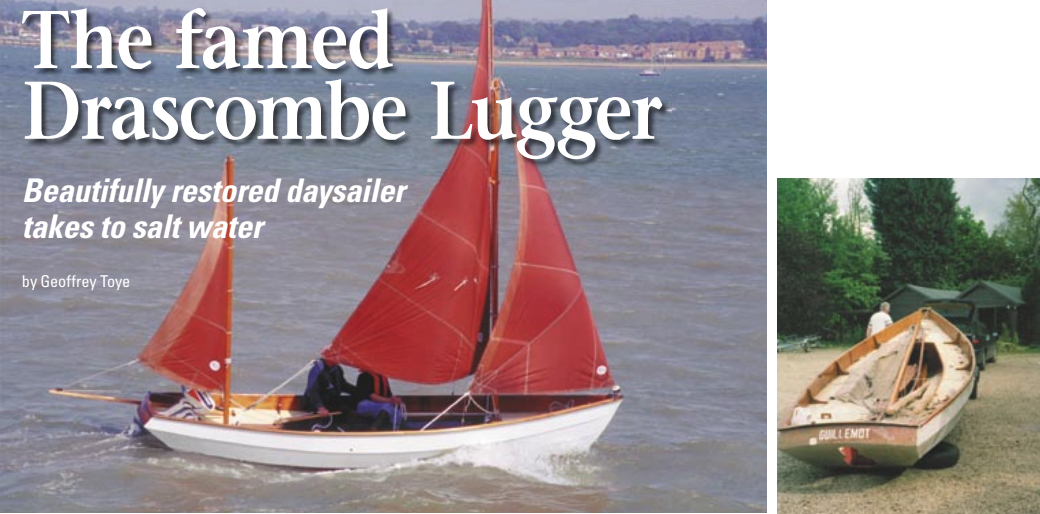
Guillemot, a craft designed and finely crafted on two continents, was soon to have a chance to show us what she could do. A major advantage of her rig is that in high winds she is balanced to sail under foresail and mizzen, her mainsail snugged down, leaving the minimal windage of the short Gunter mast. I had expected to see Stewart doing just that, but he was determined to show off what Guillemot could do at the gallop. It was electric. This was a re-launch, a one-shot deal under tricky conditions for us all.
The trailer was backed down the ramp, tilted slightly, and Guillemot was afloat. Stewart took the trailer back up the ramp while Joan and I held Guillemot by her straining painter. There were seas breaking against her hull, but she rose to them. She bumped on the unforgiving concrete and stone of the slip, but the spring in her fine timbers absorbed it as she landed on her metal runners there for the purpose.
Stewart was back, he and Joan jumped quickly aboard, and the engine was started and put astern. Guillemot
was clear as I scrambled to the rocky platform from which I would shoot pictures while Stewart and Joan put her through her paces.
In open water
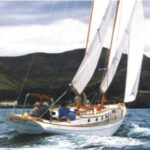
The mizzen was up, steadying the vessel as the outboard powered her through short seas that burst against her bows. The sails opened and the sound of the outboard ceased. A couple of short tacks, and they were in open water. Stewart gave Guillemot her head. She responded with spirit, dancing over the waves, even showing her keel at times, but not once did she seem overpressed, nor was she at any time other than under full command of a man who was about as fine a small boat sailor as I have seen.
A group of hardy walkers stopped to admire her. Who could not? It took the breath away. This was a dazzling display of boathandling in a craft that showed her mettle at every evolution. She tacked handsomely, pirouetting in her own length and off onto the new board incredibly smartly, yet tracking as straight as an arrow. Stewart, determined that there should be good pictures, sailed through short breaking seas as close as he dared to the shoal waters below my rock but never touching, every time spinning that swift and sure craft back onto a course for deep water while the watchers gasped for air.
All too soon the shoot was over. I held up my crossed arms, the signal that I had used up all my film. Guillemot was brought up gently at the slip. Joan was glowing with pride. I was cordially invited aboard for a day trip but with some hesitation declined. I have sailed Drascombe Luggers before, though perhaps not quite so spectacularly, and this was a moment for her owner and the man who had so perfectly restored Guillemot and so expertly sailed her.
We waved goodbye, not for the last time I am sure, and Guillemot sailed away into the sunshine, a bone in her teeth as she headed for the other side of the water, a sheltered berth, and a champagne picnic.
Thank you to Sailrite Enterprises, Inc., for providing free access to back issues of Good Old Boat through intellectual property rights. Sailrite.com