A strong invisible force dulls the brain, grabs the heart
Issue 43 : Jul/Aug 2005
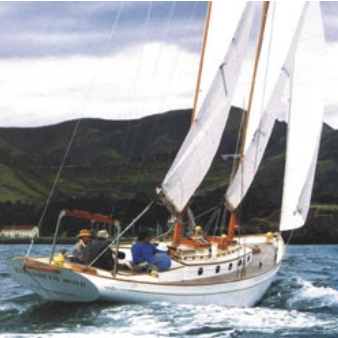
The first time I saw her she took my breath away. She was in the end slip by the sea wall at the Oakland Boat Show. I had to walk past a lot of new boats to get to her. She was completely out of place and perhaps the more stunning for it. At first I thought she was a new fiberglass boat built from a classic schooner design. No. There were a few hints of seams between planks, even a tiny flaw in the paint job, and the bronze was a bit green in some places. But the varnish was perfect, as was the rest of her.
I had work to do, so I moved down the pier. A half-hour later I was returning, with my mind on an innovative plastic dinghy, when I looked up and there she was again. I think maybe my heart skipped a beat.
The dream field at a boat show is very strong. As it should be. This is where people come to imagine otherwise and elsewhere. Some people have the crusty look of many miles on the water; some look green and hopeful. No matter . . . they all dream.
There have been a lot of boat shows where I did not go on a single new boat. I never go on very many. This time I had occasion to board a few on “working-press business,” and while I was at it I had a look around.
On several boats I was struck by the large open spaces below searching desperately for a reason to exist. Most sailors will never hold a dance or play table tennis belowdecks. Still, the designer of these boats knew the reality of his work. Boats are built to be sold. Big boats are more profitable. Big boats can be appealing because they resemble houses. Big open spaces, wine bottles on tables, potted plants, and stemware . . . stuff that does not work well in a seaway . . . these things sell. Not all buyers are experienced sailors yet.
Later, I was again drawn back to the schooner Elizabeth Muir. I walked her decks in stockinged feet, studying and imagining how she would be worked. The engineer in me was muttering in my head about how impractical it was to have so much wood and varnish to look after — something about labor-intensive — but the dreamer in me said, “Be still, I’m dreaming.” The engineer muttered on, so I locked him in his cage and went below.
These old designs had less space for their length, so it was used wisely. She was very comfortable below. Perfect. The dream was getting stronger. I’ve never sailed a boat like Elizabeth Muir. She might be a hard-mouthed witch with a brutal weather helm and unable to carry more than a scrap of sail without burying the cabintop portlights in the sea. I just didn’t know, so I gave her the sailing characteristics of my C&C 30, which are the best in my experience. While I was at it, I gave her a more seakindly motion as befits a longer, heavier boat. There were some other sailors below. They were in the same dream. Somehow all of us knew.
My editor/wife and a few others I know believe they are rational beings driven by logic. I indulge them in this. Even Einstein was not a number-crunching computer. He was a seer. He could imagine elsewhere and otherwise. He could see how it would be with great speeds and vast distances. Einstein was a sailor. The dream-field strength was high in that one.
The broker in the cockpit was a nice young woman who said that Elizabeth Muir had been built in 1991 to a 1930 design. There had been no refi t since. She had just been well kept. Perfect. The engineer was screaming through the bars in his cell, “You can’t do this! You painted the teak handrails on your C&C 30 blue. You hate varnish work.” I didn’t give him the courtesy of an answer. I asked the lovely young woman how much the owner wanted for Elizabeth Muir. She said, “Boat show special, $250,000.”
Oh. Well . . . not in this lifetime could I ever own Elizabeth Muir. Too bad, because she already owned a piece of me. I stepped ashore, looked back, and said, “It was very nice meeting you, Elizabeth.” The dream field was very strong that day.
Thank you to Sailrite Enterprises, Inc., for providing free access to back issues of Good Old Boat through intellectual property rights. Sailrite.com