Puttering in a Potter is a gunkholer’s delight
Issue 13 : Jul/Aug 2000
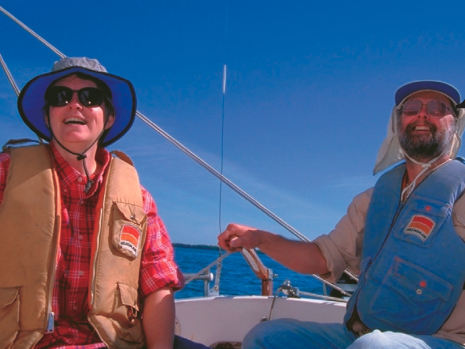
Imagine having a sailboat that can float in eight inches of water . . . one you can pull up on the beach for an evening ashore . . . one with bunks long enough to stretch out on . . . one for which parts are still available . . . one you can buy used, or even new perhaps, without getting a bank loan . . . one that can travel at 75 miles an hour from one lake to the next. Think, too, how simple life would be if you could bring your good old boat home to the garage anytime you wanted to work on it.
The West Wight Potter was not selected by John Vigor as one of his Twenty Small Sailboats to Take You Anywhere. But no matter. This is a small sailboat that you can take anywhere, even home to the garage.
Potters, as they are known affectionately by their owners, have indeed crossed oceans and earned their share of respect. They were designed on England’s Isle of Wight to “potter about,” gunkholing Great Britain’s coastal waters.
On this side of the ocean, Potters have become something of a cult boat. U.S. Potter sailors zealously tout their virtues and gather to discuss upgrades, offer handling advice, and plan picnics, fun, and occasional races.
Tom and Kim Medin are relative newcomers to an active group of Minnesota and Ontario Potter sailors who correspond by e-mail and get together to explore Midwestern lakes. Since these boats can be trailered, the sites for these informal Potter rendezvous are seemingly infinite. Minnesota, all by itself, is noted as the Land of 10,000 Lakes (and, as it turns out, they didn’t count them all). Then there are the lakes in Wisconsin, Ontario, Iowa, North and South Dakota . . . the options should keep this group busy for years.
One of the advantages of buying a production boat which has had a good long run is that there are many other sailors out there to help get you started. They’ve been there and done that and are happy to help you avoid a few of the pitfalls they discovered along the way. If the boat is still in production, so much the better. Weyekin, Tom and Kim’s 1987 19-foot model, hasn’t required many replacement parts, but they have security in knowing that the parts are available, from a mast to a shackle and from a winch to a cleat, from International Marine, which is still turning out approximately 250 units a year.
In addition to the formal support available from the manufacturer, informal sites flourish on the Web. These are full of helpful advice and links to other sites. The groups of West Wight Potters on both coasts are legendary for their gatherings and clubish devotion to each other and their
Tom and Kim weren’t looking for sailing get-togethers when they bought their boat. They’d sailed a few times with friends who had grown through a C-Scow, a C&C 26, a J-30, a Fantasia 35 and, most recently, a Hylas 44. With these friends, they’d chartered a Freedom 35 and explored Desolation Sound, British Columbia, for two weeks. Later they’d spent some time together on the Fantasia on one leg of a voyage which took the friends to New Zealand. Tom and Kim were along for the leg from Mexico’s Mazatlán to Puerto Vallarta.
That was the turning point. Kim recalls, “There were sandy coves, palm trees, and no other boats.” Tom adds, “We began thinking, ‘Why can’t we have a boat? We’ve got a lot of lakes in Minnesota.’ ”
The concept of a trailerable boat grew as the idea of sailing both in Minnesota and among the palm trees developed. Another seed was planted in their minds by a friend who was wild about her West Wight Potter 15. She invited them to come sail with her, but even though they were unable to schedule that sail, the seed germinated. Before long, they’d bought their used Potter 19.
“We wanted a cruising sailboat that we could stay on for up to a week at a time,” Tom says. “We wanted a daggerboard, so we could beach it. We wanted to be able to trailer it. There are so many lakes in Minnesota, why restrict yourself to just one?” After a pause, he adds, “We can just fit it in the garage. That’s a plus. If it were two inches longer, we couldn’t get it in.”
Tom notes, “We bought the boat sight unseen and trailered it home to Minneapolis from Lake Isabella, near Bakersfield, Calif., approximately 2,000 miles with our 3-liter Aerostar. Not many used Potters come onto the market, so we had to go far to get ours.”
Someone used to cruising on a typical keelboat of 25 to 35 feet might well ask what has to be eliminated in order to cruise on a 19-foot Potter, which can sleep four comfortably. This boat may well have bunks longer than those on that 25- to 35-footer. What gives? What gives is the head, galley, tanks, and stowage.
The head is a Porta Potti or none at all. The galley is a campstove arrangement and a sink, which Tom and Kim believe is best used for storage of lines and other miscellany which accumulates below decks. Stowage is at a minimum. But the bunks are 6 feet and more. There are two quarterberths and two bunks which meet at the V of the bow. When just two sailors are aboard, the quarterberths on this boat, as on most boats, become catch-all compartments for fenders and gear.
Potters come with a 3-to-1 tackle for raising the daggerboard, but Tom has rerigged theirs to make it a more manageable 4-to-1 system. One Potter enthusiast and something of a Potter guru in her own right, Judy Blumhorst, commodore of the Potter Yachters of Northern California, describes the daggerboard as a “lifting centerboard keel — 99.9 percent of the time, if you go aground, it’s a simple thing to unlock the keel, crank it up a few inches, and float off. It’s the best of both worlds,” she says. “When the keel’s locked down, it’s essentially a fixed-keel boat.”
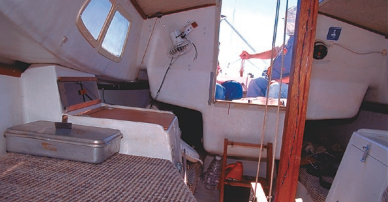
The Potters have a sink cabinet to port with a hand pump. A 5-gallon freshwater tank and a 5-gallon graywater tank are housed below the sink. The tanks are soft and difficult to fill and empty, however, and are generally left ashore, leaving the space below the sink (and the sink itself) for stowage.
New Potters have a privacy curtain and a Porta Potti under a cushion of the starboard side of the V-berth. Earlier models located the Porta Potti inside the starboard cabinet, which is a bit cramped. Dissatisfied with this arrangement, Tom and Kim removed theirs altogether.
A single-burner butane stove sits on top of the starboard cabinet. Most Potter sailors do most of their cooking in the cockpit on a grill attached to the stern rail. With the addition of a leg which comes standard with the boat, the hatchboard becomes a cockpit table for two.
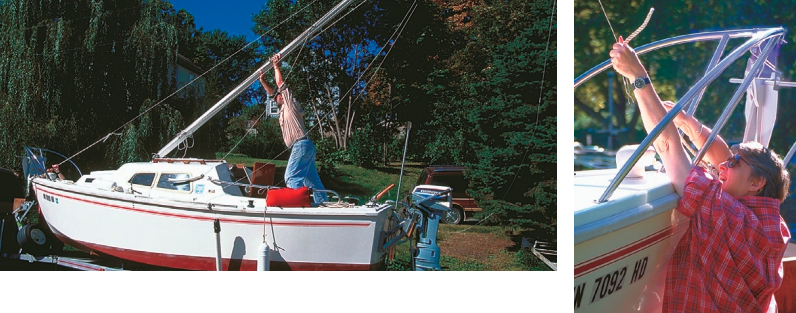
Jerry and I joined Tom and Kim for a daysail one warm morning in mid-September. The mast was stepped with a minimum of fuss, and the boat was launched in about 30 minutes. The mast is stepped, the forestay is reconnected (all others remain fixed throughout the entire process), all supplies are stowed, and the boat is eased into the water. With a cooler and a lunch box aboard, our needs were few.
Judy Blumhorst says of the P19, “She’s no racer, but with the 150-percent genoa, she’ll move right along in light winds from 3 to 12 knots, fairly smartly for a cruiser. From 10 to 20 knots, the high-clewed 100-percent jib (the lapper) is the one to use. Over 18 to 20 knots, you want the storm jib.”
Tom says the 2,000-pound (fully loaded) boat tows well when the outboard is secured to the tongue of the trailer. They learned this by first towing it with that extra weight in the cockpit, which caused a tendency to fishtail. They prefer a moderately steep ramp, he adds, “So we don’t have to drive into the water.” They might prefer to have a trailer that has its wheels outboard of the boat, but theirs is the more traditional-style trailer.
Their next major trip might be trailering Weyekin to Mexico’s Sea of Cortez where sandy beaches and palm trees beckon. The fact that this is possible is what makes a trailersailer so much fun.
Thank you to Sailrite Enterprises, Inc., for providing free access to back issues of Good Old Boat through intellectual property rights. Sailrite.com