Issue 13 : Jul/Aug 2000
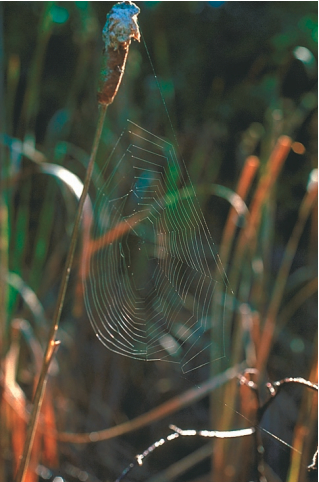
Return to your boat after a week or more, and you’ll see their lacework decorating the lifelines, shrouds, and pulpits. They’re lovely, these spider webs, with silvery threads in ageless patterns, the plan for which is known only to spiders. They’re born with this knowledge. There’s no training or parental role modeling. The morning dew collects in prismatic beads on these intricate weavings.
I enjoy studying these designs anywhere I find them in nature. But not on my boat. The spiders and their webs must go. So I clear the webs and heartlessly destroy the spiders. Evening arrives, and with the lowered rays of the sun, I notice the engineers of the insect world returning. They emerge from small shelters where they’ve hidden from sun, rain, predators, and ruthless crewmembers. They’ve been hitchhiking, spending the day with us, unconcerned about where we’re going or where we’ll wind up. This boat is their environment. It will serve their purposes for their entire lifespan. My goal is to shorten that lifespan.
They crawl to the tops of antennas and shrouds and drop delicate, trailing gossamer threads. A gentle breeze assists in the landing on another vertical surface. Before long, the two vertical structures have the genesis of their well-known design. We’ve watched, amazed, as these small engineers fashion webs from tiny threads one section at a time. We’ve watched as one spider repeatedly reached a key thread (one of the main supports), made an exact turn (35 degrees perhaps) and set off again for the next support. Like all the others, this web was perfectly planned, yet probably difficult or even impossible to see in its entirety from the close-range perspective of the spider.
I’ve watched and grown frustrated. “Who invited you?” I rant as I ruthlessly destroy the results of tedious hours of arachnid effort. “How did you get to this boat anyway?” We’re on a floating island connected to a dock much of the time by just a few lines. I’m fairly certain that spiders can’t fly. Do they crawl out along the docklines? I don’t think that’s the route. We have observed perfectly horizontal fibers, the kind created only by spiders, strung across a dock at eye level. How did a spider pull that off if it didn’t fly across the four- or five-foot gap between the pilings on either side of the dock?
Finally, I decided that, while that little act of ingenuity still defies reason, the common way for spiders to get to my boat is by climbing to the mast or shrouds of someone else’s boat and launching themselves from there into the unknown, wherever the wind is currently blowing them. Often, it seems to be to our boat. I used to sweep the little buggers overboard until I realized that, when we’re in port anyway, the action is pointless. They simply walk on the surface tension of the water and quietly return to my boat when I’m not looking. I’ve watched them do that. Ruthlessness is required here.
“Jerry,” I say, noting a spider behind him, “smash that spider, would you please?” That’s when I am reminded that he, too, is an engineer and is quietly on their side. I’m in this fight by myself. Surrounded by engineers, I acquiesce. Our boat is their home, too.
Thank you to Sailrite Enterprises, Inc., for providing free access to back issues of Good Old Boat through intellectual property rights. Sailrite.com